

The creation of the Ozone Officers Network for English-Speaking Caribbean and Haiti was approved at the 21st Executive Committee Meeting in 1997. This network comprises 14 members: Antigua and Barbuda, The Bahamas, Barbados, Belize, Dominica, Grenada, Guyana, Haiti, Jamaica, Saint Kitts and Nevis, Saint Lucia, St. Vincent and the Grenadines, Suriname, Trinidad and Tobago.
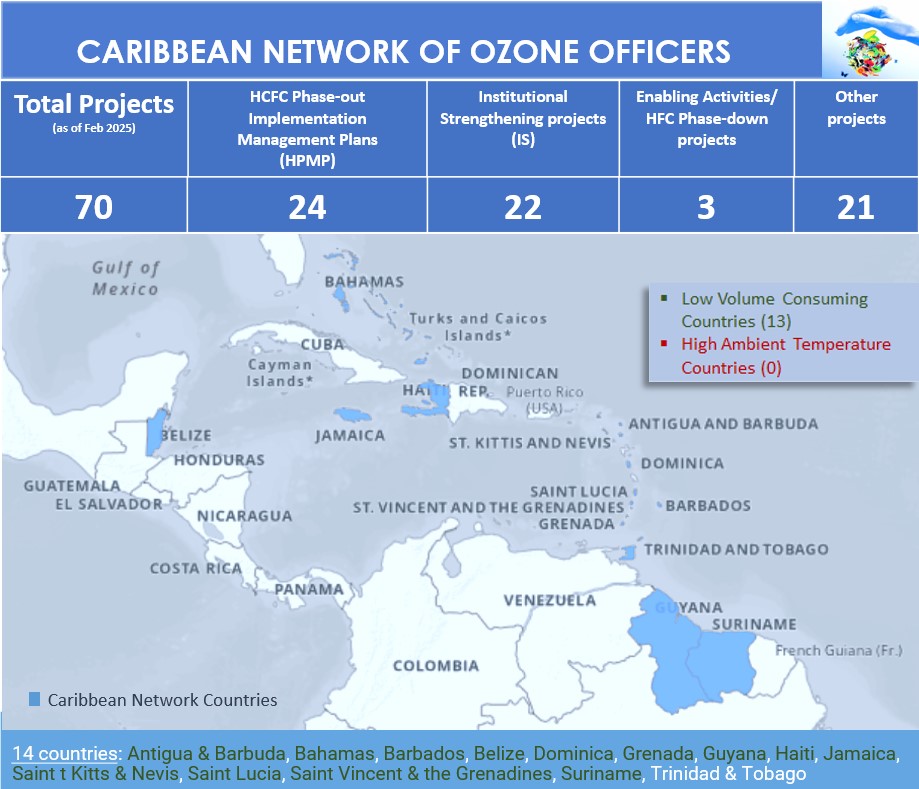
With the establishment of the UN Environment Programme (UNEP) Compliance Assistance Programme (CAP) in 2002, the mandate of the three Latin America and the Caribbean Networks was modified. They were channelled toward the development of national capacities to meet and sustain compliance with the Montreal Protocol on Ozone Depleting Substances (ODS). Additionally, with the adoption of the Kigali Amendment (KA) to the Montreal Protocol in 2016, the Caribbean Network will not only seek to strengthen and enhance the capacities of Governments to achieve and sustain the hydrochlorofluorocarbons (HCFCs) phase-out commitments under the Montreal Protocol but, will also ensure that countries have the adequate suite of policy and legislative frameworks to meet requirements under the Kigali Amendment as they seek to phase down hydrofluorocarbons (HFCs).
Achievements
As a result of collaboration between UNEP, Implementing Agencies and national initiatives, the following was achieved for the Caribbean and Haiti Network between January 2025 and September 2025:
- Support provided to countries in potential non-compliance for data reporting carried out for Suriname and Saint Kitts and Nevis.
- Support provided to one country in non-compliance for HFC - Saint Vincent and the Grenadines
- Approval of HCFC Phase-out Management Plan (HPMP) Preperation Stage II and Stage II Tranches, Preperation of Kigali HFC Phase Down Projects (KIP Preparation), Institutional Strengthening Project (ISP) Renewals, Enabling activities for HFC phase-down, Verification Reports and additional funding windows for: Preparation of national inventory of banks of waste-controlled substances and development of a national plan for management of these substances (decision 91/66) (ODS Banks); and, HPMP (stage II) (Additional activities to maintain energy efficiency in the refrigeration servicing sector (decision 89/6)) (EE Additional Activities) as follows:
- ExCom 94: Barbados Verification Report; Belize ODS Banks, HPMP II Tranche 2, EE Additional Activities and KIP Preparation; Grenada ODS Banks and Verification Report; Guyana ODS Banks and Verification Report; Saint Kitts and Nevis HPMP II Preparation; Saint Lucia ODS Banks, EE Additional Activities, KIP Stage I and Tranche 1 and HPMP II Tranche 2; The Bahamas Verification Report.
- ExCom 95: Antigua and Barbuda Enabling activities for HFC phase-down; Barbados KIP Preparation and ISP Phase IX; Belize ISP Phase XII; Dominica HPMP II Preparation and HPMP I Tranche 3; Jamaica ISP Phase XII; Saint Kitts and Nevis ISP Phase IX; Saint Vincent and the Grenadines EE Additional Activities; The Bahamas ODS Banks; KIP preparation and ISP Phase IX.
- ExCom 96: Antigua and Barbuda HPMP II Tranche 1; Barbados ODS Banks; Belize Verification Report; Dominica ODS Banks; Saint Kitts and Nevis ODS Banks; Saint Lucia Verification Report; Suriname ODS Banks and Verification Report.
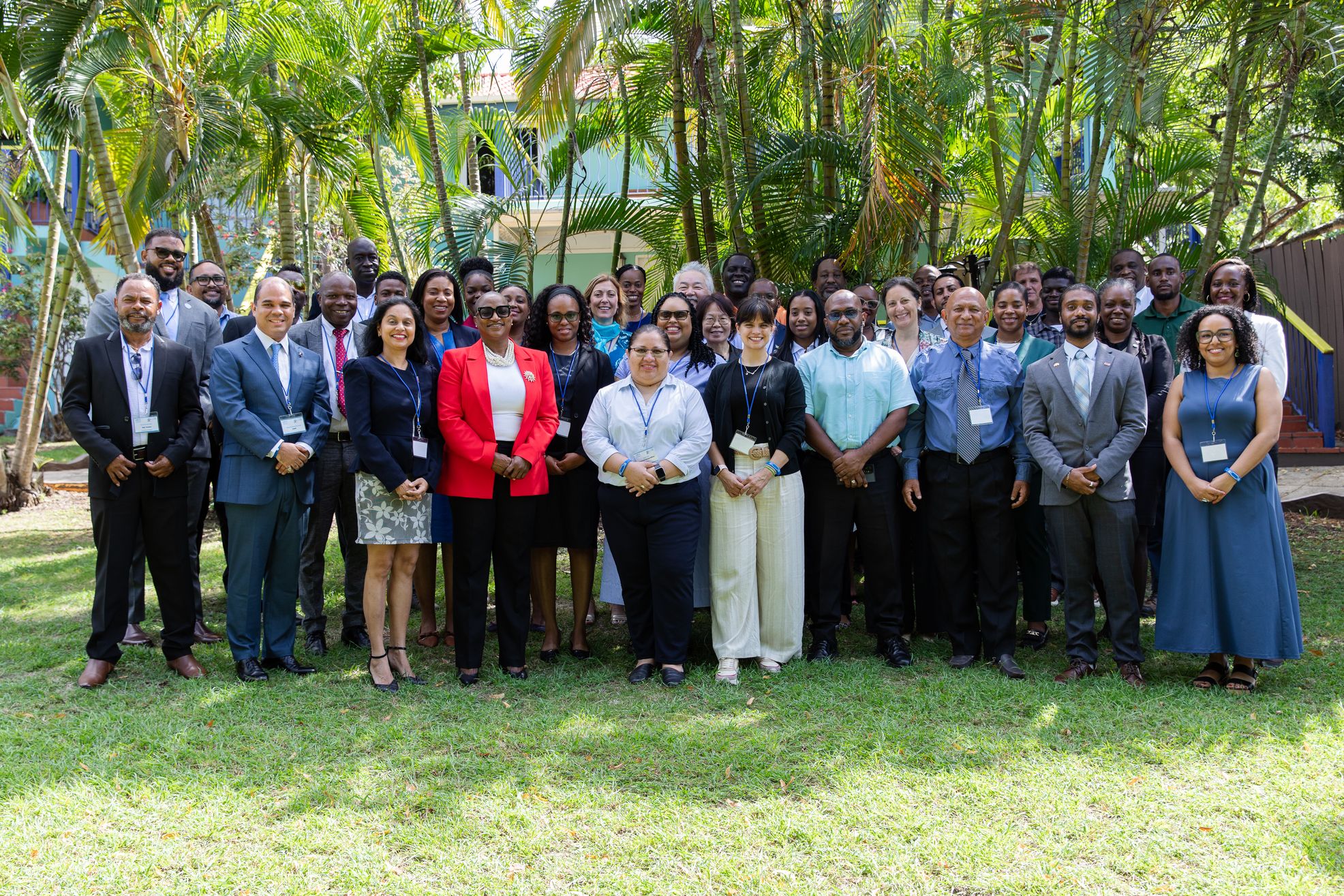
- Caribbean Network Meeting back-to-back with Twinning Workshop for Montreal Protocol Officers, Energy-Efficiency Policymakers in the English-Speaking Caribbean and Haiti Network held from 24 to 26 and 27 to 28 June 2024, respectively in Panama City, Panama; Caribbean Network Meeting back-to-back with a Workshop for Youth in the Refrigeration and Air Conditioning Sector held from 18 to 20 November 2024 in Belize City, Belize; Caribbean Thematic Network Meeting back-to back with Grenada’s Sustainable Cooling Exhibition held from 16 to 18 June 2025 in St. George’s Grenada; and, Caribbean Regional Ozone Depleting Substances (ODS) Banks Workshop for National Ozone Officers and National ODS Banks Consultants held from the 6 to 10 October 2025 in Panama City Panama.
Highlights
Since January 2024, several achievements have been attained some of which are highlighted. UNEP continued to provide support to countries for strengthening their policy and legislative frameworks for the HFC phase-down and support to those countries that had not yet ratified the Kigali Amendment, resulting in Saint Kitts and Nevis ratifying during the period. Additionally, the Caribbean Network is cooperating with the Ozone Secretariat’s efforts to attain universal ratification of the Kigali Amendment through a targeted outreach program and support materials to fast-track ratification.
In response to the evolving commitments of the Montreal Protocol and a pressing regional challenge, the aging Refrigeration Servicing Sector (RSS), UNEP organized the first Workshop for Youth in the Refrigeration and Air-Conditioning (RAC) Sector in Belize City, Belize, from November 18–20, 2024. This pioneering event brought together National Ozone Officers (NOOs) and young RAC technicians from the Caribbean, marking a new and innovative approach to building the next generation of capacity in the sector. The workshop was conducted with the support of UNEP’s Gender Mainstreaming Focal Point and UNEP Refrigerant Driver’s Licence (RDL) Assessor. The workshop also resulted in the development of a Regional Pathway for youth participation in the RAC servicing sector, supported by a concrete set of action points intended to ensure a sustainable pipeline of skilled, gender-responsive professionals to lead the sector into the future.
Another key highlight was the UNEP-organized Caribbean Thematic Network Meeting, held back-to-back with Grenada’s Sustainable Cooling Exhibition in St. George’s, Grenada, from June 16 to 18, 2025. The meeting brought together NOOs and highly experienced RAC Association Representatives from across the Caribbean Region. It provided a platform for countries to re-engage with their national and regional RAC associations counterparts, exchange experiences, promote gender mainstreaming efforts, and identify measures to strengthen these associations. Building on the workshop for Youth, the meeting also consolidated and endorsed a revised Regional Pathway. The revised Pathway solidified national and regional actions, ensuring the engagement of youth and RAC associations in Montreal Protocol activities. As a joint effort of UNEP and the NOU of Grenada, the Grenada Sustainable Cooling Exhibition and the Fireside Chat were hosted. The exhibition advanced regional priorities by showcasing alternative RAC and Recovery, Recycling, and Reclamation (RRR) technologies, facilitating direct exchanges between participants, and strengthening practical knowledge through capacity-building demonstrations on flammable refrigerants. The Fireside Chat, structured around three thematic panels, enabled open discussions on the role of associations, the participation of women and youth, and access to alternative technologies, featuring national, regional, and international speakers.
Finally, from 6 to 10 October 2025, the Caribbean Regional ODS Banks Workshop for National Ozone Officers and National ODS Banks Consultants was held in Panama City, Panama. The workshop brought together NOOs and their National ODS Banks Consultants to provide technical support and enhanced CAP services towards enhanced implementation of the ODS Banks Projects. Specialized resource persons and experts were selected to contribute to the discussions. The Workshop was managed by a facilitator who led the workshop through various facilitated sessions, introducing participants to tools, templates, and other supporting documents specifically developed to support NOOs and Consultants in the implementation of the projects. The Workshop’s overall goals were to provide additional resources, share best practices, ensure effective and efficient implementation, and avoid delays as these projects are limited in their completion dates.
Future Objectives
Considering CAP’s 2024-2026 Three-Year Rolling Strategy, the work yet to be done under the HCFC phase-out schedule, implementation of the KIPs by countries with approved KIPs, and preparation of KIPs for eligible Countries, promotion of the ratification of the Kigali Amendment by remaining countries in the region, the main objectives include:
- Supporting NOUs with effectively managing and sustaining their HPMP IIs, whilst effectively developing and implementing their KIPs.
- Providing support with strengthening and enforcing HCFC and HFC licensing and quota systems, and accurately reporting data promptly.
- Supporting effective policy and legal frameworks.
- Assisting countries with attaining the HCFC 100% phase out target in 2030 and supporting one country with the sustained total phase-out in 2025.
- Strengthening national capacity for effective customs and trade control.
- Developing, delivering, and coordinating capacity building and sustainable technicians’ training in RSS with a focus on transitioning to low-GWP, more energy-efficient alternatives.
- Supporting Countries with developing and implementing projects under the additional activities window for the introduction of Low or zero-GWP alternatives and energy efficiency, and for Inventories of ODS Banks and National Plans.
- Facilitating and supporting ratification of the Kigali Amendment.
- Facilitating country-to-country cooperation.
- Promoting gender mainstreaming.
REGIONAL CONTACTS
Mrs. Donnalyn Charles
Montreal Protocol Regional Coordinator, Caribbean Network
OzonAction CAP team for Latin America and the Caribbean