

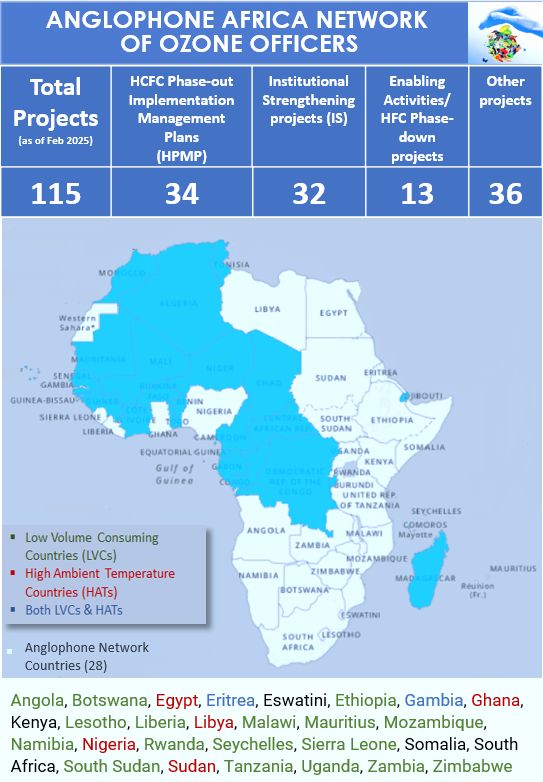
 The Ozone Officers (NOOs) Network for English-speaking Africa was established in March 1994, following its approval at the 12th Meeting of the Executive Committee of the Multilateral Fund. Today, it stands as one of the largest Regional Networks under the Montreal Protocol, bringing together 28 member countries:
Angola, Botswana, Egypt, Eritrea, Eswatini (Kingdom of), Ethiopia, The Gambia, Ghana, Kenya, Lesotho, Liberia, Libya, Malawi, Mauritius, Mozambique, Namibia, Nigeria, Republic of South Sudan, Rwanda, Seychelles, Sierra Leone, Somalia, South Africa, Sudan, Uganda, United Republic of Tanzania, Zambia, and Zimbabwe.
The Network is funded by the Multilateral Fund for the Implementation of the Montreal Protocol and benefits from the collaboration of cooperating agencies, UNIDO and UNDP, as well as bilateral partners, Germany and Italy. It is managed by the OzonAction Compliance Assistance Programme (CAP) team under UNEP’s Law Division, and hosted at UNEP’s Africa Office in Nairobi, Kenya.
Key Achievements
The Anglophone Africa Network has made notable progress in advancing countries’ compliance with the Montreal Protocol, despite the complex political and security challenges faced by some member states such as Libya, Somalia, South Sudan, and Sudan.
- Compliance Focus: Compliance with Montreal Protocol obligations remains the foremost priority of the Anglophone CAP team, guiding all technical and policy support provided to member countries.
- Data Reporting: Countries in the Network consistently demonstrate strong performance by submitting accurate and timely data on both ozone depleting substances (ODS) and hydrofluorocarbons (HFCs) to the Multilateral Fund (MLF) and the Ozone Secretariat, ensuring transparency and accountability in reporting.
- Kigali Amendment: As of September 2025, nearly all Network countries—with the exception of Libya, South Sudan, and Sudan—have ratified the Kigali Amendment, reflecting the region’s robust commitment to the global phase-down of HFCs.
- HCFC Phase-Out Stage II: Many member states are making steady progress in the implementation of Stage II hydrochlorofluorocarbon (HCFC) Phase-Out Management Plans (HPMPs), further consolidating the achievements of earlier phases.
- HFC Phase-Down: Progress has also been recorded on the initial tranche of Kigali Implementation Plans (KIPs), with several countries already taking active steps toward meeting their early phase-down targets.
- Capacity Building: Sustained efforts in licensing systems, regulatory frameworks, certification schemes, and inter-country cooperation—including cross-border dialogues— are strengthening institutional capacities across the region, ensuring countries are better equipped to maintain compliance and address future obligations.
HCFC Phase-Out
The Anglophone Africa Network has been at the forefront of efforts to phase out hydrochlorofluorocarbons (HCFCs) under the Montreal Protocol.
- Compliance: Most member countries remain within their compliance limits for HCFC consumption and are steadily reducing their reliance on these controlled substances.
- Challenges: While progress is strong, concerns remain around meeting the upcoming obligations linked to the HFC phase-down, particularly the first compliance milestone set for 2024–2025.
- Support and Knowledge Sharing: The OzonAction CAP team continues to provide countries with technical support, training programmes, and platforms for information exchange, ensuring sustained compliance and building long-term resilience in the refrigeration and air-conditioning (RAC) sector.
HFC Phase-Down
Building on the achievements of HCFC phase-out, the Network has also made important strides in preparing for the HFC phase-down under the Kigali Amendment.
- Ratification: By September 2025, nearly all Network countries—except Libya, South Sudan, and Sudan—have ratified the Kigali Amendment.
- Kigali Implementation Plans (KIPs): Several countries have already launched and advanced the first tranche of their KIPs, laying the groundwork for meeting initial HFC reduction commitments.
- Capacity and Readiness: Efforts are ongoing to strengthen policy frameworks, licensing and quota systems, certification programmes, and enforcement measures, ensuring that countries are equipped to manage the transition.
- Regional Cooperation: Cross-border dialogues, technical exchanges, and collaboration with industry stakeholders are enhancing collective readiness and reducing risks of non-compliance.
Together, these initiatives place the Anglophone Africa Network in a strong position to meet its obligations under both the HCFC phase-out and the HFC phase-down, while contributing meaningfully to global climate protection goals.
Gender mainstreaming
The Anglophone Africa Network is firmly committed to promoting gender equality in line with Sustainable Development Goal 5 (Gender Equality and Empowering Women and Girls). Gender mainstreaming is embedded in all Network activities and consistently integrated across MLF projects, with a particular focus on expanding opportunities for women in the Refrigeration and Air-Conditioning (RAC) sector.
Following the success of the first Regional Training Workshop for Female RAC Technicians, held from 17–19 January 2023 in Cairo, Egypt, further initiatives are being developed to build on this momentum.
- A three-day regional training workshop for female RAC technicians is scheduled for November 2025 in Kigali, Rwanda, led by the Anglophone Africa team in cooperation with the OzonAction Global Gender Focal Point and the National Ozone Unit (NOU) of Rwanda.
- This initiative builds on the achievements of the Cairo workshop, which demonstrated strong interest, active engagement, and tangible benefits for advancing gender mainstreaming in the RAC sector.
- National Ozone Units have recommended that such programmes be continued and expanded, helping consolidate progress and broaden women’s participation across the region.
The Kigali workshop is fully aligned with the CAP 2025 Strategy, particularly:
- Outcome 1, Activity 1: Regional and sub-regional meetings for NOUs to exchange information and address priority issues.
- Outcome 8: Gender issues and approaches are systematically integrated into Montreal Protocol programmes and projects.
In addition, this initiative supports the Multilateral Fund’s Gender Policy and will further strengthen the capacity of female RAC professionals, empowering them to play an active role in advancing compliance with Montreal Protocol obligations and contributing to the sector’s sustainable growth.
Specific challenges
While the Anglophone Africa Network has made substantial progress in advancing compliance with the Montreal Protocol, several persistent and emerging challenges continue to affect implementation across the region:
- Illegal Trade of ODS Refrigerants: Increased cases of mixed and counterfeit refrigerants undermine compliance efforts, leading to equipment failures, safety hazards, and legal disputes.
- Seized Substances and Equipment: The handling, storage, and disposal of confiscated refrigerants and ODS-based equipment remain a technical and logistical challenge for many countries.
- Linguistic Barriers: Two Portuguese-speaking member countries face difficulties in communication and knowledge exchange, limiting full participation in network activities.
- Digitalization of Licensing Systems: Some countries struggle to advance trade controls due to limited internet connectivity or inadequate technical capacity. This affects the digitalization of ODS/HFC licensing and quota systems, as well as online Country Programme (CP) reporting, remote implementation, and virtual networking.
- High Staff Turnover: Frequent changes in NOOs and the high rotation of customs officers create delays in project implementation and require significant CAP resources to retrain new personnel.
- Informal Sector Risks: The prevalence of informal technicians in the RAC sector raises serious safety concerns, particularly in handling flammable alternatives such as hydrocarbons.
- Political Instability: Security and governance challenges in several countries continue to delay activities and, in some cases, lead to non-compliance with Protocol obligations.
- Porous Borders: The extensive network of shared borders in the region makes it difficult to monitor and prevent illegal cross-border ODS trade, requiring stronger inter-country cooperation and enforcement.
Key future objectives and focus
In 2025, the Anglophone Africa Network will continue to prioritize compliance assistance services while advancing the preparation and implementation of country-level projects. These will include:
- Stages II and III HCFC Phase-Out Management Plans (HPMPs)
- KIPs preparation and Implementation
- Institutional Strengthening Projects
- Energy Efficiency-related initiatives
- ODS Banks management and disposal projects
The Network’s 2025 objectives will be firmly guided by the recommendations and conclusions from past network and thematic meetings, as well as the outcomes of the Meetings of the Parties and the Executive Committee decisions, ensuring that countries remain on track with their Montreal Protocol commitments while preparing for future obligations.
Key focus areas for 2025
- Monitoring, Reporting, Verification, and Enforcement (MRVE): Promote dialogue and provide technical assistance to sustain achievements under the Montreal Protocol and to meet upcoming compliance targets.
- Legislative and Regulatory Frameworks: Guide NOUs in updating national policies and legislation to integrate HFC controls in preparation for the Kigali Amendment’s implementation.
- Regional Trade Collaboration: Strengthen cooperation between customs authorities and NOUs in trade blocs such as COMESA, ECOWAS, SADC, and SACU for improved information exchange, enforcement, and the prevention of illegal ODS trade.
- Technical Challenges and Alternatives: Support NOUs in adopting lower-GWP alternatives, addressing technical challenges such as standards and codes, safety concerns, and availability of alternatives, especially in the commercial and industrial refrigeration sectors.
- Customs Capacity Building: Enhance training for customs officials at border points on refrigerant identification, use of detection devices, and cross-border dialogue.
- Informal Sector Engagement: Deliver capacity-building initiatives for informal sector technicians, improving safe handling practices for alternatives, particularly hydrocarbons.
- Certification Systems: Establish certification programmes for RAC technicians and professionals to raise competency and promote safe servicing practices.
- Emission Controls: Introduce HCFC emission and venting control measures to reduce unnecessary releases in the servicing sector.
- Data Reporting and Customs Codes: Support NOUs in complying with evolving Article 7 and Country Programme reporting requirements, and in applying new Harmonized System (HS) codes for ODS and HFCs.
- Informal Prior Informed Consent (iPIC): Encourage greater participation in the iPIC programme to strengthen transparency and cooperation in ODS trade.
- Linkages with TVET Institutions: Promote stronger collaboration between NOUs and Technical Vocational Education and Training (TVET) authorities, ensuring ownership of training curricula and long-term sustainability of capacity-building efforts.
- Energy Efficiency Integration: Facilitate brainstorming and pilot initiatives to integrate energy efficiency measures into HPMPs, leveraging climate co-benefits.
- Refrigerant Management Concepts: Introduce structured approaches such as leakage baselines and reduction targets to achieve measurable servicing sector consumption reductions, enabling future projects to move from qualitative to quantitative assessments.
- Kigali Amendment Readiness: Build the capacity of NOUs to understand, plan for, and implement new obligations under the Kigali Amendment.
- Gender Mainstreaming: Support countries in identifying entry points for gender integration within Montreal Protocol activities, in alignment with the Multilateral Fund Gender Policy and UNEP’s gender-responsive approach.
REGIONAL CONTACTS
Main Contact:
Mr Patrick Salifu
Montreal Protocol Regional Coordinator for Anglophone Africa
OzonAction CAP team - Africa