


Cooling the Planet: How Skilled Technicians and Smart Servicing are Driving Environmental Protection
On World Environment Day (5 June), attention often turns to forests, oceans, and wildlife. Yet one of the most powerful, and often overlooked, levers for environmental protection lies in the hands of refrigeration and air-conditioning (RAC) technicians. From proper installation, maintenance and servicing practices to energy efficiency measures, the cooling sector is a critical frontline in protecting both the ozone layer and the climate.
Training of RAC technicians: A Foundation for Environmental Protection
 The Montreal Protocol and its Kigali Amendment play a central role in protecting the environment by phasing out ozone‑depleting substances and reducing climate‑warming refrigerants. A well‑trained and skilled workforce in the RAC sector is essential to ensure that these substances are managed, recovered, and replaced safely and efficiently in practice.
 To this end, the training of air conditioning and RAC practitioners is systematically supported through national programmes embedded within HCFC Phase‑Out Management Plans (HPMPs) and Kigali Implementation Plans (KIPs), financed by the Multilateral Fund. These initiatives translate global environmental commitments into tangible, on‑the‑ground action by strengthening technical capacity and professional standards across the RAC servicing sector.
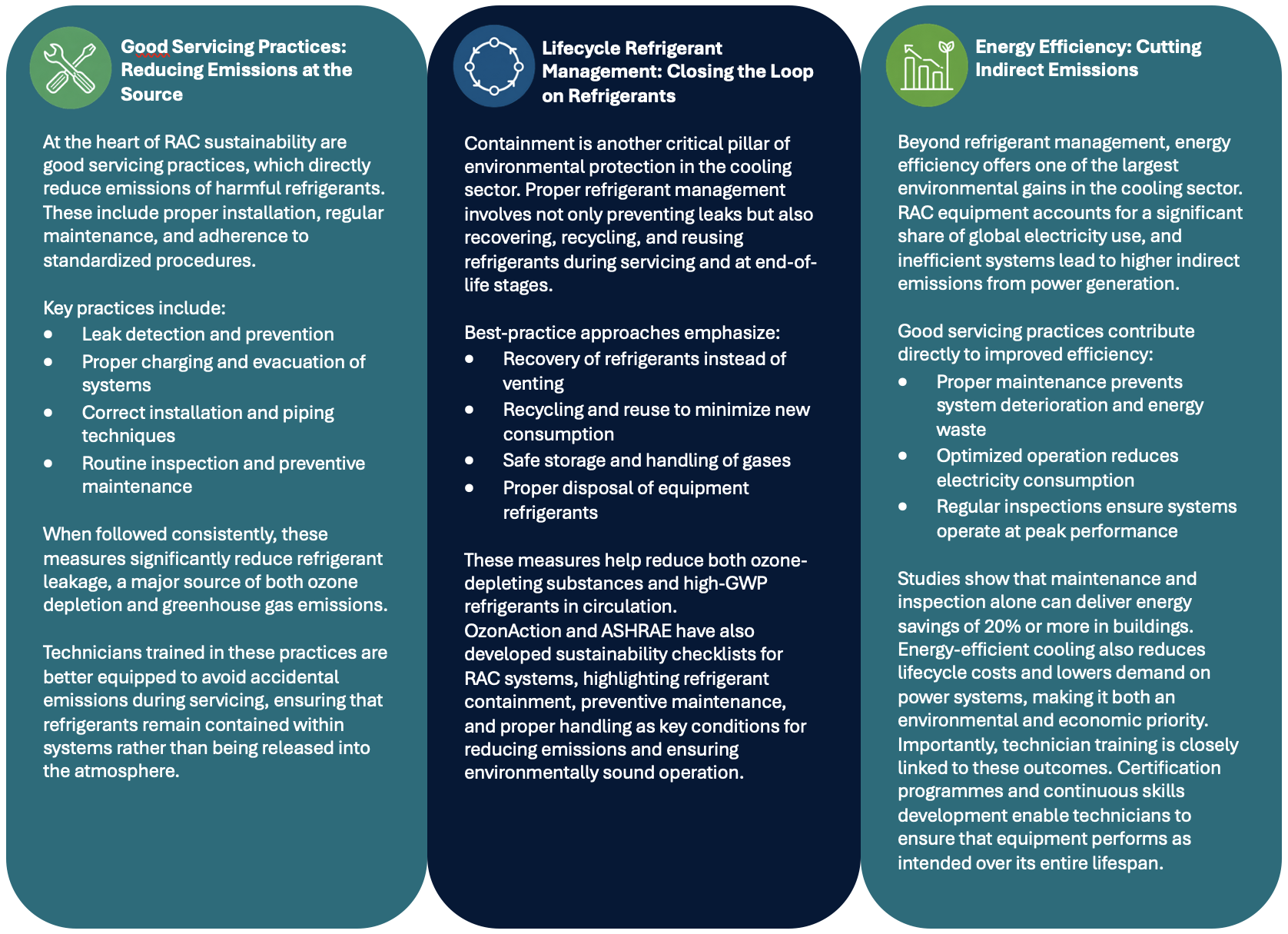
 Through these initiatives, UNEP OzonAction and other implementing agencies organise structured training courses, hands-on workshops, and certification schemes that focus on good servicing practices. These include proper refrigerant handling, leak detection and reduction, recovery and recycling, safe use of low-global-warming-potential (GWP) alternatives and maintaining system energy performance.
 This capacity-building approach ensures that technicians are equipped with the skills needed to support both ozone layer protection and climate mitigation, as they are directly responsible for installing, maintaining, and repairing equipment that uses controlled refrigerants.
Crucially, HPMP and KIP training initiatives emphasize that environmental benefits depend not only on technology, but on the quality of servicing practices. By embedding good practices into national training systems and certification frameworks, these programmes help prevent refrigerant emissions, improve equipment performance, and enable the safe transition to ozone and climate-friendly alternatives, delivering lasting environmental gains across the cooling sector.
Women Driving Change in the Cooling Sector


Recently held UNEP OzonAction’s International Training of Trainers programme shows how these efforts translate into real impact on the ground. In May 2026, eleven female refrigeration and air-conditioning professionals from South Asia participated in an intensive, hands-on training in Italy, covering good servicing practices, safe refrigerant handling, energy-efficient technologies, and certification systems. By strengthening both technical expertise and training capacity, the programme is helping expand national skills development while also promoting greater participation of women in a sector where they have traditionally been underrepresented.
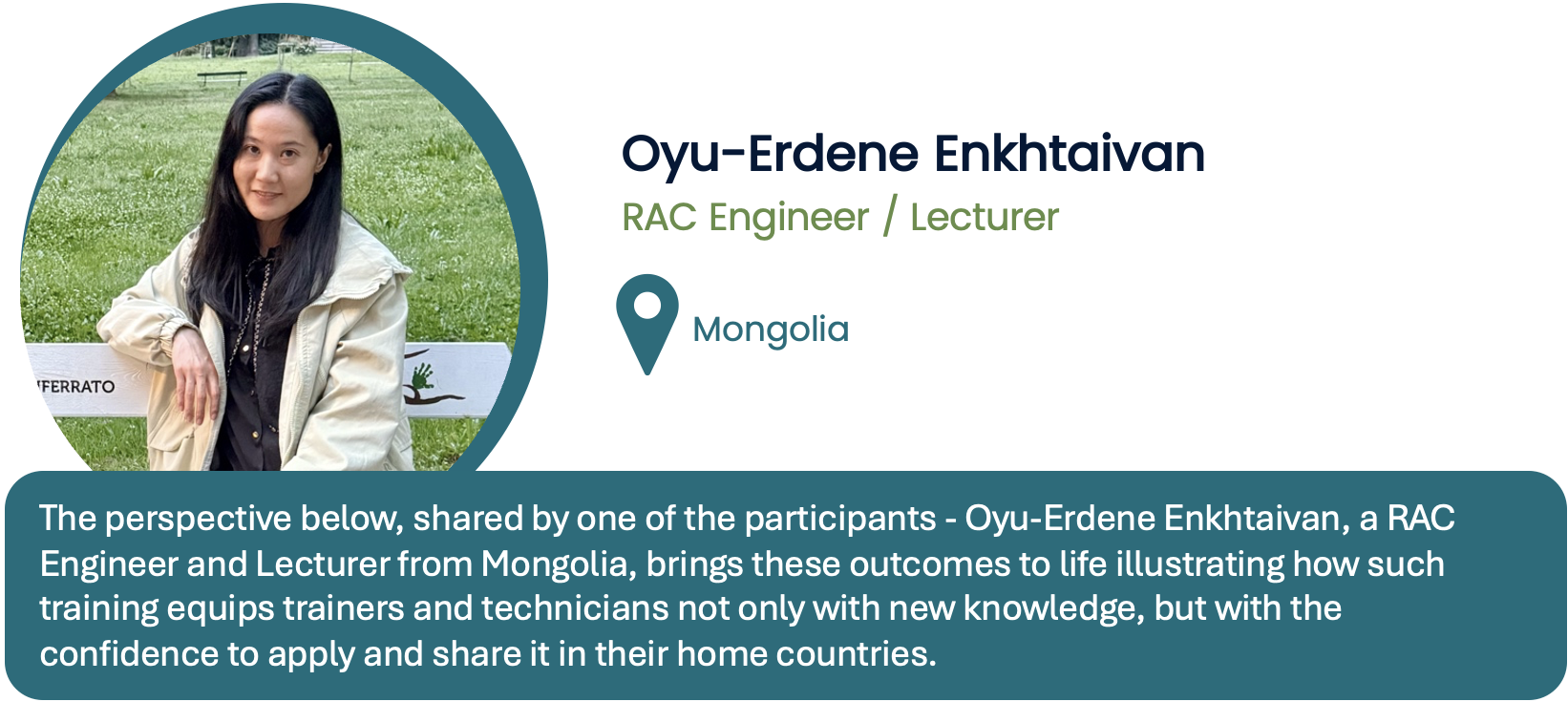

What does being an RAC practitioner/lecturer mean to you, personally and professionally?
For me, working as a lecturer in the Refrigeration, Air Conditioning, and Ventilation (RAC) sector is a meaningful profession that contributes directly to people’s comfort, food safety, and energy efficiency in their daily lives and working environments. I also believe that sharing my knowledge and experience with students, and supporting them in becoming skilled and confident engineers, is one of my most important responsibilities.
As a university lecturer, I focus not only on teaching technical knowledge, but also on helping students develop professional ethics, responsibility, and the right engineering mindset. I believe a good educator is someone who not only transfers knowledge, but also serves as a role model, supports students, and continues growing together with them.
Why is it important to see more women as trainers and leaders in the RAC sector?
I believe it is important to see more women as trainers and leaders in the RAC sector because diversity of perspectives and approaches plays a key role in innovation and development within the industry. The presence of female engineers and educators helps create a more inclusive and encouraging environment, especially for young women considering technical careers.
Seeing women succeed and lead in engineering also helps challenge the outdated perception that technical fields are only for men. It demonstrates that professionalism, knowledge, and capability matter far more than gender.
At a time when the world needs more skilled technical professionals, increasing women’s participation in the RAC sector will contribute significantly to industry growth, innovation, and a more sustainable future.
What are the advantages of the RAC profession?
The RAC profession is one of the most in-demand and socially important fields today. Professionals in this sector have opportunities to work across many different industries.
For example, refrigeration systems play a vital role in maintaining food quality and safety in the food industry. Ventilation and air conditioning systems provide healthy and comfortable environments in buildings, offices, and mining operations. In healthcare, refrigeration technologies are essential for storing medicines, vaccines, and medical equipment safely.
In addition, modern data centers, artificial intelligence systems, and digital technologies all rely heavily on advanced cooling systems. This means the RAC sector is not only a technical field, but also one that is directly connected to human health, safety, and technological advancement.
For these reasons, I hope more young people will recognize the value and future opportunities offered by this profession and choose to study and work in the RAC field.
What message would you share with young people, especially women interested in RAC or technical careers?
Do not be afraid to pursue engineering or technical careers. Engineering is not only about machines and tools — it is about solving problems, thinking creatively, collaborating with others, and making a positive impact on people’s lives.
If you are willing to learn, work hard, and stay persistent, there is absolutely an opportunity for you to succeed in this field. And honestly, being a knowledgeable, skilled female engineer and shining confidently in the professional world is pretty cool, isn’t it?



For more insights from fellow training participants, please explore the gallery below.