


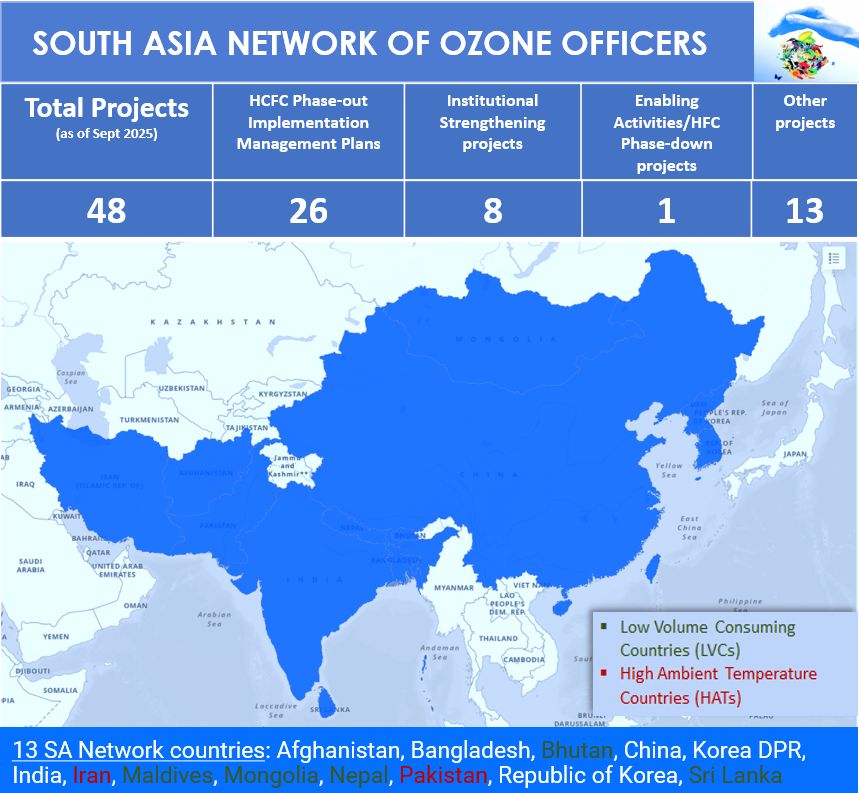
 The Ozone Officers’ Network for South Asia (SA), established in 1997, is managed by UNEP as part of its global networking under UNEP OzonAction. Member countries include Afghanistan, Bangladesh, Bhutan, China, the Democratic Republic of Korea, India, Iran (the Islamic Republic of), the Maldives, Mongolia, Nepal, Pakistan, the Republic of Korea, and Sri Lanka, and one supporting developed country, Japan.
Key Achievements
The SA Network includes some countries that have a unique position in the Montreal Protocol and their commitment towards the phase-out of ozone depleting substances (ODS). For instance, the Maldives was the first developing country to achieve full phase-out of hydrochlorofluorocarbons (HCFCs) at the end of 2020. The SA Network also consists of the major producers and consumers of HCFCs and hydrofluorocarbons (HFCs), such as China and India.
The South Asia Network also has some of the earliest parties to ratify the Kigali Amendment on the phase down of HFCs. As of September 2025, 11 out of 13 South Asia Network countries have ratified the Kigali Amendment: DPR Korea (2017), Maldives (2017), Sri Lanka (2018), Bhutan (2019), Bangladesh (2020), China (2021), India (2021), Mongolia (2022), Republic of Korea (2023) and most recently, Nepal (2025) and Pakistan (2025).
As of 2024, the HCFC phase-out in the SA Network has been on track and under the required compliance levels on a regional aggregate level, as illustrated in the figure below.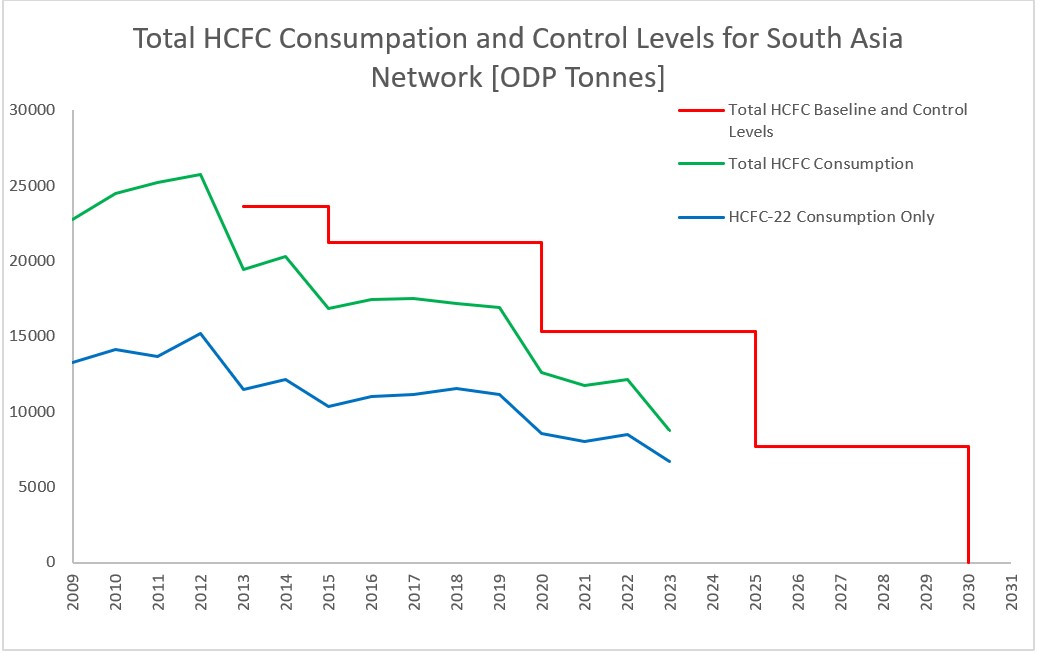
Recent Highlights
In 2025, Bangladesh, Bhutan, Maldives, and Mongolia, are continuing their work on Kigali HFC Implementation Plan (KIP) preparation projects, while the KIP Stage I of Sri Lanka has been successfully approved. Between 2023 and 2025, the HCFC phase-out management plans (HPMP) Stage III of Pakistan, India and Iran have been successfully approved, and their implementation is ongoing. Maldives and Mongolia have successfully been approved for additional funding for activities to introduce alternatives to HCFCs with low or zero GWP and for maintaining energy efficiency in the refrigeration servicing sector.
Network Meetings, Thematic Workshops and Events: From 2023, the following regional/sub-regional events were organized/co-organized for the South Asia Network. Background information on these events is available in the OzonAction Meeting Portal:
2025
- International Training for Master Trainers on R-290 Room Air Conditioner Servicing, Good Practices Training on Refrigeration and Air Conditioning Servicing of Natural Refrigerants, Guangzhou, China, 7-9 January 2025
- Network Meeting of South Asia National Ozone Officers, Bangkok, Thailand, 3-5 July 2025
- International Training for Master Trainers on Good Servicing Practices for Cold Room relying on Natural Refrigerants, Guangzhou, China, 4-7 November 2025
- Thematic Meeting for ODS banks inventory and management, Bangkok, Thailand 18-20 November 2025
2024
- Thematic Meeting for High Ambient Temperature (HAT)/Group 2 Countries, 22-23 April 2024, Dubai, The United Arab Emirates
- Joint Network Meeting of South Asia and Southeast Asia National Ozone Officers, back-to-back with the Energy Efficiency Twinning Workshop, 20 – 24 May 2024, Guangzhou, China
- Joint Network Meeting for Ozone Officers in South Asia and West Asia and Customs Border Dialogue, Chennai, India, 24 – 27 September 2024
2023
- Asia Pacific Exploring Innovative Strategy to Garner General Public Advocacy on Ozone2Climate Action, 27 January 2023
- Parallel South Asia (SA) Network Meeting of National Ozone Officers (NOOs) & Green Customs Initiatives Capacity Building Workshop for Customs Officers (COs) of SA, & Twinning NOO-COs Workshop on ODS/HFC Trade Control & Reporting, Maldives, 21-25 May 2023
- Pilot Advanced NOO Training, Joint Meeting of South Asia & Southeast Asia Networks of NOOs and Thematic Workshop to Enhance Awareness and Communication under the Montreal Protocol, Phuket, Thailand, 20-24 November 2023
- Training of Assessor on Competency-based Certification for Good Servicing Practices in the Refrigeration and Air Conditioning Servicing sector, Kuala Lumpur, Malaysia, 28-30 November 2023
Gender
The South Asia Network has been working to promote gender balance into the Montreal Protocol implementation, such as gender disaggregated data collection, gender awareness-raising, and set gender promotion as one of the targets in the activities where possible.
Key Challenges
- Most of the servicing sector is highly informal in the region, resulting in little capacity and knowledge of ozone and climate-friendly technologies and servicing practices, thus creating a major barrier to the adoption of such technologies.
- Lack of awareness by the end-users (consumers) on ozone and climate-friendly Refrigeration and Air Conditioning (RAC) technologies has been a barrier to the uptake of environmentally friendly refrigerants and energy-efficient RAC equipment.
- In light of Kigali Amendment implementation, new partnerships need to be fostered to achieve synergies of Montreal Protocol obligations with climate change and energy efficiency goals.
- In certain situations, geographic positioning and sharing of porous borders make controls and prevention of illegal ODS trade challenging.
- Some of the countries in the Network face implementation challenges due to prevailing political situations and security challenges.
- Some of the countries in the Network face challenges in advancing trade controls through digitalization of ODS/HFC licensing and quota systems due to limited connectivity in the country or a lack of adequate capacities.
- Some countries in the Network face challenges in promoting equal opportunities for men and women in the industry.
- COVID-19 impacts on HFC baseline consumption: Due to the COVID-19 pandemic related economic slowdown, some SA countries have experienced reductions in HFC consumption during the baseline years (2020-2022). The consumption of HFCs has increased due to businesses resuming post-pandemic and economic growth in the region. It is essential to closely monitor the growth of HFC consumption to ensure that Group 1 SA countries would meet the freeze obligation while maintaining economic growth.
Future Objectives
The 2025 South Asia Network workplan is mainly comprised of compliance assistance services, preparation and implementation of individual country projects including HPMPs, additional activities related to Energy Efficiency, Institutional Strengthening Projects, Inventory of ODS Banks, and the KIP preparation and implementation.
The objectives of the SA Network will be built on the recommendations and conclusions from the past network and thematic meetings, Meetings of the Parties, and the Executive Committee Meeting decisions. The Network will focus on the following issues:
- Promoting dialogue and providing assistance related to monitoring, reporting, verification, and enforcement (MRVE) to sustain the Montreal Protocol targets already met and to meet future targets.
- Extending cooperation with the enforcement community at the international, regional, and national levels to combat illegal trade through awareness, joint activities, and coordination.
- Helping NOUs to understand and comply with the changing Article 7 and Country Programme data reporting requirements.
- Prioritizing training and capacity building activities for the refrigeration servicing sector through ongoing HPMPs, CAP services, and specific training tools already developed or under finalisation.
- Supporting NOUs to address different technical challenges related to adopting and deploying lower-GWP alternatives, including, but not limited to, updating standards/codes, addressing needs of high ambient temperature countries, safety considerations, availability of alternatives for commercial/industrial refrigeration sector, and other technical priorities of Article 5 countries.
- Encouraging linkages between NOUs and Technical Vocational Education and Training (TVET) authorities and increasing the ownership/involvement of national training institutions to deliver training and adopt the curricula developed by UNEP, to further promote the sustainability of the capacity building delivered with Multilateral Fund assistance.
- Exploring sector specific strategies for the cold chain sector.
- Further pursue the integration of energy efficiency in HPMP and KIP implementation.
- Introducing refrigerant management concepts and ideas for activities to be included in HPMPs/KIPs such as setting leakage baselines and leak reduction targets to enable measurable consumption reductions in the servicing sector.
- Building the capacity of NOUs to understand and address new obligations under the Kigali Amendment and assisting countries with the incorporation of Kigali Amendment requirements into their national legal and policy frameworks.
- Gender: UNEP CAP will continue to build the capacity of SA Network countries to identify entry points to integrate gender into different workstreams of Montreal Protocol implementation.
REGIONAL CONTACTS
Mr Mikheil Tushishvili
Interim Montreal Protocol Regional Coordinator - South Asia
Mr. Andrea Ossi Perretta
Programme Management Officer – South Asia
OzonAction CAP team for Asia and the Pacific