


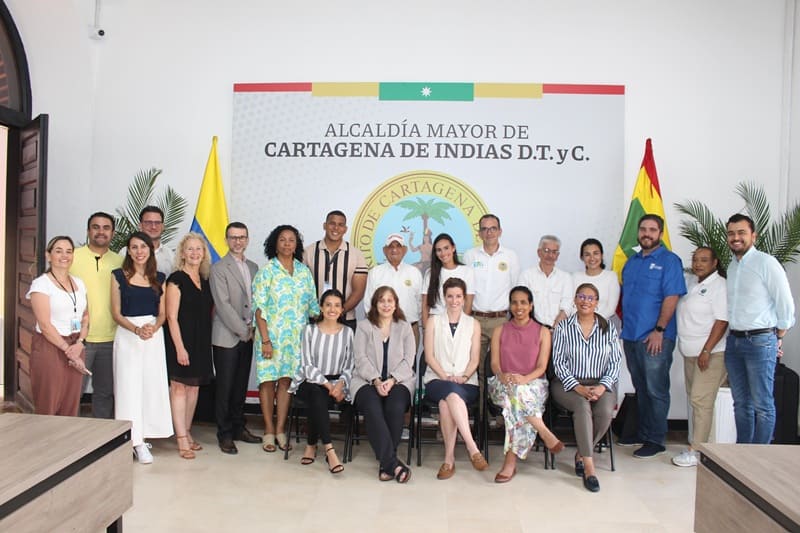
The Circular Plastic Economy Cities Network in Latin America and the Caribbean brings together six cities from Colombia, Jamaica, and Panama, with the support of UNEP and the GEF. Its goal is to promote regional cooperation, share experiences, and implement circular economy strategies to reduce plastic pollution, including marine plastics. Nine additional cities are expected to join, strengthening a coordinated and sustainable approach to plastic management in the region. Cartagena, March 27, 2025 (@Minambienteco) – Cities in Colombia, Jamaica, and Panama have joined forces to establish the Circular Plastic Economy Cities Network in Latin America and the Caribbean, an initiative aimed at tackling plastic pollution through sustainable strategies grounded in the circular economy. Driven by the GEF Project to Reduce Marine Plastics and Plastic Pollution in Cities of Latin America and the Caribbean, the Network is backed by the United Nations Environment Programme (UNEP), its Latin America and Caribbean Office, and the Secretariat of the Cartagena Convention. The founding cities of the Network are Cartagena and Barranquilla (Colombia), Kingston and Montego Bay (Jamaica), and Panama City and Colón (Panama).
Through this initiative, regional cooperation, knowledge exchange, and the implementation of circular strategies to reduce plastic pollution will be promoted. Additional cities across the region are expected to join progressively. “This launch marks a milestone in the joint efforts to address plastic pollution in Latin America and the Caribbean, promoting a shared vision and sustainable, locally driven solutions,” said Jacqueline Álvarez, Head of the Chemicals and Health Branch at UNEP. Lena Estrada, Colombia’s Minister of Environment and Sustainable Development, highlighted the importance of strengthening regional collaboration to reduce plastic use. “We welcome the launch of this network, which brings us closer to achieving the medium- and long-term goals we have set as a country and as a region,” she said.
The Circular Plastic Economy Cities Network is expected to become a platform for collaboration in implementing circular strategies throughout the plastic value chain. By partnering with a variety of stakeholders, it will support the design and rollout of action plans that can be replicated in other cities across the region. Key expected outcomes of the Network include: Promotion of a harmonized regional agenda on the circular plastic economy Consolidation of a coordinated approach among participating cities Strengthening of local, national, and regional capacities for developing circular solutions Expansion of the Network to nine additional cities, enhancing its impact and knowledge exchange Through this joint effort, the region is moving toward a more sustainable development model, with cities committed to reducing plastic pollution and fostering an effective circular economy.



CEP was established in 1981 as part of the Regional Seas Programme in recognition of the importance and value of the Wider Caribbean Region’s fragile and vulnerable coastal and marine ecosystems including endemic plants and animals.