Regional Seas Conventions and Action Plans (Regional Seas) joined governments, regional organizations, scientists, and partners at the 11th Our Ocean Conference (OOC11) in Mombasa, Kenya, to address the BBNJ Agreement, ocean governance, marine biodiversity, the blue economy, and other priorities critical to the health and sustainable management of our ocean.Regional Seas hosted a series of events that examined practical ways to put global commitments into practice. The conference also marked the launch of the Sustainable Western Indian Ocean Programme (SWIOP), a €60.5 million initiative to strengthen ocean governance and support sustainable blue economy development in nine Western Indian Ocean countries.A key outcome was the announcement of two commitments to support implementation of the BBNJ Agreement. UNEP Regional Seas Programmecommitted to mapping overlaps between Ecologically or Biologically Significant Areas (EBSAs) and Marine Protected Areas by June 2027, while the Nairobi Convention committed to developing a Regional BBNJ Vision and Implementation Framework by June 2027.The week showed how regional cooperation can turn global commitments into results for shared marine ecosystems and the people who depend on them.
Regional Seas Side Events
15 June 2026
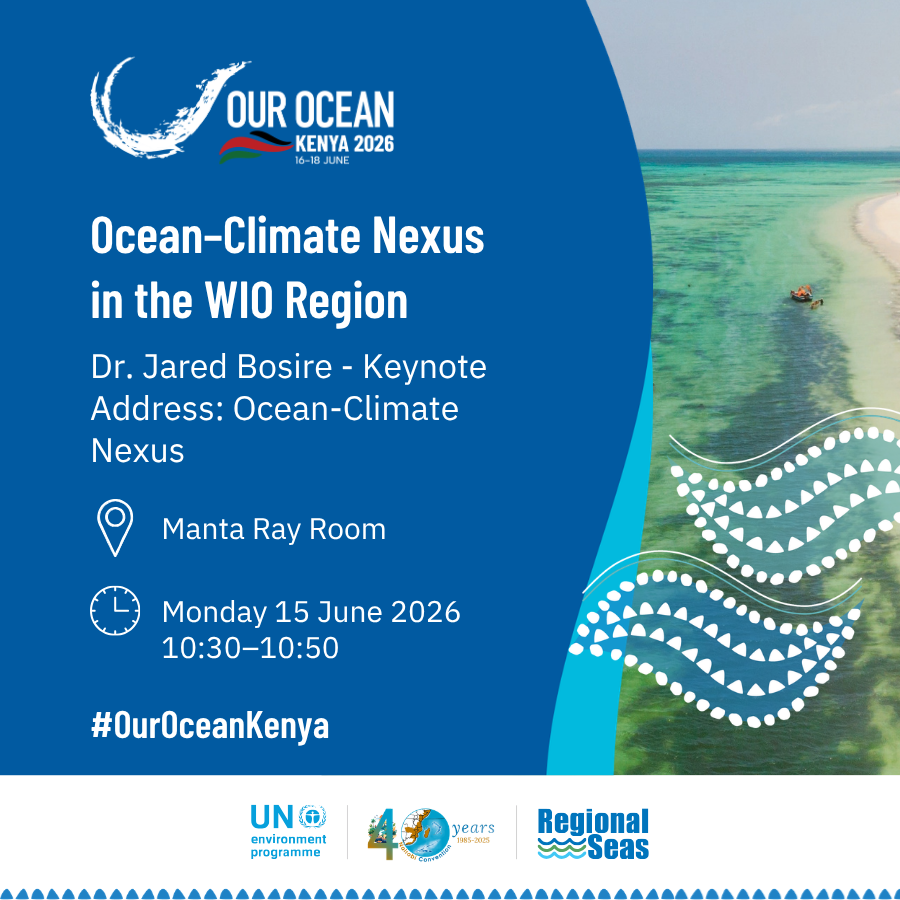
Keynote Address: Ocean-Climate Nexus in the Western Indian Ocean (WIO) Region
Dr. Jared Bosire, Head of the Nairobi Convention, delivered a keynote address on the Ocean-Climate Nexus in the Western Indian Ocean region, highlighting regional efforts to strengthen ocean governance, build climate resilience, and advance coordinated action for a resilient ocean future.
17 June 2026
Raising Ambition and Financing in the Wider Caribbean: Advancing the Wider Caribbean Ocean Coordination Mechanism and the Actioning Blue 30×30 Roadmap
Hosted by: Government of Jamaica, Government of Grenada, Dominican Republic, Panama, CARICOM Secretariat, Organisation of Eastern Caribbean States Secretariat, Ocean Coordination Mechanism, Caribbean Biodiversity Fund, Intergovernmental Oceanographic Commission (IOC) of UNESCO, Global Ocean Accounts Partnership, UNEP Cartagena Convention Secretariat, Blue Nature Alliance, The Nature Conservancy Caribbean, Conservation International, Caribbean Regional Fisheries Mechanism, Global Island Partnership, Global Youth Biodiversity Network, Wildlife Conservation Society, Blue Marine Foundation and Campaign for Nature.Caribbean countries presented a coordinated package of new and strengthened commitments that demonstrated implementation readiness and coordinated action. These included:
- New endorsements of the Actioning Blue Declaration
- New signatures of the Wider Caribbean OCM Memorandum of Understanding (MoU)
- New announcements of expanded marine protection
- National pledges to implement Ocean Accounts by 2030
- Commitments to develop Sustainable Ocean Plans and engage with the High Level Panel for a Sustainable Ocean Economy
Each package was presented by a regional champion for the respective theme, who highlighted progress on these commitments and provided an overview of new and emerging commitments from the region. Together, these commitments represented coordinated action at the ocean, climate, biodiversity and sustainable development nexus among governments and intergovernmental organizations, reflecting a more ecosystem-based approach to ocean governance.
Towards UNOC-4: Strengthening Regional Action on Marine Plastic Pollution through the Regional Seas Programme in the Western Indian Ocean and East Asian Seas Regions
Hosted by: Coordinating Body on the Seas of East Asia (UNEP/COBSEA)The side event showcased how regional frameworks, research, technical expertise and multi-stakeholder partnerships advanced practical solutions across the source-to-sea continuum, from plastic waste prevention and city-level action to improved management of sea-based sources, including ALDFG. The side event:
- Highlighted regional experiences from UNEP Regional Seas, including COBSEA and the Nairobi Convention.
- Demonstrated how regional action plans, such as RAP MALI, supported the implementation of global commitments at national and sub-national levels.
- Shared practical approaches from research institutions and implementation partners, including on sea-based source management, ALDFG prevention and management, and city-level plastic reduction.
- Promoted South-South exchange, peer learning and scalable partnerships that informed regional action and contributed to a pipeline of solutions towards UNOC-4.
Africa's Blue Frontier: Strengthening Ocean Governance for Africa's Blue Economy for People and NatureHosted by: Nairobi Convention and WIOMSA
Africa's oceans and coastal ecosystems are central to sustainable development, food security, livelihoods, climate resilience and economic growth. As the continent advances its Blue Economy agenda, the side event highlighted the importance of effective ocean governance in ensuring that development benefits both people and nature.The ministerial dialogue brought together ministers, leaders and decision-makers to discuss opportunities for strengthening regional cooperation, enhancing marine and coastal governance, and advancing sustainable blue economy initiatives across Africa. Participants underscored the importance of collaborative action to support resilient ocean ecosystems and sustainable development across the continent.
Building on Success: From Policy Dialogue to Investable Blue Economy Models in the Western Indian OceanHosted by: Nairobi Convention, South West Indian Ocean Fisheries Commission (SWIOFC) and FAOThe side event highlighted how regional policy dialogue is translating into practical, scalable and investable blue economy initiatives in the Western Indian Ocean. Discussions focused on advancing sustainable fisheries, strengthening coastal livelihoods, supporting ocean conservation and promoting sustainable economic growth across the region.Participants shared experiences and explored opportunities to build on regional cooperation, strengthen partnerships and accelerate investment in blue economy solutions that deliver benefits for both people and the ocean.
18 June 2026
From Science to Sovereignty: Mobilising Political Leadership and Investment to Power Africa’s Inclusive Blue Economy
Hosted by: Intergovernmental Oceanographic Commission of UNESCO, African Union Commission, African Development Bank, UNEP, Western Indian Ocean Marine Science Association, Early Career Ocean Professionals Programme, Nairobi Convention Secretariat, Abidjan Convention Secretariat
Africa’s oceans support food security, livelihoods, trade and climate regulation, yet they face growing pressures from climate change, biodiversity loss, pollution and rapid blue economy development. Recognizing that investment and development were advancing faster than the scientific knowledge and data systems needed to guide them, the side event highlighted the critical role of ocean science and knowledge as essential development infrastructure for Africa’s coastal and island states.
The event brought together policymakers, scientists and partners to strengthen the link between science, policy and investment, particularly in support of blue economy development, climate resilience and risk reduction. It also positioned IOCAFRICA as a key regional platform for coordinated action, partnership-building and resource mobilization under the United Nations Ocean Decade.
The side event concluded with a call for stronger political commitment and sustained investment in ocean science systems to enable informed decision-making and support sustainable development across the continent.
Empowering African countries to combat marine pollution (Content coming soon)
Beyond Ratification: Regional Seas as an Effective Mechanism in the Implementation of BBNJ
Hosted by: Nairobi Convention and UNEP Regional Seas
With five decades of action-oriented cooperation, the Regional Seas Programme covers more than 140 countries and 18 Regional Seas Conventions and Action Plans (Regional Seas), seven of which are administered by UNEP. The Programme provides a legally anchored, regionally driven platform and more than 50 thematic protocols to protect marine and coastal environments and advance integrated ocean governance through a shared seas approach.
The side event, "Beyond Ratification: Regional Seas as an Effective Mechanism in the Implementation of BBNJ," examined how the Regional Seas Programme supports the effective implementation of the BBNJ Agreement. As the Agreement entered into force, participants emphasized that strengthening coordination across national waters and areas beyond national jurisdiction was essential. They highlighted how Regional Seas, with their established governance mechanisms, scientific networks and convening power, were well positioned to help bridge this jurisdictional divide.
The event opened with keynote reflections on the evolving global ocean governance landscape and the strategic role of regional cooperation in delivering the objectives of the BBNJ Agreement. Speakers highlighted how Regional Seas could contribute to implementing key elements of the Agreement, including area-based management tools (ABMTs), environmental impact assessments (EIAs), capacity-building and the transfer of marine technology, while ensuring complementarity with existing regional mandates.
Panellists explored practical pathways that had already been taken to enhance policy coherence and announced planned institutional collaboration across governance levels. Discussions addressed how regional bodies could facilitate scientific cooperation relevant to areas beyond national jurisdiction (ABNJ), support Member States in preparing for BBNJ processes, promote ecosystem-based approaches that consider ecological connectivity between exclusive economic zones (EEZs) and the high seas, and foster inclusive participation.