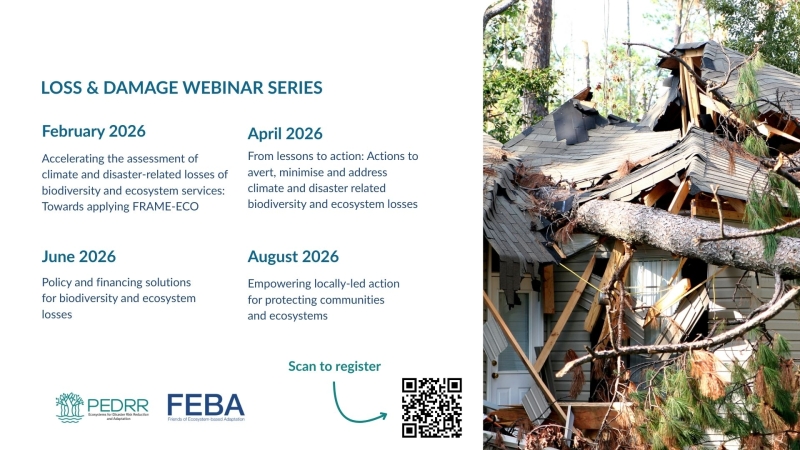
Webinar 1 – Accelerating the assessment of climate and disaster-related losses of biodiversity and ecosystem services: Towards applying FRAME-ECO.
The opening session will introduce FRAME-ECO as a framework for tracking, managing, and reporting non-economic losses of biodiversity and ecosystem services, including impacts on ecosystem extent, condition, and the services and diverse values they provide.
The webinar will explore how FRAME-ECO can complement and add value to existing approaches such as Post Disaster Needs Assessments (PDNA), System of Environmental-Economic Accounting (SEEA), and disaster tracking systems by United Nations Office for Disaster Risk Reduction, United Nations Development Programme and World Meteorological Organization, ultimately contributing to tracking and reporting efforts under the Santiago Network and the Warsaw International Mechanism for Loss and Damage (WIM).
Participants will be invited to share knowledge, provide feedback, and identify opportunities for collaboration to strengthen partnerships and define next steps for FRAME-ECO’s development.
Webinar 2 – From lessons to action: Actions to avert, minimise and address climate and disaster-related biodiversity and ecosystem losses.
The Lessons to Action webinar aims to promote transformative, innovative approaches to responding to irreversible, unavoidable losses of biodiversity and ecosystem services. Through field-based evidence, the session will highlight best practices and lessons learned from frontline communities. Practical examples of Nature-based Solutions (NbS) will showcase where these interventions are succeeding, where barriers persist, and how they can be scaled up and strengthened. Voices from those most affected will be central to the discussion, offering insights into how deeply rooted ecological and cultural connections shape vulnerability and resilience.
Webinar 3 – Policy and financing solutions for biodiversity and ecosystem losses
Climate-related Loss and Damage is increasing rapidly, yet most financing mechanisms still fall short in addressing the environmental and biodiversity dimensions of the crisis, particularly its non-economic dimensions. Although initiatives like the Fund for Responding to Loss and Damage (FRLD) mark important progress, current pledges, approximately $ 786 million, fall far short of the estimated $400 billion needed annually in developing countries.
The Policy and Financing Solutions webinar will explore how national and international climate finance and policy frameworks can more effectively recognise and respond to nature-related loss. The session will consider a policy-centred approach to integrating biodiversity and ecosystem considerations into national corporate governance codes through planetary accounting frameworks.
Speakers will explore pathways to integrate biodiversity and ecosystem loss into National Adaptation Plans (NAPs), Disaster Risk Reduction (DRR) strategies, and funding proposals. Practical NbS examples will be highlighted to demonstrate how locally grounded, evidence-based approaches have supported integration, offering insights for strengthening ecosystem-based disaster risk reduction and climate resilience.
Webinar 4 – Empowering locally-led action for protecting communities and ecosystems
While climate-related Loss and Damage is increasing globally, its impacts are unevenly distributed. This is true both at the global and local levels, where informal settlements and marginalized communities are disproportionately affected by climate and disaster impacts. Globally, more than one billion people live in such informal settlements.
The Locally-led Action webinar will explore the kinds of losses and damages informal communities are facing and how these are exacerbated by a lack of green spaces and healthy ecosystems and will consider existing measures and approaches adopted by marginalised communities to mitigate climate-related Loss and Damage.
With real-world examples, the session will reflect on how communities can be empowered and capacity strengthened to sustainably restore and manage ecosystems, leverage NbS to reduce future disaster impacts, and consider approaches for strengthened access to support when faced with future disaster events.
Webinar 5 – Finding nature: How cities can integrate NbS in their response to the climate crisis, minimizing loss and damage
The urban impacts of climate change continue to confront subnational policymakers with difficult choices about how to sustain development and protect human wellbeing amid both slow- and rapid-onset events.
For rapidly growing cities, particularly in Least Developed Countries (LDCs) and Small Island Developing States (SIDS), climate impacts are already exposing the limits of conventional approaches, underscoring the need to fundamentally rethink urban planning and design. In response, cities worldwide are increasingly turning to NbS, recognizing the potential of nature for addressing the increasing frequency and intensity of climate change impacts.
This webinar explores how NbS and EbA are already supporting resilient development in urban areas. It presents how such strategies can be mainstreamed into subnational policies and support disaster risk reduction strategies, as well as minimize the impacts of Loss and Damage within cities.
Register to join the conversation and access the full webinar series.