

• Overview
  • Join the Launch
  • How Faith Groups Should Use This Document
  • Key Elements

At the Faith for Earth Coalition, the notion that values, culture and spirituality is a catalyst to drive sustainable lifestyles with benefits to people and the planet has been proven by the incredible efforts of faith groups. 

For instance, their ability to leverage the existing institutional faith-based networks enhancing programmes on the environment, as in the case of the Ekopesantren Programme and Laudato Si’ Animators Programme. Faiths are mobilizing the communities in which they are trusted voices of morality and ethics, demonstrating practical ways to promote pro-environmental behaviours.

The purpose of this roadmap is to convene faith actors, religious institutions, and spiritual communities as catalysts for promoting sustainable lifestyles. Dr. Iyad Abumoghli, Founder & Director of UNEPs Faith for Earth Coalition remarks that:

“Combining spiritual beliefs with pro-environmental actions can yield a powerful framework for addressing current environmental challenges. Religious communities can inspire meaningful change by leading by example and ensuring the well-being of all life on Earth”. 

Have a look at the Roadmap, by clicking here.

The document provides a strategic and practical framework for how religious and spiritual communities can actively contribute to environmental stewardship and sustainable living. Faith groups, like the five featured in the publication demonstrate multiple advantages.
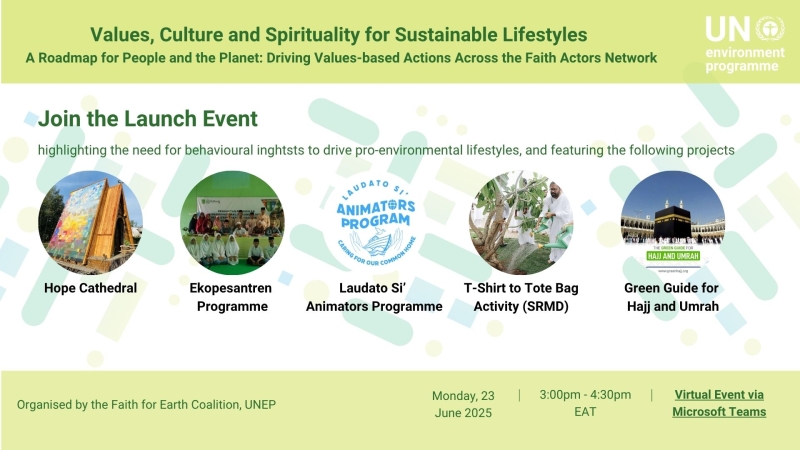
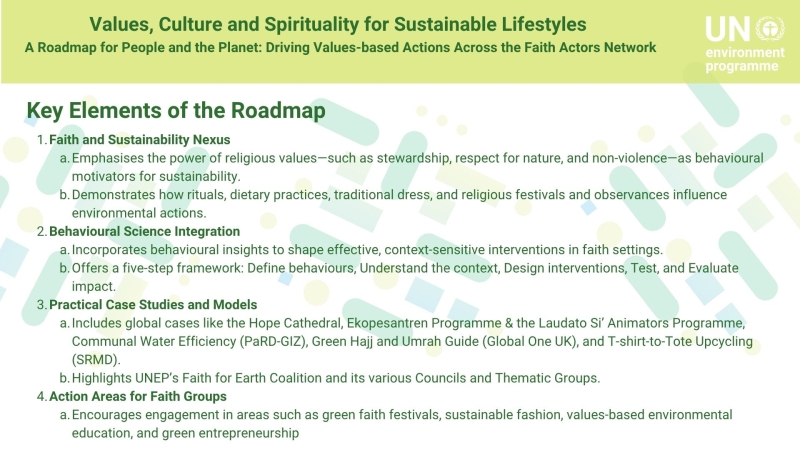
A Roadmap for People and the Planet: Driving Values-based Actions Across the Faith Actors Network is structured as follows:

  1. It highlights the need for behavioural science, and how religious groups, institutions and organisations can further incorporate and strengthen their approaches by placing at the forefront the Framework for Shaping Sustainable Lifestyles: Determinants and Strategies;
  2. It features five exceptional projects and programmes that demonstrate how faith actors are institutionalising sustainable lifestyles; and
  3. Introduces four projects and four ways to work with the Faith for Earth Coalition. 

Event Date: Monday, 23 June 2025
Time: 3:00 PM - 4:30 PM EAT
Organized by: Faith for Earth Coalition (UNEP)

Event Poster

Missed it? Watch the Webinar here.

Highlights from the Launch

Dr. Iyad Abu Moghli (Director, Faith for Earth) opened the session by introducing the Sustainable Lifestyles Roadmap, stressing that faith communities—rooted in values like moderation and care for creation—can drive systemic change.

Watch his Opening Remarks here.

Azmaira Alibhai (Coordinator, Faith for Earth) highlighted the role of behavioural science in bridging awareness and action, showing how faith networks translate values into culturally relevant sustainability efforts.

Bishop Emeritus Atle Wilhelm Sommerfeld (Diocese of Borg, Norway) shared the Hope Cathedral in Norway, a recycled-plastic landmark symbolizing ecological hope and interfaith collaboration, built with 11,000 volunteer hours.

Dr. Fachruddin Mangunjaya (Universitas Nasional (UNAS) Jakarta) presented Indonesia’s Ekopesantren Programme, integrating Islamic teachings into climate action across 39,000 schools via a MOOC and partnerships like waqf forests.

Ashley Kitisya (Laudato Si’ Movement) discussed the Laudato Si’ Animators program, training 20,000+ leaders globally to apply Pope Francis’ encyclical locally (e.g., drought solutions, fossil fuel divestment), and the #RaisingHope Earth campaign uniting faith groups for ecological justice.

Halak Shah (Shrimad Rajchandra Love and Care) showcased upcycling projects like T-shirt to Tote, turning waste into rural resources, and Power of One, redistributing 800,000 donated items to vulnerable communities.

Ines Belliard (Global One, UK) presented the Green Guide for Hajj and Umrah (translated versions), emphasizing faith-driven climate action. Developed over a decade, it offers practical steps to reduce pilgrimage waste, rooted in Islamic values. A notable example is the Cambridge Eco Mosque.


Faith actors (religious leaders, faith-based organisations, youth, women-led organisations, etc) can influence individual and collective behaviours toward achieving the Sustainable Development Goals (SDGs), particularly SDG 12 on Sustainable Consumption and Production. 

The Faith for Earth Coalition will launch this publication on Values, Culture and Spirituality for Sustainable Lifestyles in support of UNEA Resolution 6.8 'Promoting Sustainable Lifestyles' adopted at the sixth session of the United Nations Environment Assembly (UNEA-6).

Faith-based organisations and actors can use this roadmap in the following ways:

  • Strategic Planning: Integrate the roadmap into institutional plans, policies, and educational curricula to advance sustainability goals at the UN, UNEP, or at the national and local level.
  • Programme Design: Develop and implement values-based environmental initiatives, campaigns, and festivals informed by the document’s behavioural framework.
  • Advocacy and Dialogue: Engage in national and international platforms (e.g., COP, UNEA) to influence policy with spiritual perspectives on sustainability.
  • Community Mobilisation: Act as trusted messengers within communities, using religious teachings to inspire sustainable habits and responsible consumption.
  • Partnership and Networking: Collaborate with UNEP, interfaith networks, and government agencies to scale up successful models and share best practices.

Key Elements