This workshop will present a detailed roadmap developed by UNEP consultants, share lessons learned from countries that have successfully implemented similar standards—including the United States, China, India, and Thailand—and gather feedback from national stakeholders on the proposed implementation plan.
Background
Viet Nam’s road transport challenge
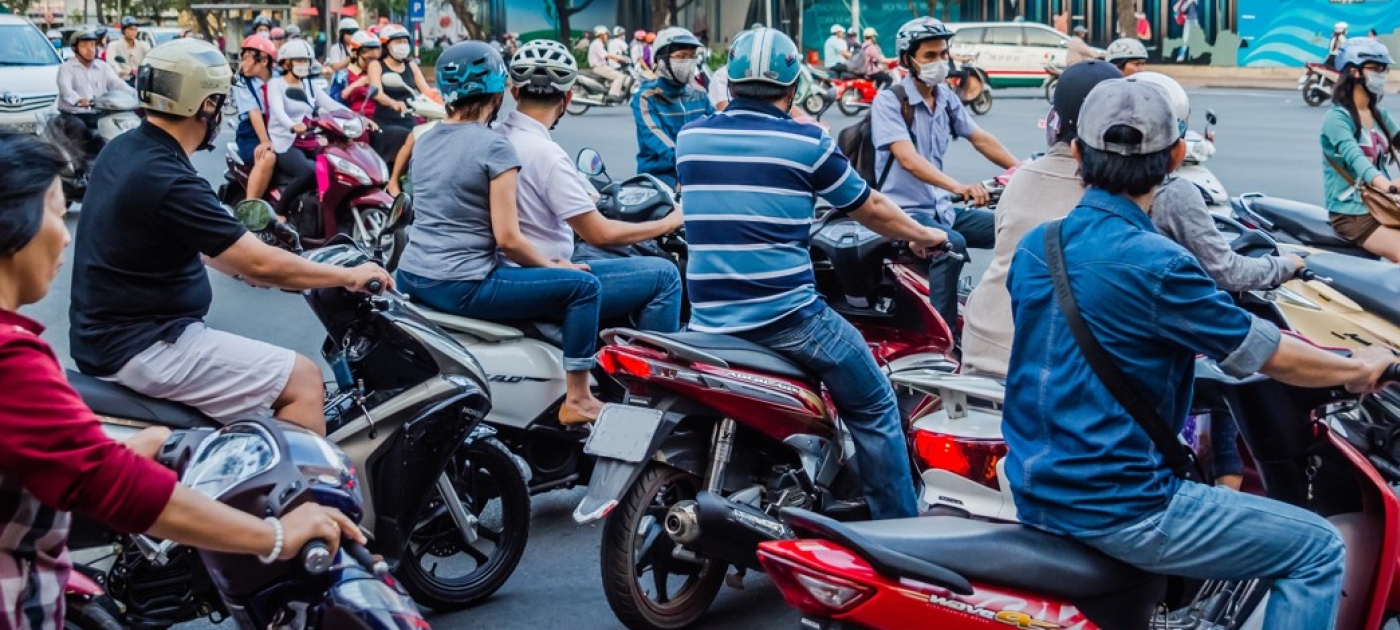
Viet Nam is one of the most motorbike-dependent nations in the world, with approximately 72 million two-wheelers on its roads—the largest fleet in Southeast Asia—accounting for roughly 90 per cent of all vehicles in the country according to the UNEP-supported study Supporting Electric Vehicles in Viet Nam, developed by the University of Transport Technology and funded by the German International Climate Initiative (IKI).
This dominance of 2Ws has significant implications for air quality and climate, the study found. Two-wheelers alone contribute approximately 35 per cent of road transport emissions while cars account for 17 per cent, and passenger vehicles 8 per cent.
___________________________________________________________________
Climate Commitments and Green Energy Transition
Viet Nam is among the countries most severely affected by climate change, particularly rising sea levels. At COP26, the country committed to achieving net zero emissions by 2050 and has s,ince taken significant legislative action to deliver on this pledge. In its updated Nationally Determined Contribution (NDC) of 2022, Viet Nam committed to reducing total GHG emissions by 15.8 per cent below business-as-usual levels by 2030 using domestic resources—a target that can be increased to 43.5 per cent with international support.
A landmark step in this direction came in July 2022, when the Vietnamese government issued Decision No. 876/QĐ-TTg, approving the Action Program on Green Energy Transition and the Reduction of Carbon and Methane Emissions in the Transport Sector. The decision sets ambitious milestones: promoting the production, assembly, and import of electric road vehicles during 2022–2030; gradually ceasing the production of fossil-fuel motorcycles and motorbikes by 2040; and ensuring 100 per cent of road vehicles transition to electricity and green energy by 2050.
The promise of fuel economy standards and electric mobility
Fuel economy standards complement Viet Nam’s electrification agenda by setting efficiency benchmarks for both conventional and electric vehicles. Research supported by UNEP shows that adopting electric 2Ws could reduce CO₂ emissions by approximately 30 per cent compared to conventional motorcycles. Furthermore, achieving 22 per cent penetration of electric two-wheelers in Viet Nam’s existing motorbike fleet by 2030 could reduce national CO₂ emissions by approximately 16.4 per cent compared to business-as-usual levels.
Establishing a clear implementation roadmap for fuel economy standards—covering compliance mechanisms, enforcement tools, incentive programmes, credit trading, tax schemes, and transition phases—will be essential to translating these targets into measurable on-the-ground progress.
___________________________________________________________________
What to expect
The workshop will open with welcome remarks from the Ministry of Construction and Building Materials and Viet Nam Register, followed by an introduction to the UNEP project. Participants will then hear presentations and engage in discussions across two thematic blocks:
Viet Nam’s fuel economy landscape and proposed roadmap
- An overview of Viet Nam’s existing fuel economy standards, presented by the National Emission Testing Centre.
- A detailed presentation of the proposed fuel economy standards implementation roadmap for light-duty vehicles, two-wheelers, motorcycles, and mopeds, developed by UNEP.
International lessons learned
A series of presentations sharing implementation experiences from countries that have pioneered fuel economy standards, focusing on practical aspects such as compliance mechanisms, enforcement tools, incentive policies, credit trading or pooling, tax schemes, and transition phases:
- United States and China: Ms. Zifei Yang, Director – Emerging Markets Region, International Council for Clean Transport (ICCT)
- India: Mr. Sharif Qamar, Associate Director, Transport and Urban Governance – TERI (The Energy and Resource Institute), India (online)
- Thailand: Mr. Papondhanai Nanthachatchavankul (Tum), GIZ Thailand
The workshop will also include a dedicated feedback session on the proposed implementation plan, as well as a discussion with the Viet Nam Automobile Manufacturers Association (VAMA) and the Viet Nam Association of Motorcycle Manufacturers (VAMM) on industry challenges and the way forward.
___________________________________________________________________
Who will attend
- Government officials from the transport, environment, and energy ministries
- Vehicle and industry associations
- National testing and standards bodies
- International development partners and technical institutions
- Researchers and practitioners in transport policy, emissions reduction, and electric mobility
___________________________________________________________________
Looking ahead
Viet Nam stands at a pivotal moment in its transport decarbonisation journey. With the world’s largest two-wheeler fleet in Southeast Asia, ambitious government targets, and growing momentum for electric mobility, the establishment of a clear and enforceable fuel economy standards framework can accelerate the country’s progress towards its net zero 2050 goal—while delivering cleaner air, lower fuel costs, and a more sustainable transport system for millions of Vietnamese citizens.