


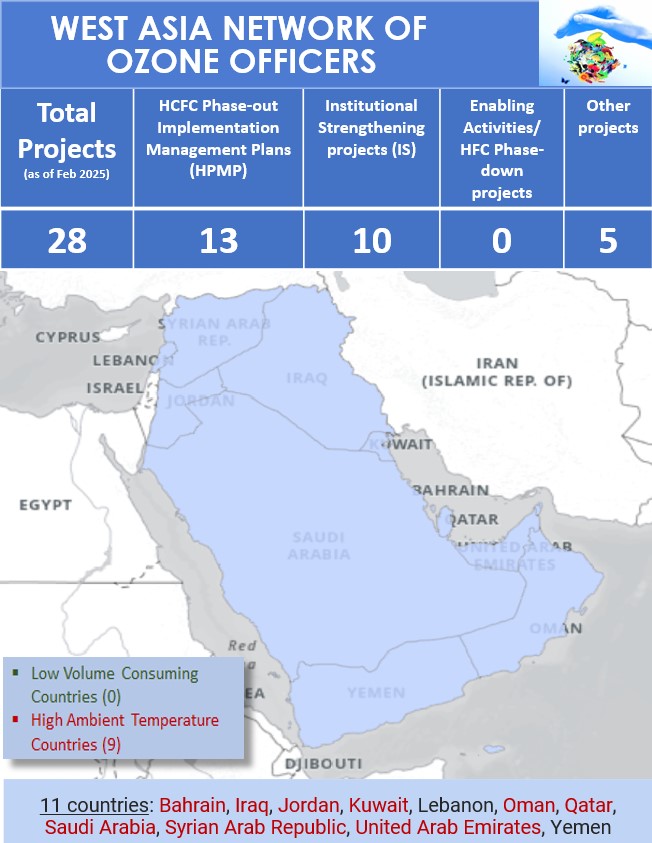
 The West Asia Regional Ozone Officers Network established in 1997 serves to enhance, strengthen and catalyze efforts among member countries to achieve and sustain compliance with the Montreal Protocol and its amendments. Our primary goal is the phase-out of Ozone Depleting Substances (ODS) and phase-down of hydrochlorocarbons (HFCsà as required und the Kigali Amendment in a timely manner while minimizing negative impacts on economic and social aspects. The West Asia region encompasses the following member countries: Bahrain, Iraq, Jordan, Kuwait, Lebanon, Oman, State of Palestine (observer), Qatar, Saudi Arabia, Syrian Arab Republic, United Arab Emirates and Yemen.
The Compliance Assistance Programme (CAP) team in West Asia, headed by a Montreal Protocol Regional Coordinator and supported by a Programme Officer and a Programme Assistant, provides policy and technical advice and services to West Asian countries. These services ensure sustained compliance under the Montreal Protocol and facilitate the achievement of forthcoming targets.
A key priority for each country is the timely implementation of phase-out projects to meet compliance targets. To support this, the Compliance Assistance Programme (CAP) provides a range of services essential for maintaining compliance and addressing regional concerns. We offer policy and legislative support, technological guidance, and help identify and adopt feasible alternatives suitable for the region's hot climate. This is all facilitated through regular regional network meetings, thematic workshops, and South-South cooperation initiatives tailored to meet the needs of each country and the region as a whole.
In addition, CAP ensures effective and timely support to member states by initiating and maintaining close coordination and cooperation at high national levels, as well as with regional and sub-regional organizations, secretariats, and associations. These partners include the Air-Conditioning, Heating, and Refrigeration Institute (AHRI), the League of Arab States (LAS), the Gulf Cooperation Council (GCC), the Regional Intelligence Liaison Office (RILO), the World Customs Organization (WCO), the American Society of Heating, Refrigerating, and Air-conditioning Engineers (ASHRAE), and EUROVENT Middle East. This collaboration ensures the full engagement of all stakeholders in delivering planned activities related to policy development, regulation, capacity building, and combating the illegal trade of controlled substances.
Adapting to Challenges: The Role of Digital Tools
In response to the COVID-19 pandemic, CAP West Asia adopted virtual platforms like webinars and e-learning to maintain support for our member states. These digital tools continue to be integral to our operations, ensuring project continuity and enhancing our overall resilience.
Priorities for CAP 2024-2026
In alignment with the 2024-2026 CAP Strategy, CAP West Asia's priority is to assist the region in meeting and sustaining compliance with its HCFC and HFC commitments under the Montreal Protocol and its Amendments. This will be achieved by providing the necessary support to network countries to effectively manage their national ozone programs, report accurate and timely data, establish and enforce effective legal, regulatory, and policy frameworks, and control imports and exports. The focus also includes reducing and preventing illegal trade, engaging key stakeholders and the public, promoting the adoption of appropriate lower-GWP and energy-efficient refrigeration and air conditioning technologies, ratifying the Kigali Amendment and developing related phase-down plans, and ensuring timely and effective implementation of Multilateral Fund projects.
Outcomes and Objectives
Within the strategic context of the 2024-2026 CAP Strategy, OzonAction CAP will work to achieve nine major outcomes. Each of these outcomes contributes to the overarching goal of sustainable ozone layer protection and climate change mitigation in the West Asia region. These outcomes will be delivered through a series of tailored outputs and activities over the next three years.
REGIONAL CONTACTS
Mr Khaled Klaly
Montreal Protocol Regional Coordinator for West Asia
OzonAction CAP team for West Asia