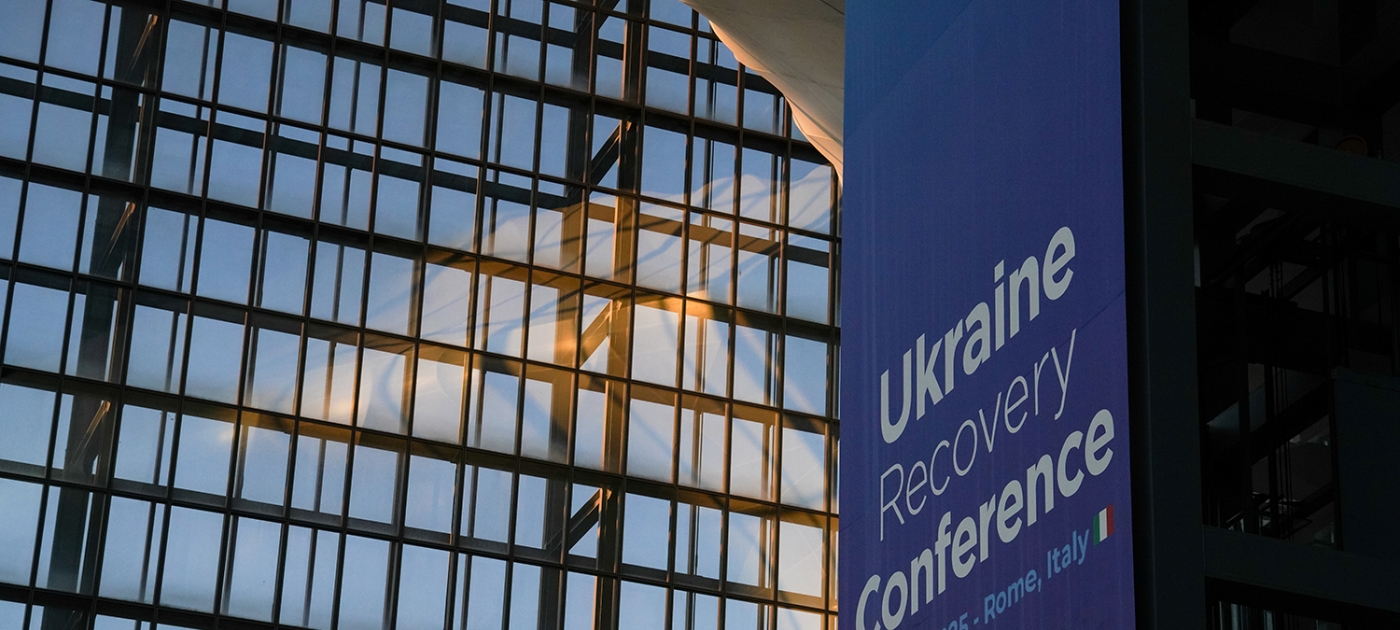
The 2025 Ukraine Recovery Conference, held in Rome on 10-11 July, focused on environmental restoration and sustainable infrastructure development, and resulted in the announcement of agreements and pledges worth US$10 billion.
The event brought together 15 Heads of State and governments, 6,000 participants, the United Nations Environment Programme (UNEP), European ministers, the Ukrainian government, and key European institutions, including the EU Commission, European Investment Bank, and the European Bank for Reconstruction and Development, to discuss Ukraine's green recovery.
The annual event serves as a critical forum for advancing international coordination, political leadership, innovative technical solutions and tangible commitments that will help shape Ukraine’s environmental recovery for years to come.
At the conference, several strategic partnerships were formalized, translating political commitments into practical recovery frameworks. Memoranda of Understanding were signed between UNEP and the key cities of Kharkiv and Mykolaiv, as well as the Odesa Region. These agreements establish formal cooperation mechanisms for sustainable district energy development initiatives covering renewable energy, municipal heating systems, and planning for distributed and resilient energy systems.
UNEP’s support to local authorities under the MoUs will include, for Kharkiv, comprehensive feasibility studies to demonstrate how fully decentralized and integrated heating and electricity systems can provide sustainable alternatives to traditional energy infrastructure. These studies represent more than theoretical; they offer technically and economically viable pathways for Kharkiv's sustainable urban heating recovery and modernization, with potential for replication in other conflict-affected urban areas.
Similarly, the assessment prepared for Mykolaiv provides a detailed evaluation of the city's current energy and water distribution systems, while identifying opportunities to integrate heat, electricity, and water distribution networks. This integrated approach holds the potential for significant reductions in emissions and costs as well as enhanced urban resilience, demonstrating how reconstruction efforts can achieve multiple objectives simultaneously.
UNEP announced the launch of three important publications to coincide with the conference, focused on providing science-policy guidance for Ukraine’s Green Recovery. The ‘Asbestos-containing Debris in Ukraine’ assessment addresses one of the country's most pressing environmental health challenges and provides technical guidance for safe reconstruction practices. Meanwhile, the ‘Sustainable Wastewater Management as a Pillar for a Sustainable Reconstruction of Ukraine’ report offers detailed technical recommendations for water infrastructure to recover. Finally, the Black Sea Environmental Impact Analysis provides a basis to assess environmental impacts of war across Black Sea marine and coastal ecosystems, as well as their potential impacts at the regional/cross-border level.
The convergence of high-level political commitment, technical innovation and international partnerships aims to contribute to an environmental recovery that positions Ukraine at the forefront of sustainable post-conflict reconstruction. The commitments and resources unveiled at the Ukraine Recovery Conference mark a major step forward and demonstrate that a resilient and lasting recovery lies in long-term planning, finance and technical innovation.
For more information contact james.dayani@un.org.