
A new report from the United Nations Environment Programme (UNEP) and the Intergovernmental Forum on Mining, Minerals, Metals and Sustainable Development (IGF) identifies over 100 Sustainability Standards and Initiatives operating across the minerals and metals value chains. The study finds that while the Sustainability Standards and Initiatives are increasingly used to promote environmental and social performance, their rapid proliferation has created a fragmented and often confusing landscape for governments, companies and communities.
The report, Stocktake of Sustainability Standards and Initiatives for Minerals and Metals: Leveraging Synergies Between Sustainability Standards and Initiatives and Public Instruments to Enhance Environmental Governance highlights that well-designed Sustainability Standards and Initiatives can complement—but cannot replace—strong public regulation. Credible and transparent initiatives have the potential to raise sustainability ambition, improve access to environmental data, support compliance and bring diverse stakeholders into decision-making. At the same time, the review warns that fragmentation, high compliance costs and limited relevance to producer-country contexts—particularly in the Global South—remain significant barriers to their effectiveness.
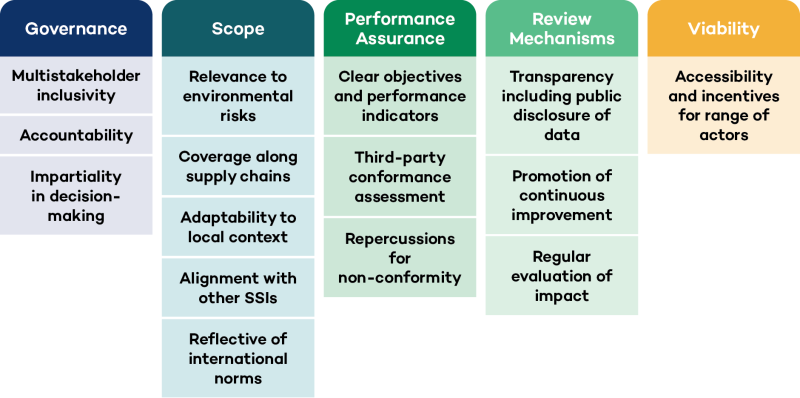
To help policymakers and standard setters differentiate between credible and weaker initiatives, the report identifies 15 hallmarks of effective Sustainability Standards and Initiatives, offering a practical reference point for assessing alignment with public governance objectives. Released at a time of surging global demand for minerals and metals driven by the energy transition and digitalization, the stocktake underscores the need for greater cooperation, interoperability and independent assessment of Sustainability Standards and Initiatives’ impacts.
Here is a closer look at Sustainability Standards and Initiatives and how they can support efforts to reduce the environmental footprint of the minerals and metals sector.
What are Sustainability Standards and Initiatives?
They are frameworks, systems, schemes or programmes designed to help actors across minerals and metals supply chains to meet and strengthen their sustainability performance. Unlike public instruments, such as laws or treaties, the Sustainability Standards and Initiatives are typically led by the private sector or multi-stakeholder partnerships.
Their number has doubled over the past two decades. With more than 100 in this sector alone, this diversity offers flexibility and innovation. However, it can also create a complex and fragmented landscape that confuse stakeholders and dilute the impact of Sustainability Standards and Initiatives.
Why did UNEP and IGF undertake this stocktake?
Driven by the energy transition, digitalization and infrastructure expansion, global demand for minerals and metals has raised pressure to ensure responsible sourcing. Yet governments, particularly in the Global South, face challenges assessing and integrating the growing number of private standards into public policy.
Building on three resolutions from the United Nations Environment Assembly (resolutions 6/5, 5/12, and 4/19) and as part of their 2024 Memorandum of Understanding, UNEP and IGF compiled the stocktake to clarify how Sustainability Standards and Initiatives interact with laws, regulations and policy commitments, and how they might enhance environmental governance rather than undermine it.
How can Sustainability Standards and Initiatives strengthen environmental governance?
When credible, transparent and aligned with public objectives, Sustainability Standards and Initiatives can be powerful tools for sustainability. The report highlights several opportunities:
- Integrating them into regulation as benchmarks or reference tools.
- Raising ambition by exceeding legal baselines on biodiversity, climate and social inclusion, etc.
- Supporting enforcement where public oversight is limited.
- Improving transparency through standardized reporting and open data.
- Fostering inclusive governance among governments, industry, communities (including women and youth groups) and Indigenous Peoples.
- Encouraging innovation in areas such as geo-traceability, circular economy and digital monitoring.
- Providing market-based incentives and fostering cross-border oversight.
What risks or limitations do Sustainability Standards and Initiatives face?
Despite their potential, Sustainability Standards and Initiatives carry significant challenges for integration into public instruments:
- Fragmentation and overlap among standards cause confusion and inefficiency.
- Compliance burdens can obstruct participation and marginalize artisanal and small-scale miners, especially in the Global South.
- Greenwashing risks emerge where verification is weak, thresholds are low or enforcement is lacking.
- Corporate dominance in governance structures can undermine impartiality.
- Limited government engagement and failure to adapt to local contexts weaken legitimacy.
- False substitution for regulation or incomplete issue coverage bothers as well.
What defines a credible Sustainability Standard and Initiative?
What are the next steps?
The report calls for independent studies on the costs, impacts and trade-offs associated with the implementation of Sustainability Standards and Initiatives, emphasizing evidence-based communication of benefits. It urges collaboration and interoperability among standard-setting bodies and recommends using multilateral platforms to foster dialogue and shared learning.
UNEP and IGF plan to advance this work through a community-of-practice to exchange experiences, promote coherent approaches and ensure that Sustainability Standards and Initiatives contribute effectively to sustainable mineral and metal governance worldwide.