
Pharmaceuticals play a critical role in maintaining human and animal health, enhancing food production, and driving economic prosperity. However, their release into the environment—whether during manufacturing, use, or end of life — may pose significant risks. These include contributing to antimicrobial resistance, endocrine disruption, and toxic effects on ecosystems and public health. Watch the video: The hidden pollution behind your pills
Active pharmaceutical ingredients (APIs) are the biologically active ingredients in a pharmaceutical product. About 4,000 active pharmaceutical ingredients are administered worldwide in prescription medicines, over-the-counter therapeutic drugs and veterinary drugs (UNEP, 2019).
Pharmaceutical residues are released into rivers, lakes, and groundwater aquifers. In addition, when applied in animal husbandry and where manure is used as a fertilizer, veterinary pharmaceuticals are released into the soil and wider environment. This results in both soil contamination and biomagnification through uptake of pharmaceuticals into food crops.
Sources of releases of pharmaceuticals to the environment include direct emissions from drug manufacturing, patient and animal excretion, aquafarming, and disposal of unused or expired medicines.

In 2016, a global literature review of studies that measured environmental concentrations of environmentally persistent pharmaceutical pollutants (including antibiotics, analgesics, lipid-lowering drugs, estrogens, and others) detected a total of 631 different pharmaceuticals or their transformation products in the environment of 71 countries; 16 of these were detected in all five UN regions (Umweltbundesamt, 2016). The list of countries and pharmaceuticals reported around the world continued increasing in the following years: an update of the database in 2020 evidenced up to 89 countries with reports of the presence of pharmaceuticals in the environment (Umbweltbundesamt, 2021).

Pharmaceutical residues released into the environment can cause direct and indirect effects on organisms and ecosystems, including toxicity, endocrine disruption, alterations of microbial communities, and the selection of antimicrobial resistance (AMR). While impacts on aquatic organisms are the most studied, severe consequences have also been documented in terrestrial species -such as the mass vulture die-offs linked to diclofenac- and in disruptions of key ecological functions. For humans, environmental exposure occurs mainly through water and food, with risks still poorly understood, compounded by indirect effects arising from ecosystem degradation and the spread of antimicrobial resistance.
Environmentally Persistent Pharmaceutical Pollutants (EPPPs)
What are EPPPs? Environmentally Persistent Pharmaceutical Pollutants (EPPPs) refer to pharmaceutical substances specifically designed to be slowly degradable or even non-degradable, to resist chemical degradation during passage through a human or animal body. They present a special risk, therefore, when they or their active metabolites or degradants enter, persist or disseminate in the environment. (SAICM 2015).
EPPPs were nominated as an emerging policy issue under the Strategic Approach to International Chemicals Management (SAICM) at the fourth session of the International Conference on Chemicals Management (ICCM 4) in 2015. Stakeholders resolved to implement cooperative action to increase awareness and understanding among policymakers and stakeholders and to generate and share information to fill identified knowledge gaps (ICCM 4 Resolution IV/2 part III). The resolution calls for coordinated approaches, including among Inter-Organization Programme for the Sound Management of Chemicals (IOMC) agencies, to provide consistent and evidence-based assistance to governments.
In 2023, the ICCM 5 held in Bonn (Germany), adopted the Global Framework on Chemicals (GFC) as a successor of the SAICM. As per resolution V/5, all existing emerging issues under SAICM, including EPPPs and EDCs, transitioned on an interim basis to "issues of concern" under the GFC until the next session of the Conference (in 2026) at which time the Conference will determine their fate (GFC, 2024).
What is UNEP doing on the topic?
- UNEP is working on the pharmaceuticals in the environment topic. Also, as one of the relevant IOMC participating organizations, UNEP is particularly addressing EPPPs in the context of GFC, through the development of technical material and consultation with interested stakeholders.
- UNEP has been working with WHO to develop global best practices and guidance to facilitate early action at key life cycle stages, with financial support from the GEF. In this context, UNEP is also coordinating a series of outreach events and the preparation of knowledge products and communication materials, with funding from the GEF as well as the Government of Sweden.
- The Latin American Subregional Consultation: “Advancing a response to pharmaceuticals in the environment in the context of the Global Framework on Chemicals (GFC)” was held in Bogotá, Colombia, in October 2025.
The Addressing Pharmaceuticals in the Environment through a Lifecycle Approach Event Series is co-organized by the United Nations Environment Programme in cooperation with the World Health Organization and the Geneva Environment Network to raise awareness and share best practices, challenges and opportunities to address pharmaceuticals release into the environment. Topics such as preventive measures, innovation, waste and wastewater management are addressed during the webinars, with the participation of stakeholders of governments, IGOs, NGOs, academia and the private sector.
Safe Disposal of Unused Medicines – A One Health Approach for National Systems
Unused medicines arise from multiple factors, such as changes in treatment, over-prescription, non-adherence and supply mismanagement across both human and veterinary sectors. These challenges are increasingly recognized in countries’ National Action Plans on AMR and global policy discussions. Nevertheless, the absence of a coordinated and holistic approach continues to hinder the effective implementation of safe disposal practices, contributing to environmental pollution and public health risks.
In response, UNEP has developed the guidance Safe disposal of unused medicines - A One Health approach for national systems. The guidance provides a systematic, comprehensive and multisectoral framework to support countries in strengthening national systems for the safe disposal of unused human and veterinary medicines.
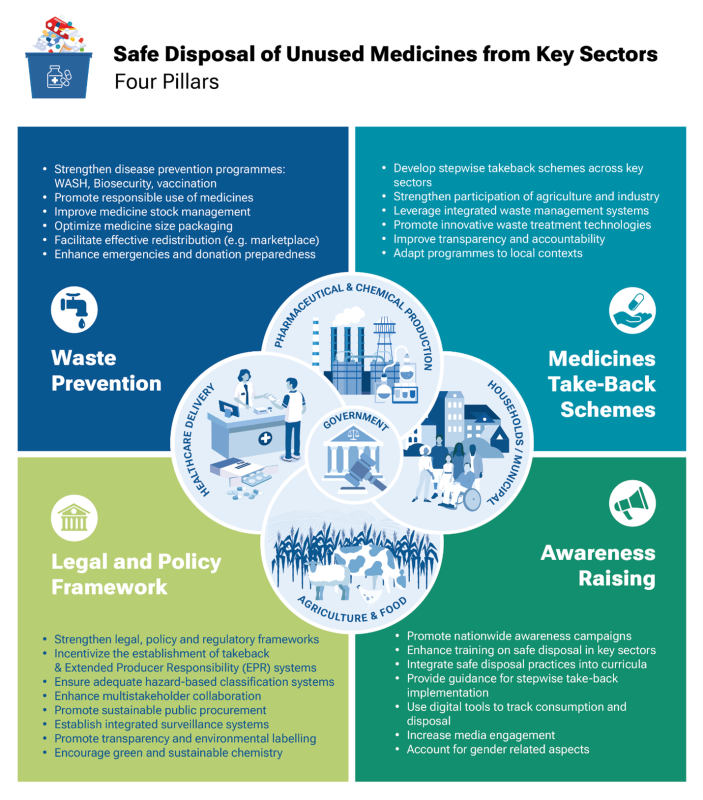
Grounded in a One Health approach, the guidance emphasizes the interconnections between human health, animal health and the environment. It focuses on key sectors—healthcare, agriculture, pharmaceutical industry and households—and is structured around four foundational pillars:
- Waste prevention
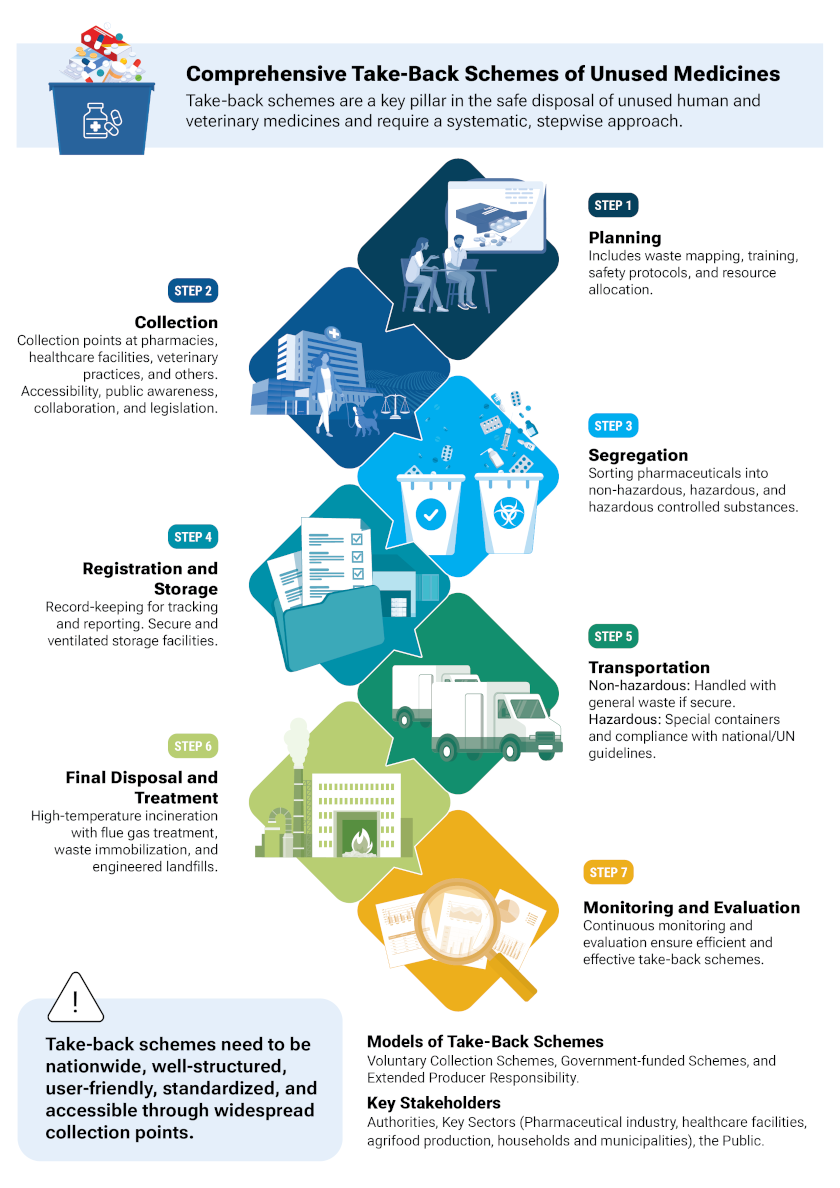
- Comprehensive take-back schemes
- Legal and policy frameworks
- Awareness-raising
The guidance also offers stepwise approaches, practical examples and enabling conditions to support implementation across diverse national contexts.
Further Resources
Safe disposal of unused medicines - A One Health approach for national systems UNEP, March 2026
Addressing Pharmaceuticals in the Environment through a Lifecycle Approach Event Series
Environmentally persistent pharmaceutical pollutants UNEP Factsheet, December 2022
Safe management of pharmaceutical waste from health care facilities: global best practices, WHO, February 2025
Guidance on wastewater and solid waste management for manufacturing of antibiotics, WHO, September 2024
Guidelines for Sustainable Procurement of Healthcare Commodities and Services UNDP, March 2020
Global Chemicals Outlook II UNEP, 2019