
Overview
The world faces three major environmental crises: climate change, pollution, and biodiversity loss. Innovative digital tools powered by diverse data sets are emerging to tackle these challenges. However, significant barriers remain in leveraging environmental data for decision-making due to ecosystem fragmentation, lack of interoperability, and access limitations.
In response to UN Environment Assembly resolution 4/23, UNEP developed the Global Environmental Data Strategy (GEDS), submitted to UNEA-7 in December 2025 as an Information Document (UNEP/EA.7/INF/5). Informed by over 40 consultations engaging more than 500 stakeholders — including Member States, UN entities, scientific networks, standards bodies, and the private sector — GEDS provides a voluntary, enabling framework to strengthen environmental data ecosystems at national, regional, and global levels. It does not create new reporting obligations or standards, but seeks to reduce fragmentation, lower costs, and maximize the value of data that countries already generate.
GEDS implementation is now underway, with the first phase in 2026 focusing on the development and piloting of the Environmental Data Capacity (EDC) Toolkit to help governments translate GEDS principles into practical country-level action.
GEDS framework
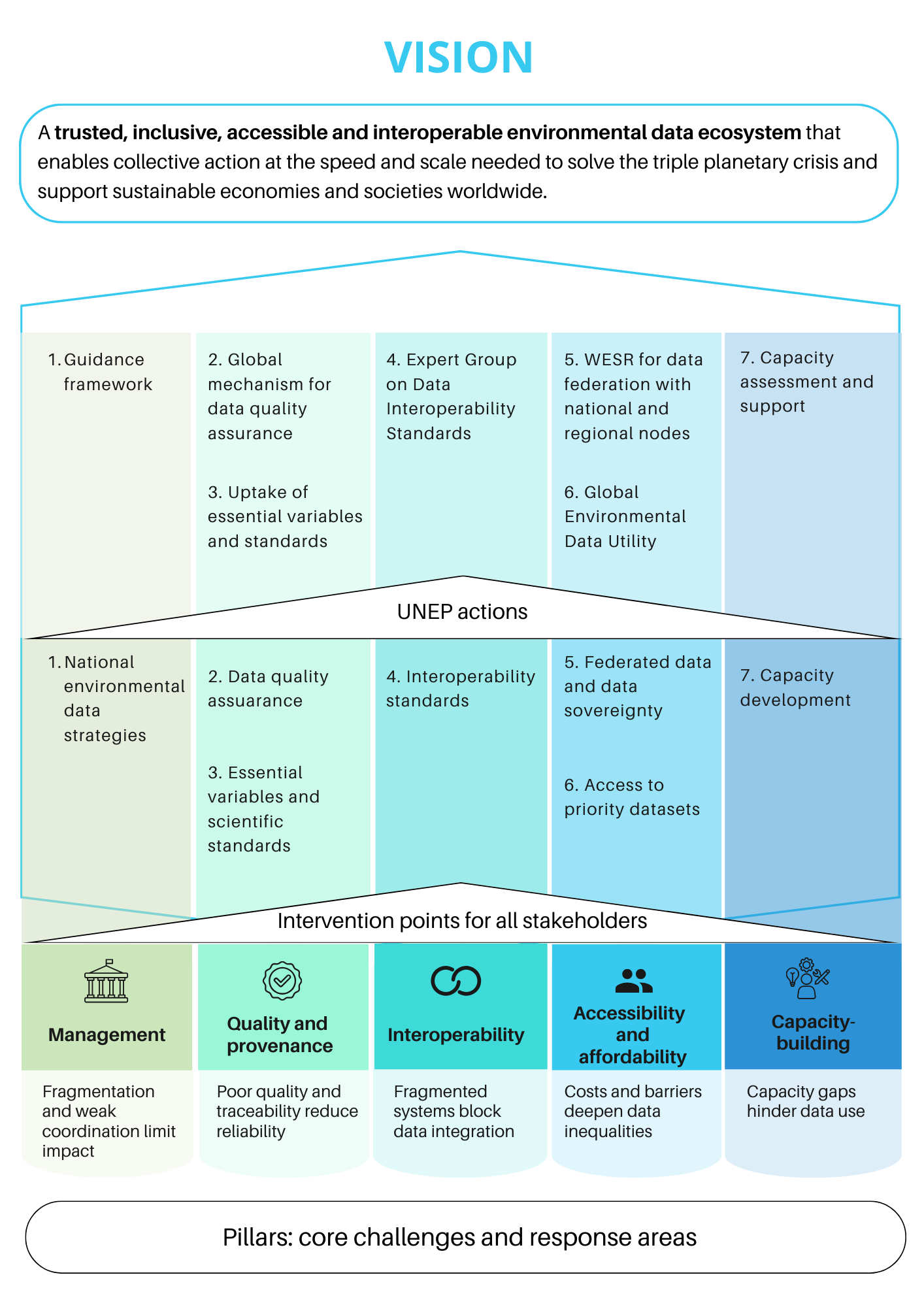
GEDS is organized around five interlinked pillars that define the core challenges in the global environmental data ecosystem:
- Data management — strengthening the policies, institutions, and practices that ensure environmental data is governed transparently and sustainably.
- Quality and provenance — improving the consistency, documentation, and traceability of environmental data to support reliable decision-making.
- Interoperability — enabling data to be discoverable, accessible, and reusable across fragmented systems and standards.
- Accessibility and affordability — addressing cost and access barriers to ensure environmental data is available to all, including Global South countries.
- Capacity-building — developing the human, institutional, and technical skills needed to collect, manage, and use environmental data effectively.
Building on these pillars, GEDS identifies seven strategic intervention points where targeted, coordinated action by UNEP and partners can unlock significant progress toward the GEDS vision by 2030.