Accelerating energy efficiency improvements can deliver over a third of all carbon dioxide (CO₂) emission reductions between now and 2030 (IEA, 2024).
The Digital Demand-Driven Electricity Networks Initiative (3DEN) helps countries use digital tools to make their energy and agri-food systems more efficient, accessible, and clean.
Launched in 2021 with the support of the Italian Ministry of Environment and Energy Security, the International Energy Agency (IEA), and UNEP, 3DEN supports pilot projects and offers technical and regulatory guidance that turn data into action – proving that energy efficiency can be a force for climate progress.
3DEN accelerates energy efficiency through digitalization. By working with private companies on the ground, it helps generate real data, shape better policies, build markets for scale, and uncover new ways to solve energy challenges.
-
Vision
3DEN believes that in times of rapid change, a different way of doing cooperation is necessary. 3DEN starts with implementation, which serves to gather on-the-ground market data on proven business models, then proves scalability and policy potential. It keeps feet on the ground, working directly with utilities, tech companies, farmers, and communities. And it is built to scale: every pilot is designed to be copied, adapted, and replicated across countries.
3DEN focuses on three areas that must move together: technology (smart grids, digital twins, AI, IoT), finance (blended finance, public-private partnerships, co-financing), and regulation (data governance, cybersecurity, demand-side policies).
-
Pilot projects
From grid digital twins in India to gamified demand-response apps in Brazil, 3DEN invests in real-world solutions that make energy systems smarter, more resilient, and more accessible.
3DEN supported four pilot projects that demonstrated how digital tools can make energy systems smarter, more inclusive, and more efficient. In India, a digital twin of the electricity grid gave utilities real-time visibility to reduce outages, cut energy waste, and lower costs for thousands of consumers. In Brazil, social housing residents received smart digital tools and a gamified app to manage their energy use, turning passive consumers into active prosumers. In Morocco, a leading bottled water company installed advanced energy monitoring systems powered by AI, enabling real-time industrial optimization. In Colombia, the country's first demand-response initiative engaged over 100,000 users to relieve grid congestion, prevent blackouts, and delay costly infrastructure upgrades ([case study link]). Together, these pilots avoided hundreds of thousands of tonnes of CO₂ emissions and reached over 140,000 beneficiaries.
Ongoing projects
Fourteen projects were selected and announced at COP30 in Belém, Brazil, representing a combined investment of USD 28.6 million. Implementation began in summer 2026. The work now spans both urban energy systems and agri-food solutions – from smart grids to precision irrigation and solar cold storage – across eight countries: Brazil, Ethiopia, Kenya, Morocco, Nigeria, South Africa, Tanzania, and Tunisia.
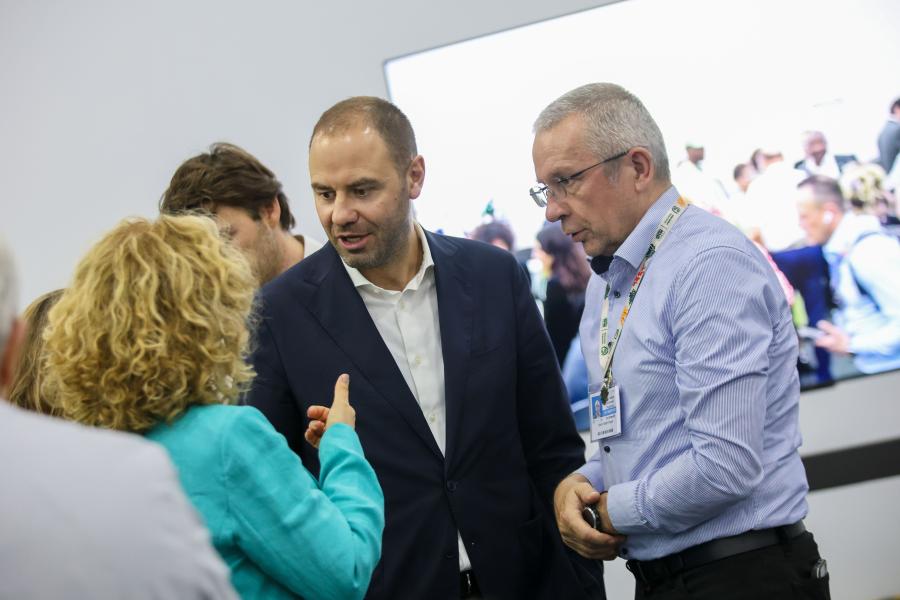
Alessandro Guerri, Director General, Ministry of Environment and Energy Security, Italy, and Martin Krause, Director, Climate Change Division, UNEP. Photo: IISD
-
Call for proposals
A new call for applications is coming soon.
Utilities, tech companies, agribusinesses, and consortia will be invited to bring forward proposals for digital solutions in energy and agri-food systems.
Register now and be the first to apply.

With the support of: