There is a long history of TEEB applications in India that have been undertaken for a range of ecosystems, including forests, inland wetlands, coastal and marine ecosystems, and agricultural ecosystems. More recently, the focus has been on agricultural systems — including applications on organic farming, agroforestry, and community-managed natural farming — by applying the TEEBAgriFood Framework to assess their environmental, social, and economic impacts in a more holistic way.
Wheat Production Systems in Northern in India (2017 - 2022)
Organic Farming and Agroforestry in India (2019 - 2023)
Key Achievements
Some of the key milestones achieved over the previous project phase included:
- All India Network Programme on Organic Farming in India (AI-NPOF), run by the Indian Council of Agricultural Research (ICAR), promotes organic farming by generating research on organic farming across 20 collaborating centers across India covering 16 Indian States.
- At the 19th AI-NPOF meeting, ICAR released the Framework for Assessment of Ecosystem Services in Organic and Natural Farming Systems, in which the TEEBAgriFood Framework is prescribed as the core methodology.
- Assessment undertaken under the AI-NPOF programme informs the implementation of Paramparagat Krishi Vikas Yojana (PKVY), the Ministry of Agriculture and Farmers’ Welfare (MoAFW) major programme on organic farming, and the National Mission on Natural Farming (NMNF) across India. 2.47 million farmers have been enrolled under PKVY nationally. Additionally, NMNF plans to implement natural farming across 15,000 clusters, aiming to reach 10 million farmers with a target area of 750,000 hectares.
- TEEBAgriFood has been included in the BSc (Hons) in Natural Farming introduced by ICAR and offered in 4 Central Universities and 51 State Agriculture Universities.
- G20 – supported the Environment Working Group on the thematic area of land restoration during India’s Presidency in 2023. TEEB Framework included in the G20 Compendium of Best Practices on Land Restoration.
- Revision of the guidelines of Rainfed Area Development scheme of MoAFW to include assessment of impact based on capitals approach to educate farmer groups on the holistic benefits of adoption of Integrated Farming System (IFS) and Integrated Organic Farming Systems (IFOS) models.
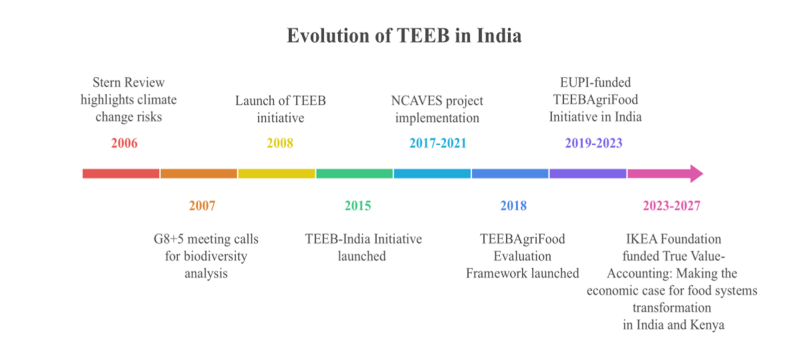
Based on this work, the TEEBAgriFood Initiative in India has entered a next phase, funded by the IKEA Foundation (2023 -2027).
Scope of work
The IKEA Foundation is supporting a four-year TEEBAgriFood project in India (2023–2027) to make the economic case for sustainable food systems by applying the True Value Accounting approach. The initiative focuses on organic farming and agroforestry in Uttar Pradesh, Uttarakhand, and Assam, strengthening public and private sector action through evidence-based policy support and capacity building.
Public Sector Workstream
The IKEA Foundation phase aims to make the economic case for pro-nature policies to achieve the given outcomes:
- Supporting the government in formulating policy measures for sustainable food systems by providing evidence-based recommendations from TEEBAgriFood studies to inform decision-making.
- Equipping farmers, local communities, civil society organizations, and the media to advocate for best agricultural practices, strengthening collective efforts to transform food systems in alignment with government goals.
- Collaborating with agri-businesses to assess their environmental and social impacts using the TEEBAgriFood Framework.
Within the public sector workstream, assessment and valuation studies will capture different elements under the four capitals while considering future policy scenarios. The insights generated at the farm and landscape level will directly inform and strengthen existing as well as emerging policies (detailed in the next section). Building on this evidence base, the workstream deepens engagement with farmer collectives, civil society, and government institutions to co-create an adaptive Theory of Change that aligns with national and state priorities.
To ensure wider relevance, assessments are being carried out across diverse agro-ecologies in three states, enabling comparability and robust cross-state insights. In so doing, the project also contributes to the request of the PSC to mainstream the project outcomes nationally. Beyond farm-level assessments, the IKEA Foundation phase broadens the scope of analyses to include value chain perspectives, linking to government initiatives such as One District One Product and policies like PKVY, RKVY, MoVCDNER, and NAP, with a focus on organic practices and agroforestry.
At every stage, the approach emphasizes iterative policy dialogue- through workshops, field visits, roundtables, and tailored communication- ensuring that evidence translates into actionable measures. By strengthening the capacities of decision-makers, farmers, and communities, the project encourages a shift from yield-centric perspectives to holistic valuations of food systems, embedding ecosystem services into India’s agricultural decisions.
Private Sector Workstream
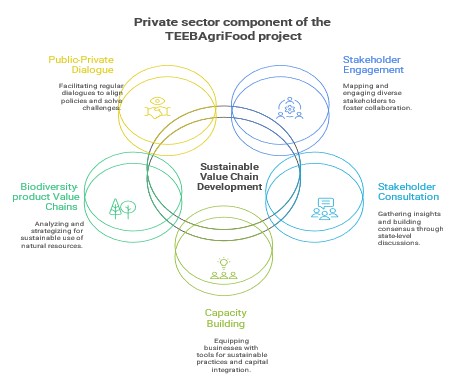
The private sector component builds on initial engagements under the EUPI phase, where large businesses were introduced to the Capitals Approach. In the current phase, this engagement is expanded and deepened to enable large, medium, and small agribusinesses, Farmer Producer Organisations (FPOs), and related enterprises to practically integrate capitals thinking into their operations. More information can be found at: https://c4rb.org/applying-capitals-approach-in-business-decision-making-for-sustainable-agri-food-sector/.
The project undertakes systematic stakeholder mapping in organic farming and agroforestry value chains across the three states- including agribusinesses, industry associations, certification agencies, NGOs, and government actors. This mapping informs targeted consultations and capacity-building workshops, equipping participants with tools to assess impacts and dependencies across natural, social, and human capital, while identifying opportunities for improved profitability and sustainability. Continuous technical assistance and handholding ensure enterprises can apply these tools effectively in their operations.
By analysing barriers and opportunities in biodiversity-dependent value chains (eg timber, bamboo, MAPs, NTFPs, eco-tourism, and ancillary activities), the project develops strategies with policy recommendations that strengthen community livelihoods. Commodity-specific assessments, including post-production analysis, are linked to national initiatives like One District One Product, ensuring alignment with government priorities.
Regular public- private dialogues foster convergence between policy and practice. Selected FPOs and enterprises pilot the Capitals Approach end-to-end- from impact mapping and risk assessment to market linkages, financing, storytelling and brand enhancement. Through this, the private sector workstream not only enhances enterprise resilience and competitiveness but also supports India’s broader transition toward equitable, nature-positive food systems.
Policy mainstreaming - Next steps:
Based on further granular analytical work and stakeholder engagement in this phase, the project aims to make significant inroads into national policies, contributing to the development of strategic frameworks and initiatives as directed by PSC and Ministries.
- Downscaling of evaluations to the landscape/cluster level – this will entail closer interaction with farmer clusters FPOs and SHGs to instil best practices and valuation therefrom.
- Maximise application in different agro-climatic zones of project States to allow for mainstreaming of results across wider geographies
- Development of the Operational Guidelines and implementation of the scheme for Climate Resilient Agriculture (CRA). The vulnerable districts identified under the National Innovations in Climate Resilient Agriculture (NICRA) will be a focus for the project sites in the three States.
- Inputs to the Voluntary Carbon Market (VCM) Framework for the Agriculture Sector, launched in January 2024, TEEBAgriFood assessments will contribute towards assessing co-benefits and shaping Indian standards for carbon sequestration and emissions methodologies, particularly for small and medium farmers. Furthermore, the National Mission on Natural Farming (NMNF), launched in November 2024, seeks to transition 10 million farmers toward chemical-free practices by 2026.
- TEEBAgriFood aims to support MoAFW through documentation of traditional farming best practices in project states. As per the request of States, the project shall also study the impact of natural farming. MoAFW has requested for conceptualising a Payment for Ecosystems Service pilot based on sustainable agriculture. The Indian Institute of Forest Management (IIFM) with its rich experience of valuation has been contracted by UNEP to look at this.
-
UNEP will assist MoEFCC in developing the guidelines for operationalisation of the sustainable agriculture-based credits under the Green Credit Programme, aiming at the promotion and adoption of sustainable forms of agriculture which will focus on retaining the quality of the crops as well as the soil.
Project Resources
TEEBAgriFood India Initiative - Project Brief