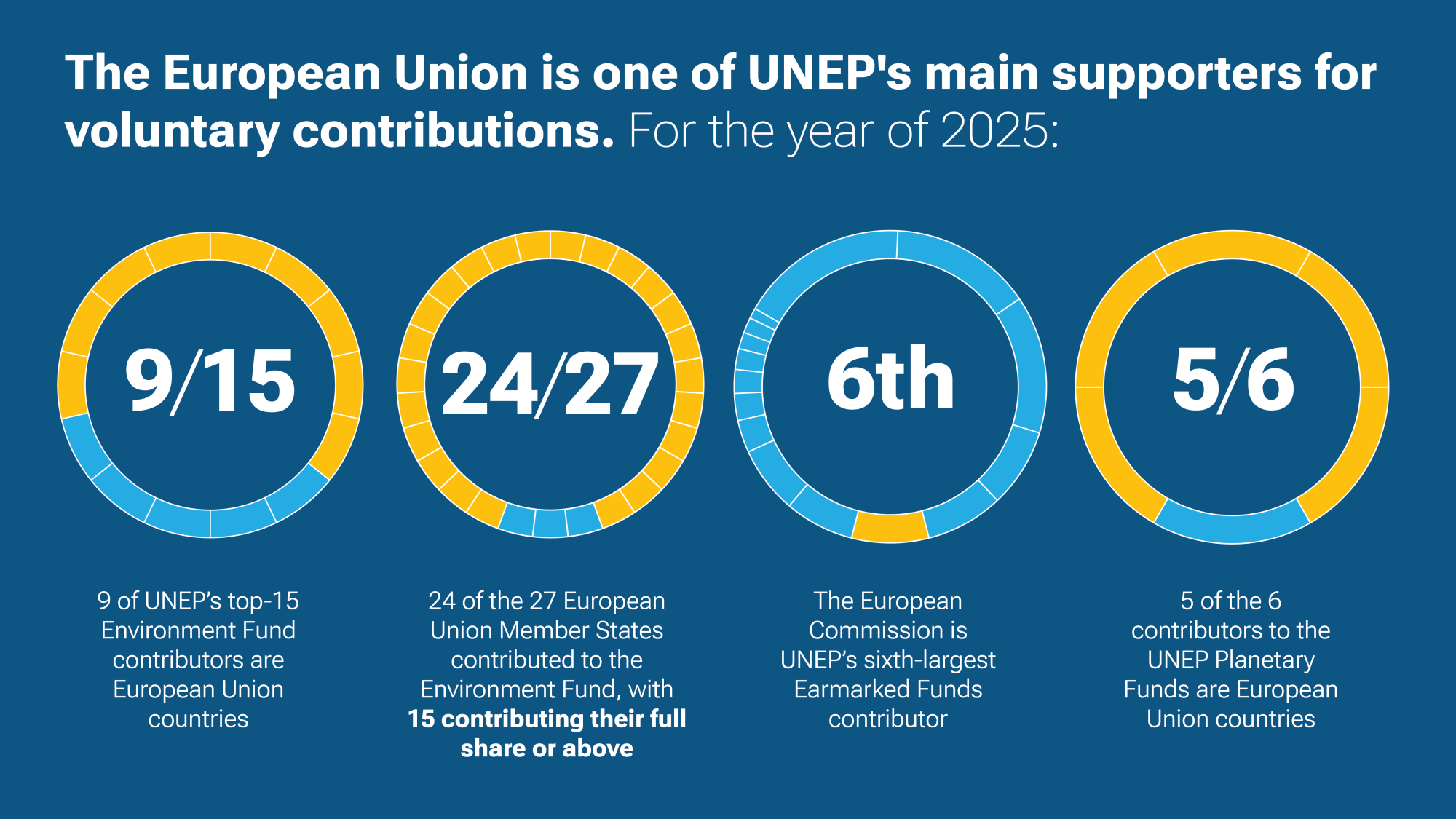

The European Union (EU) and its Member States provide important political and financial support to the UN Environment Programme (UNEP) for our programmes around the world.
UNEP and the EU are active partners in establishing, implementing and evaluating international environmental policies. The European Union and its Member States are contracting parties to and keen supporters of a large number of Multilateral Environmental Agreements (MEAs), some of which are administered by UNEP. The European Commission (EC) has taken a prominent role in such agreements, including the Climate Change Convention and its Kyoto Protocol, the Montreal Protocol, the Convention on Biological Diversity, the Basel, Rotterdam and Stockholm Conventions and a number of regional agreements.
As a proponent of international environmental governance, the EU has also been very supportive in strengthening UNEP’s role as “the leading global environmental authority that sets the global environmental agenda, promotes the coherent implementation of the environmental dimension of sustainable development within the United Nations".
The EU participates biennially, alongside its Member States, in the meetings of the UN Environment Assembly, the world’s highest-level environmental decision-making body, to set priorities for global environmental policies and to develop international environmental law.
UNEP and the EC have a strong and long-standing partnership both on a policy dialogue and programmatic cooperation. UNEP and the EC have worked together since UNEP’s creation in 1972 and further strengthened their relationship through the agreement of a Memorandum of Understanding (MoU) in 2004. The agreement enhanced the ability of both organizations to jointly contribute to the strengthening of the environmental dimension of sustainable development and poverty eradication in the context of implementing the Sustainable Development Goals. The MoU is implemented through annual High-Level Policy Dialogues, which are underpinned by regular technical meetings. A revised Annex to the MoU is in place as of 2026.
An MoU signed on 28 March 2025 between UNEP and the European Environment Agency (EEA) establishes a formal framework for cooperation between the two organizations on environmental knowledge, assessments, data systems and policy support. The agreement is designed to strengthen collaboration in areas where UNEP and the EEA have complementary mandates, including:
- Environmental and climate assessments and foresight;
- Data sharing and environmental information systems;
- Biodiversity, pollution, climate change and circular economy knowledge products;
- Support for implementation and monitoring of global environmental agreements and frameworks;
- Capacity-building and cooperation with partner countries and regional networks; and
- Improved interoperability of environmental data and indicators.
UNEP and the European Investment Bank signed an MoU on 2 March 2020, with the common objective of strategic cooperation on climate change, conservation, protection, enhancement and support of nature and natural resources, including biological diversity worldwide and circular economy.
UNEP and the European Committee of the Regions (CoR) signed an MoU on 22 June 2012, on the margins of the Rio+20 Conference in Rio de Janeiro. The agreement aimed to place cities and regions at the center of sustainable development and environmental governance. In January 2025, UNEP and the CoR signed a Joint Action Plan (2025–2030) to operationalize and update cooperation under the MoU. The action plan focuses on:
- Climate mitigation and adaptation;
- Pollution reduction;
- Nature restoration and biodiversity protection;
- Localization of the Sustainable Development Goals; and
- Greater engagement of local and regional governments in international environmental processes.
UNEP and the European Space Agency (ESA) signed an MoU on 3 December 2023 to cooperate on using Earth observation data and technology for the environment.