• Overview
  • Why this matters
  • Sectors & Impacts
  • Roadmap
  • Tools & Guidance
  • Synergies in Action
  • Resources

Pollution is jeopardizing ecosystems and human health, whether through contaminated air, soil and water, or exposure to harmful chemicals and waste.

Biodiversity, as defined under the Convention on Biological Diversity, means the variability among living organisms from all sources, including terrestrial, marine and other aquatic ecosystems, and includes diversity within species, between species and of ecosystems (Convention on Biological Diversity, 1992). Ecosystem functions and services are closely linked to biodiversity: they describe the ecological processes and benefits that living systems help maintain, such as pollination, soil fertility, water purification, food-web stability and climate regulation (Millennium Ecosystem Assessment, 2005; IPBES, 2019).  

Chemical pollution is a direct pressure on biodiversity because pollutants released to air, water, soil and waste streams can contaminate habitats, bioaccumulate through food webs, harm species, reduce ecosystem resilience and is recognized by the Convention on Biological Diversity (CBD) as one of the main drivers of biodiversity loss.  

This Hub supports countries in connecting NBSAP implementation, KMGBF Target 7 and relevant chemicals and waste MEAs to reduce pollution risks and impacts to levels that are not harmful to biodiversity, ecosystem functions and services (Convention on Biological Diversity, 2022).

It connects the KMGBF, the Global Framework on Chemicals (GFC), and relevant MEAs into a single resource for national focal points, policy makers and practitioners. 

What this Hub provides
  • Overview of linkages: A concise overview of how chemical pollution and biodiversity loss are connected through sources, releases, pathways and impacts.
  • Sector-specific impacts: A practical view of key sectors, pollutant groups, biodiversity and health impacts, and selected KMGBF targets and MEA frameworks.
  • Indicators, tools and custodians: Sectoral indicators and linked data sources, tools and custodians to help national teams identify evidence, monitor progress and align reporting.
  • Synergies in action: Key milestones, country examples and cooperation processes supporting coherent implementation across biodiversity, chemicals and waste MEAs.
  • Roadmap and implementation guidance: Step-by-step roadmap to help countries integrate chemical pollution into NBSAP priorities, actions and reporting processes.
Who is this Hub for?
  • National MEA focal points (CBD, BRS, Minamata, UNFCCC) and government representatives involved in NBSAPs, NIPs and NAPs 
  • MEA secretariats supporting ongoing synergetic work on chemicals pollution and biodiversity 
  • IGOs, academia, NGOs and civil society involved in chemicals and biodiversity work 
  • Practitioners working on national reporting and indicator alignment across frameworks

How do sources, releases, pathways, and impacts connect together?
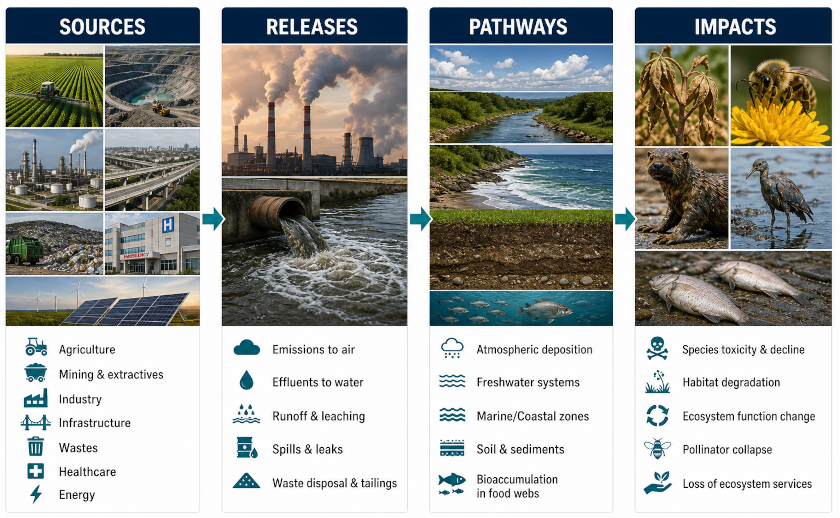
How do sources, releases, pathways, and impacts connect together?

Policy Framework

KMGBF Target 7 

Adopted at CBD COP15, Target 7 calls for reducing pollution risks to levels that are not harmful to biodiversity by 2030. COP decision 16/35 explicitly invites chemicals conventions to collaborate on Target 7 implementation.

BRS Conventions 

Basel, Rotterdam and Stockholm Conventions collectively reduce pollutants threatening species, habitats and food webs. Decisions BC-16/22, RC-11/9, and SC-11/21 formally adopt the Global Biodiversity Framework.

Global Framework on Chemicals (GFC)

Adopted at ICCM5, the GFC oversees sound management of chemicals and waste towards a 'Planet Free of Harm.' Resolution V/6 calls for close MEA interactions, including strengthening linkages between chemicals and biodiversity agendas.

Minamata Conventions

Decision MC-5/17 highlights interconnected challenges of mercury pollution and biodiversity loss, advocating coordinated implementation to generate co-benefits. National Action Plans (NAPs) on ASGM increasingly underscore biodiversity linkages.

How to use this Hub

01
Understand the issue
Start with the pollution pathway & the explanations of how chemicals drive biodiversity loss.

02
Explore sector dynamics
Use Sectors & Impacts to understand where pollutant pressures arise and which impacts and frameworks are most relevant.

03
Access indicators and tools
Use Tools & Guidance to find sector-specific data, sources, tools and custodians.

04
Use roadmaps for planning
Apply the six-step roadmap to translate sector findings into NBSAP priorities, actions and reporting.

05
See collaboration and resources
Use Synergies in Action & Resources to identify ongoing processes, case studies and cross-MEAs support.
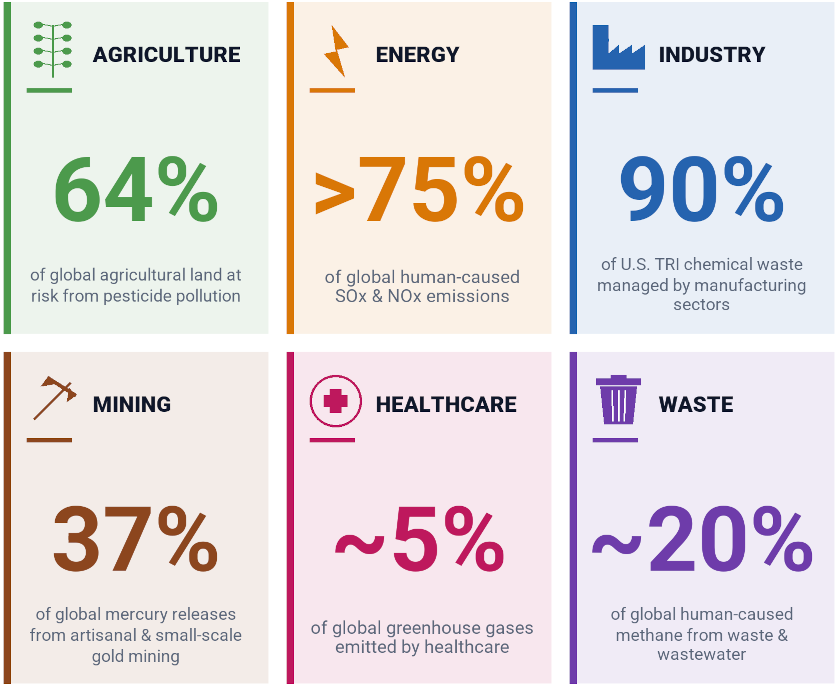
Chemical pollution is considered by the CBD as one of the main drivers of biodiversity loss.

Chemicals used across sectors such as mining, agriculture, industry and healthcare — and their resulting emissions and releases — disrupt the natural cycle of ecosystems and surrounding species, leading to the reduction of ecosystem services.

The scale of chemical production continues to grow without adequate safeguards. Global agricultural production significantly increased 2010–2023, implying continuous agrochemical use with direct biodiversity consequences. 

$5T
Global chemicals market in 2017, projected to double by 2030 
UNEP GCO II, 2019

3.69M t
Agricultural pesticide use worldwide in 2022, steadily increasing
FAO, 2024

20M+
People in Artisanal and Small-scale Gold Mining that use mercury across 80+ countries
UNEP/Minamata

153%
Pesticide use in low-income countries estimated to have increased by 153% over the last decade
Wyckhuys et al., 2023

Sectoral Pollutant Pressures

sectoral pollutant pressure

The Case  for Action

Direct Driver of Biodiversity Loss

Pollution is identified in international agreements as a direct driver of species decline. Pesticides reduce pollinator populations; mercury bioaccumulates in aquatic food webs; POPs degrade soils and disrupt food chains across ecosystems. 
IPBES Global Assessment, 2019; CBD

KMGBF Target 7 Mandate

Target 7 commits all Parties to reduce pollution risks to biodiversity by 2030. CBD COP decision 16/35 explicitly invites chemicals conventions and the GFC to collaborate on implementation. 
CBD COP15 Decision 15/4; COP16 Decision 16/35

Triple Planetary Crisis

The GFC was adopted to address the interconnected crisis of climate change, pollution and biodiversity loss Through preventing harm from chemicals and wastes, it aligns with the KMGBF to protect ecosystems. 
ICCM5 Resolution V/6

Co-benefits for Health & Nature

Joint chemicals—biodiversity action yields co-benefits: reducing mercury in ASGM protects both miners' health and aquatic ecosystems. Minamata Decision MC-5/17 advocates coordinated implementation to generate such co-benefits. 
Minamata COPS Decision MC-5/17

"Reduce pollution risks and the negative impact of pollution from all sources, by 2030, to levels that are not harmful to biodiversity and ecosystem functions." 
KMGBF Target 7, Kunming-Montreal Global Biodiversity Framework (CBD COP15, 2022) 

Sectors, Pollutants & Biodiversity Impacts

Summarization of sectors dynamics, key chemicals and pollutants as well as biodiversity and health impacts.

How Key Sectors Drive Biodiversity Loss
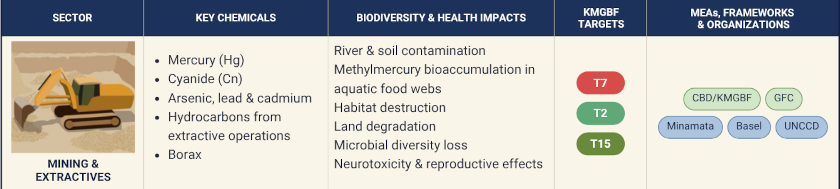
Mining & Extractives
Impact of mining and extractive sector on biodiversity

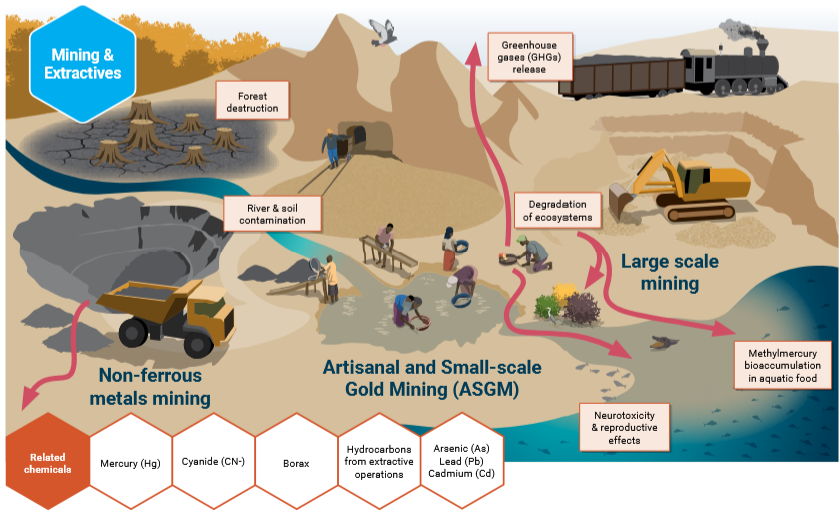
Includes large-scale mining, ASGM, other metals, artisanal small scale gold mining and non-ferrous metals mining. Mercury, cyanide and borax cause deforestation, land degradation, methylmercury bioaccumulation in aquatic food webs, DNA mutations from long-term heavy metal exposure, and disruption of wildlife reproduction in fish-eating birds and mammals.

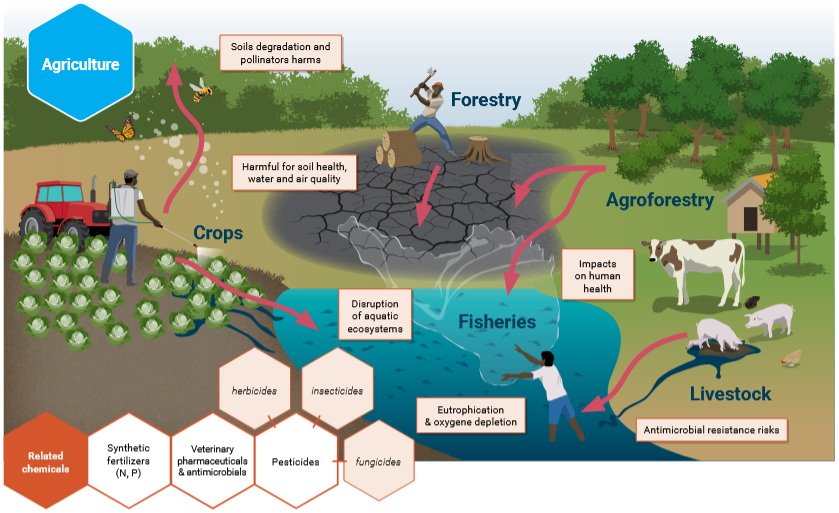
Agriculture
Impact of agriculture sector on biodiversity

Covers fisheries, crops, animals, forestry and agroforestry. Pesticides (herbicides, insecticides, fungicides) and fertilizers degrade soils, harm pollinators and beneficial organisms, deplete oxygen in aquatic ecosystems, and cause neurological, endocrine and reproductive impacts on humans — especially agricultural workers.

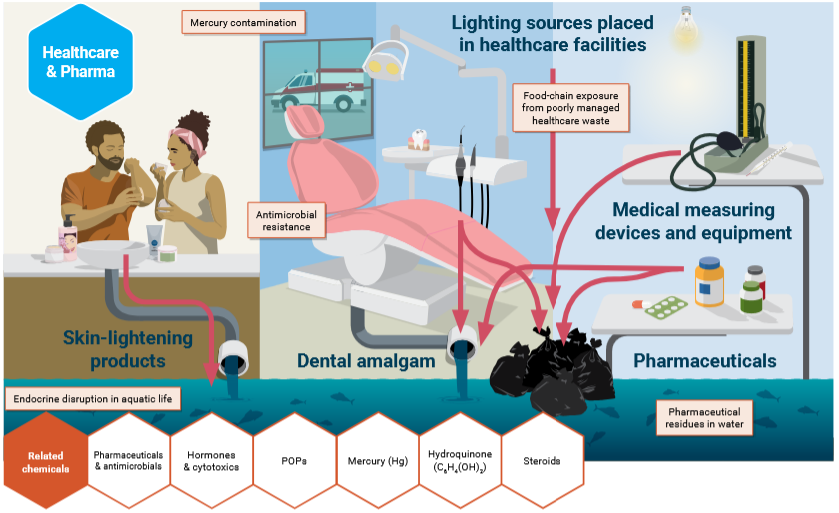
Healthcare & Pharma
Impact of healthcare and pharma sector on biodiversity

Pharmaceuticals, skin-lightening cosmetics, medical measuring devices, dental amalgam and lighting sources release mercury, hydroquinone and POPs. Mismanagement of medical waste releases hazardous residues into water and soils, bioaccumulating in aquatic ecosystems and causing endocrine disruption.

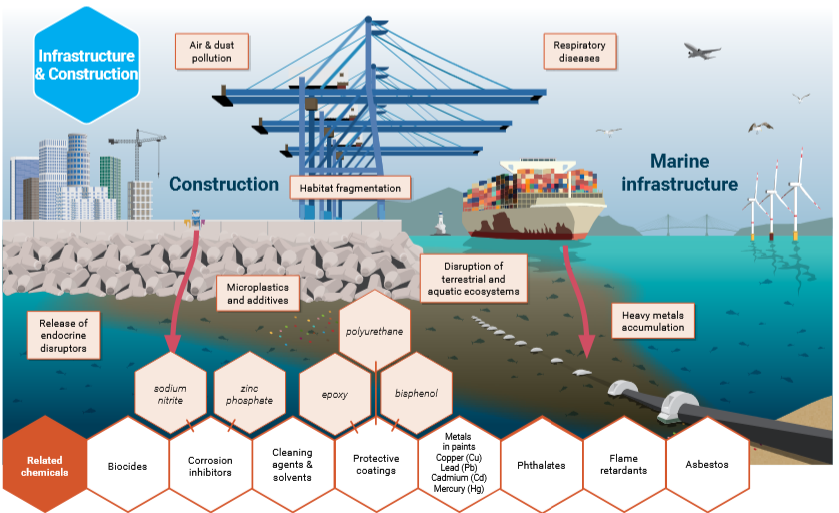
Infrastructure & Construction
Impact of infrastructure and construction sector on biodiversity

Construction and marine infrastructure rely on biocides, protective coatings (epoxy, polyurethane, Bisphenol-A), corrosion inhibitors, solvents, copper, lead, cadmium, mercury, phthalates and flame retardants — leading to heavy metal accumulation in sediments, microplastic release, and endocrine disruption in aquatic species.

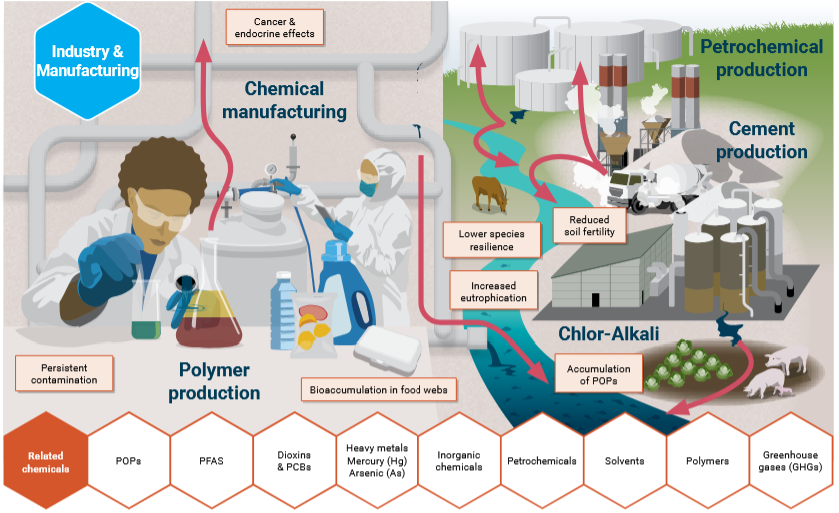
Industry & Manufacturing
Impact of industry and manufacturing sector on biodiversity

Chemical manufacturing and the scientific chemicals industry use acids, bases, petrochemicals, solvents, ethylene, propylene, acetone and ethanol — among the top ten industrial chemicals worldwide — affecting freshwater and marine systems and biodiversity. 

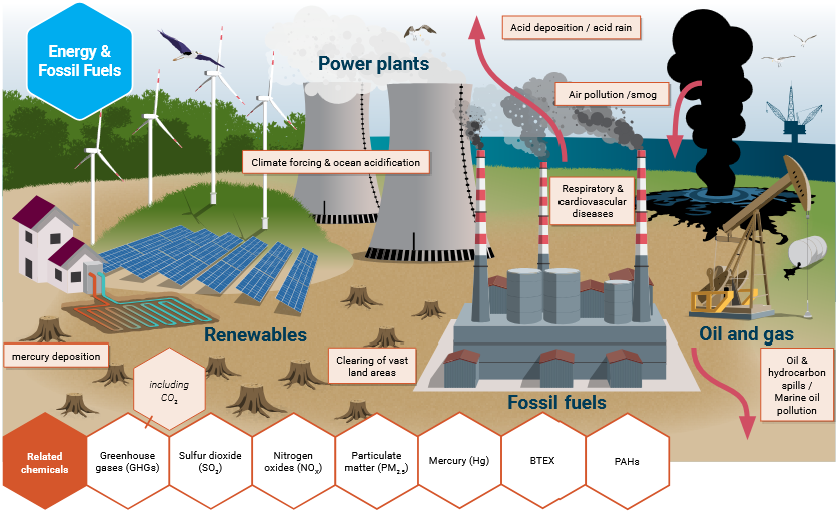
Energy & Fossil Fuels
Impact of energy sector on biodiversity

Main source of global GHG emissions. SO₂ and NOₓ generate acid rain and smog; thermal power plants disrupt aquatic life; hydroelectric installations physically alter water systems; wind, solar and hydro infrastructure clear vast land areas, degrading habitats.

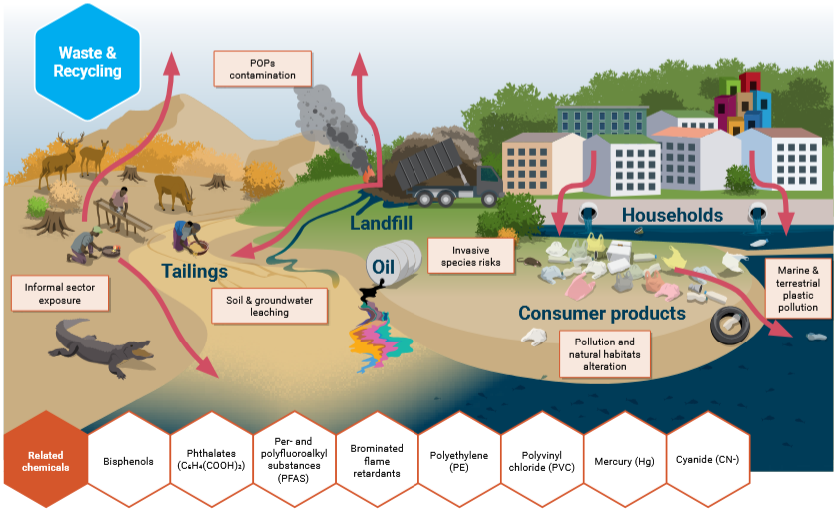
Waste & Recycling
Impact of waste sector on biodiversity

Improper management of hazardous waste from coal, oil, industrial chemicals, POPs, pharmaceuticals, antimicrobials, heavy metals and plastics degrades soil and water, drives habitat loss and species migration, and releases SO₂, NOₓ and particulates through incineration and open burning. 

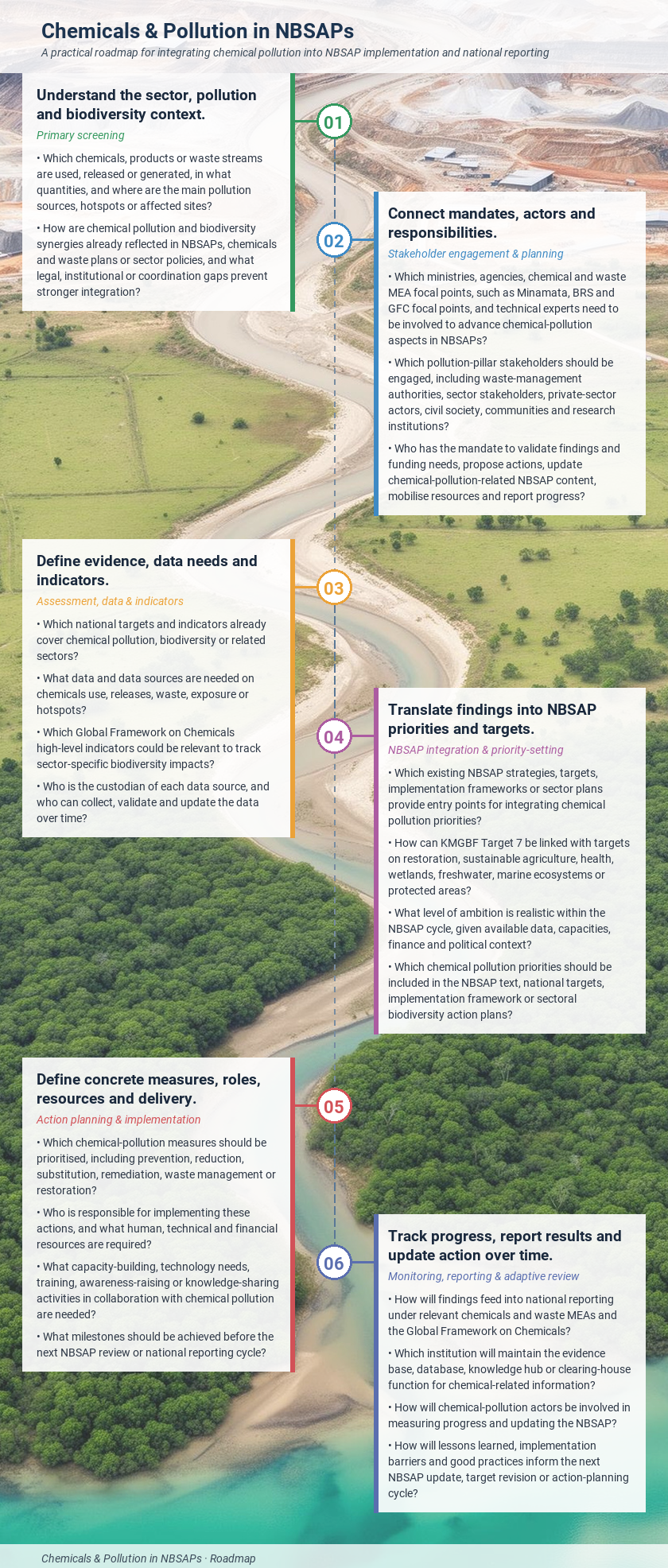
Chemicals & Pollution in NBSAPs Roadmap

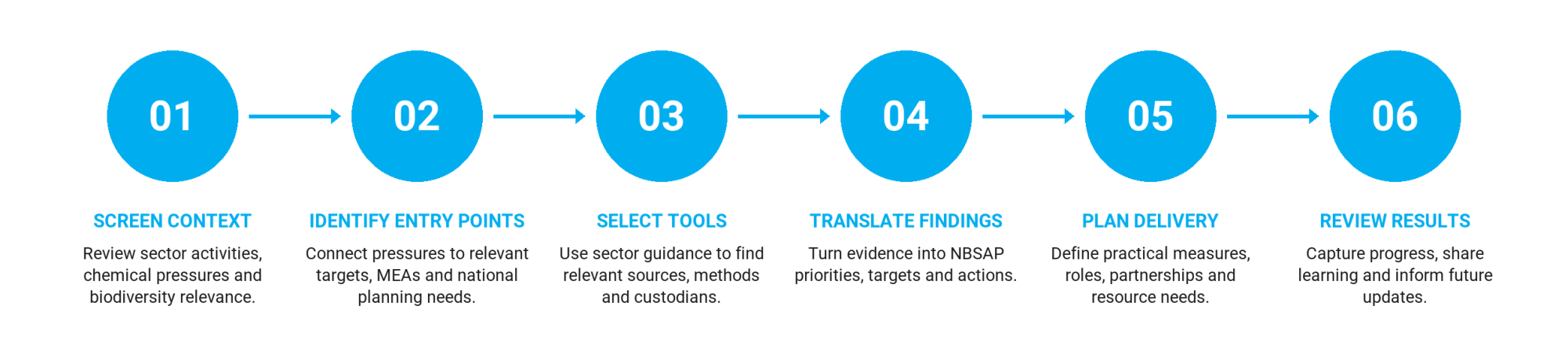
The UNEP roadmap provides step by step guidance on integrating chemicals pollution into NBSAP implementation and national reporting.

  1. Preliminary screening 
    Understand the sector, pollution and biodiversity context
  2. Stakeholder engagement & planning
    Connect mandates, actors and responsibilities
  3. Assessment, data needs & indicators
    Define evidence, data needs and indicators
  4. NBSAP integrating & priority-setting
    Translate findings into NBSAP priorities and targets.
  5. Action planning & implementation
    Define concrete measures, roles, resources and delivery
  6. Monitoring, reporting & adaptive review
    Track progress, report results and update action over time
roadmap complete

Tools & Guidance for Action

KMGBF Targets Legend

  • Target 2: Restore 30% of degraded ecosystems
  • Target 3: Conserve 30% of land, waters and seas
  • Target 7: Reduce pollution to levels not harmful to biodiversity
  • Target 8: Minimize the impacts of climate change on biodiversity and build resilience
  • Target 10: Sustainability in agriculture, aquaculture, fisheries and forestry
  • Target 11: Restore, maintain and enhance nature's contributions to people
  • Target 14: Integrate biodiversity in decision-making at every level
  • Target 16: Enable sustainable consumption to reduce waste and overconsumption
  • Target 22: Ensure participation, access to justice and information on biodiversity
  • Target 23: Ensure gender equality and a gender responsive approach for biodiversity action

Steps

6 steps

See on previous tab the Chemicals & Pollution in NBSAPs Roadmap with detailed guidance on planning, implementation and reporting.

Sector-specific tools, data sources and custodians

Mining & Extractives
sector mining impacts on biodiversity

Examples of tools, data sources and custodians

Agriculture
sector agriculture impacts on biodiversity

Examples of tools, data sources and custodians

Healthcare and Pharma
sector healthcare impacts on biodiversity

Examples of tools, data sources and custodians

Infrastructure & Construction
sector infrastructure impacts on biodiversity

Examples of tools, data sources and custodians

Industry & Manufacturing
sector industry impacts on biodiversity

Examples of tools, data sources and custodians

Energy & Fossil Fuels
sector energy inpacts on biodiversity

Examples of tools, data sources and custodians

Waste & Recycling
sector waste impacts on biodiversity

Examples of tools, data sources and custodians


Synergies in Action

Processes, partnerships, and country examples that embody chemicals–biodiversity integration — building on the Party-led Bern process for effective KMGBF implementation.

Key Milestones

2019   Bern I Workshop
First consultation workshop among biodiversity-related conventions on the post-2020 global biodiversity framework.

2021  Bern II Consultation Workshop
Second consultation workshop strengthening cooperation among biodiversity-related conventions.

2022  CBD COP15 — KMGBF Adopted
Kunming-Montreal Global Biodiversity Framework adopted; Target 7 addresses pollution risks and impacts on biodiversity by 2030.

2023  ICCM5 — Global Framework on Chemicals Adopted 
GFC adopted; Resolution V/6 strengthens international cooperation and links to biodiversity-related implementation.

2023  BRS COPs — Decisions BC-16/22, RC-11/9 and SC-11/21
BRS COP decisions welcomed the KMGBF and requested analysis of how the Basel, Rotterdam and Stockholm Conventions can contribute to its 2030 targets and 2050 goals.

2023  Minamata COP-5 — Decision MC-5/17 
Decision on mercury and the Kunming-Montreal Global Biodiversity Framework.

2023–2024  Regional Capacity-Building Workshops 
UNEP-supported workshops on coherent implementation of biodiversity and chemicals/waste MEAs.

2024  Bern III Conference 
Conference on cooperation among biodiversity-related conventions for KMGBF implementation.

2024  SADC Regional Biodiversity Strategy and Action Plan Workshop 
SADC Member States validate regional biodiversity strategy and action plan. 

2025  CBD COP16 Decision 16/35
Decision invites chemicals and waste conventions, FAO, GFC and others to collaborate on Target 7. 

2025  Bogis-Bossey Expert Workshop
Expert workshop on the Bern Process and MEA contributions to KMGBF implementation and review.

2025  Minamata COP-6 — Decision MC-6/20
Road map for enhancing co-benefits between Minamata Convention implementation and the KMGBF. 

Results

→ The Party-led Bern Process (I, II, III) has produced concrete outputs to operationalize KMGBF Target 7 through inter-convention cooperation. 
→ Regional workshops (East Africa, West Africa, SADC) built country roadmaps linking chemicals to NBSAPs with stakeholder engagement. 
→ Uganda's national workshop piloted sector-specific roadmaps for Mining and Agriculture, including field visits demonstrating chemical-biodiversity linkages. 
→ Key gaps remain in data collection, policy enforcement, and national multi-MEA coordination — but guidance and tools are now available. 

Case Studies

birds

National Strategy: Uganda, 2025–2030 NBSAP III Implementation
Uganda’s NBSAP III aligns national biodiversity priorities with the Kunming-Montreal Global Biodiversity Framework. Developed through a whole-of-government and whole-of-society process, it addresses pollution, restoration, sustainable use and mainstreaming across sectors, with actions on pollution and waste in vulnerable ecosystems. Learn more 

forest


~31 tonnes mercury releases prevented 
Through PlanetGOLD Programme, UNEP/UNIDO global artisanal small-scale gold mining project reducing mercury use while yielding ecosystem benefits in Ghana, Indonesia, and MongoliaLearn more

Regional Workshops

Rwanda workshop


Rwanda, 29–31 August 2023 
Biodiversity, Chemicals and Waste MEA Implementation 
UNEP’s Rwanda workshop supported national focal points in strengthening synergies between biodiversity and chemicals/waste MEAs, using the KMGBF and Montevideo Programme V as entry points for national coordination. Learn more

senegal workshop


Senegal, 26–28 November 2024 
Coherent MEA Implementation 
The Dakar workshop supported West and Central African countries in strengthening coherent and synergistic national implementation of biodiversity, chemicals and waste MEAs. Learn more

botswana workshop


Botswana, 4–6 March 2025 
Mainstreaming MEAs in UN Country Teams
The Gaborone workshop focused on integrating MEAs into national sustainable development planning, UN Country Team processes, Common Country Analyses and Cooperation Frameworks in the SADC region. Learn more

kenya workshop


Kenya, 11–13 November 2025 
Integrated MEA Implementation
The Nairobi workshop built on earlier regional workshops to promote integrated implementation of biodiversity and chemicals/waste MEAs and strengthen national coordination across related SDG processes. Learn more

Challenges → Recommendations

Challenges

Recommendations

Knowledge gaps on biodiversity–pollution linkages

→ Discuss biodiversity loss and pollution in informative sessions at COPs, OEWGs and related international gatherings

Lack of Environmental Impact Assessments integrating pollution and biodiversity

→ Promote EIAs and SEAs through UN Country Analyses that include biodiversity and pollution considerations

Insufficient MEA focal point engagement in national planning

→ Engage national MEA focal points early in developing UNSDCFs and align with NBSAPs and chemicals strategies

Absence of national multi-MEA coordination mechanisms

→ Establish national MEA coordinating committees or equivalent bodies to encourage synergies

Insufficient or inaccurate data for monitoring

→ Include data collection following specific methodologies in projects; set up national repositories

Lack of policy enforcement measures

→ Screen existing policies, develop realistic enforcement measures with appropriate institutional capacities


Resources

Policy anchors, reporting platforms, data systems, and technical references that support chemicals–biodiversity integration, enabling evidence generation, implementation, and coordination across MEAs and frameworks. 

1. Policy alignment, frameworks and MEAs synergy anchors

2. National planning, reporting and knowledge reuse

3. Pollution inventories, releases and emissions

4. Environmental state monitoring

5. Hazard, toxicity, modelling and safer chemistry

6. Biodiversity, spatial risk and ecosystem receptors

7. Global evidence reports and cross-cutting implementation support


Last updated: 24 Jul 2026, 13:04