Why now
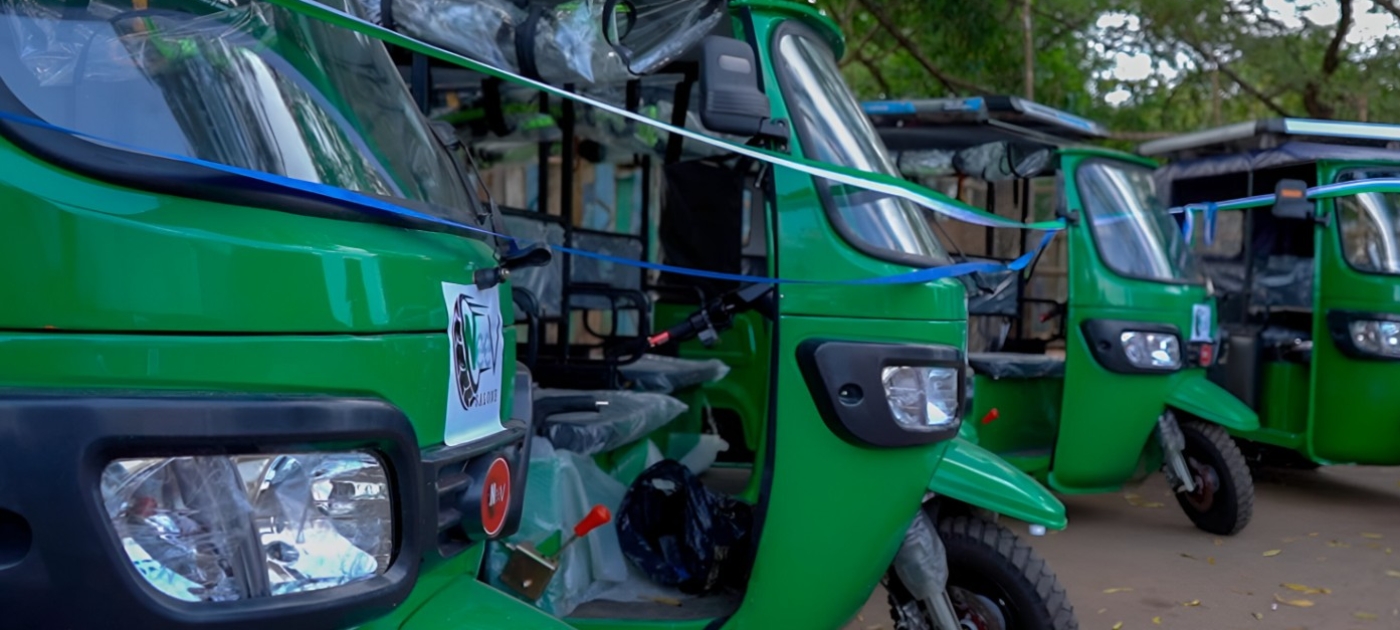
Two- and three-wheelers are the backbone of passenger and goods movement across much of Africa, Asia and Latin America, providing essential access to jobs, services and last-mile logistics where public transport and road infrastructure are limited.
UNEP estimates that around 570 million 2&3Ws are in use across these regions; 60–70 million new units are added each year. Yet only about 15% of the global fleet is electric today.
The climate, health and economic case for fast electrification is compelling:
- Climate: Shifting the segment to electric could mitigate an estimated 500–600 MtCO₂e annually, while reducing fuel import dependencies in non-OECD countries, where 2&3Ws consume 15–20% of transport liquid fuels.
- Air quality and health: Motorcycles can emit up to ten times more particulate matter per kilometre than other road vehicles, with direct impacts on cardiovascular health for residents, pedestrians, children and roadside workers.
- Noise pollution: Urban noise levels from 2&3Ws frequently exceed 100 decibels under acceleration, a growing public health concern.
- Economic opportunity: Electrification is technically mature, fleet turnover is fast (typically 5–10 years), and total cost of ownership is already favourable for high-mileage commercial uses such as moto-taxis and delivery. In addition, electrification is opening pathways for local vehicle assembly, battery management, and charging infrastructure creating green jobs.
Despite this potential, 2&3Ws remain excluded from prominent global zero-emission vehicle initiatives and are often underregulated. The Mexico City conference aims to close that gap.
___________________________________________________________________
Why Mexico City
Latin America and the Caribbean are home to around 60 million motorized 2&3Ws, with 5.6 million new units registered in 2024. Mexico leads the region, with nearly 2 million new registrations in 2024 and 3.2 million motorcycles on the road in Mexico City alone, where 70% of motorcycle purchases are linked to delivery work.
Mexico City is emerging as a promising testbed for electric mobility. The city's Commission for Environmental Preservation has approved amendments to ban the sale and circulation of gasoline vehicles by 2050, and EVs — including two-wheelers — are exempt from the city's Hoy No Circula driving restrictions.
Early market movers are already active: Italika, Mexico's largest motorcycle manufacturer, has launched a battery-swapping pilot for delivery riders, while Chinese OEM Yadea recently opened its first North American E2W manufacturing plant in the State of Mexico.
___________________________________________________________________
Objectives
The conference will seek to:
___________________________________________________________________
Event Details
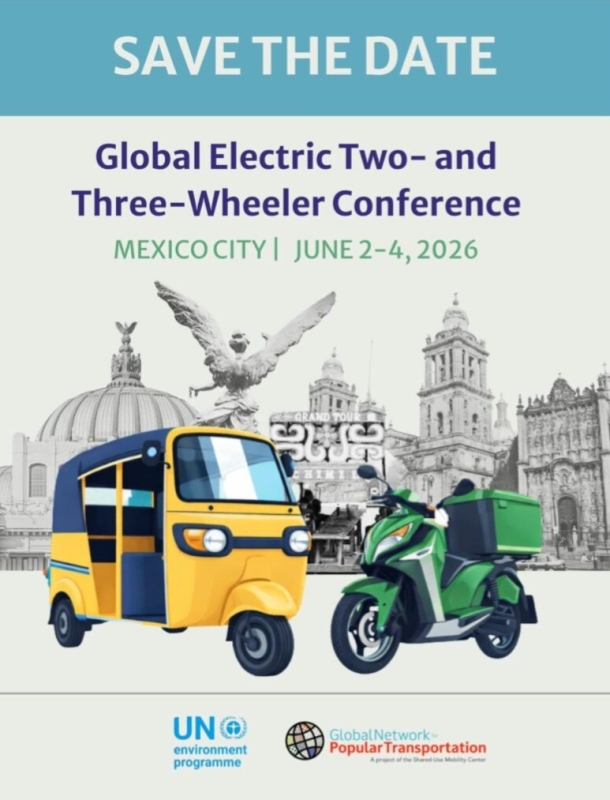
📅 Dates: 2–4 June 2026
📍 Location: Mexico City, Mexico
🏢 Convenor: UN Environment Programme (UNEP) — Sustainable Mobility Unit and Global Network for Popular Transportation (GNPT)
🌐 Languages: English and Spanish
🤝 Format: Plenary sessions, deep-dive workshops, technical visits and a project marketplace
Funding support: Global Environmental Facility (GEF)
Register for the Conference
___________________________________________________________________
About UNEP's work on electric 2&3Ws
UNEP's Sustainable Mobility Unit leads global efforts to accelerate the transition to inclusive, zero-emission transport systems, with electric two- and three-wheelers a central pillar of its strategy.
Through its Global Electric Mobility Programme, the Unit supports more than 50 low- and middle-income countries in developing national e-mobility strategies, piloting electric-vehicle projects, strengthening policy frameworks, and building local technical capacity. Its work on 2&3Ws spans Africa, Asia and Latin America, backed by global working groups, regional investment platforms and partnerships that provide technical guidance, analytics and financing models to scale adoption.
Looking Ahead
The Mexico City conference will mark a pivotal step in building a globally coordinated movement to electrify two- and three-wheelers — informing the launch of a Global E2&3W Campaign that unites smart policy, business engagement and people-powered coalitions.
By connecting lessons from Bangkok to Mexico City and beyond, the event aims to help countries seize one of the highest-leverage opportunities of the decade: cleaner air, safer streets, stronger local industries and a just transition for the millions of workers whose livelihoods depend on two- and three-wheeled mobility.
Contact: Annika Berlin — annika.berlin@un.org
Register for the Conference
___________________________________________________________________
Register for the Conference