Why it matters
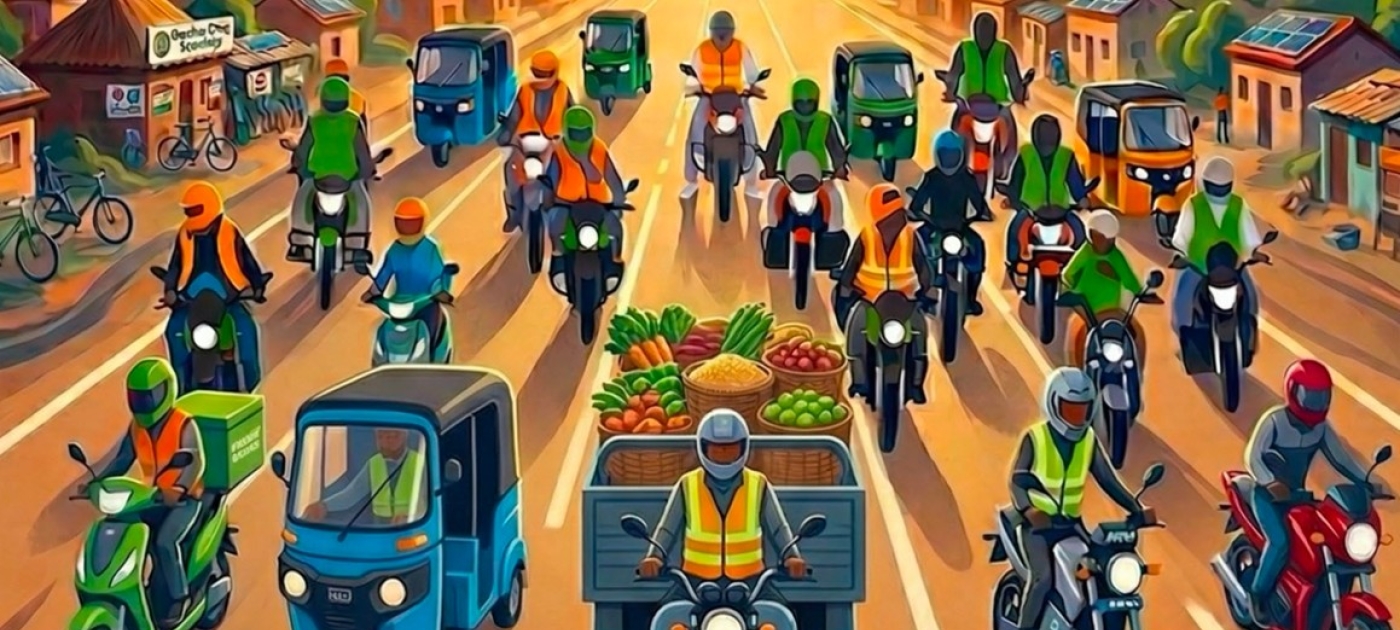
- The opportunity is large and immediate. Two- and three-wheelers are the fastest-growing transport mode in many LMICs and the first, cheapest priority for electrification, with major gains for clean air, climate and household incomes.
- Finance is the bottleneck. Most of the variation in financing cost across markets reflects broader macro and customer risks (sovereign rates, lenders' cost of funds, credit underwriting) rather than an EV-specific premium.
- Cost of capital varies sharply by region. In mature markets (China, India, Vietnam) lending terms for E2Ws already match petrol equivalents; in Latin America and Africa, where capital is expensive and EVs are new, affordable finance is scarce and concessional support is often needed.
- There are proven ways forward. Guarantees and risk-sharing, cash-flow-based asset finance, battery and telematics data, vehicle-as-a-service models, buyback guarantees and product standards stand out as the highest-potential interventions across the Global South.
_______________________________________________________________
About the report series
Capital 2 Mobilize was developed under the UNEP Global Electric Mobility Programme and is funded by the Global Environment Facility (GEF). It draws on market data across the major E2W and E3W markets of Africa, Asia and Latin America, together with interviews and case studies from operators, investors and financiers active in the sector. The series is intended for policymakers, development finance institutions, investors, lenders, OEMs and mobility operators working to scale electric two- and three-wheelers in emerging markets.
The reports: what to download
Several documents are published together and they range from a short brief to detailed technical volumes, so readers can choose according to your interest. The following are published now:
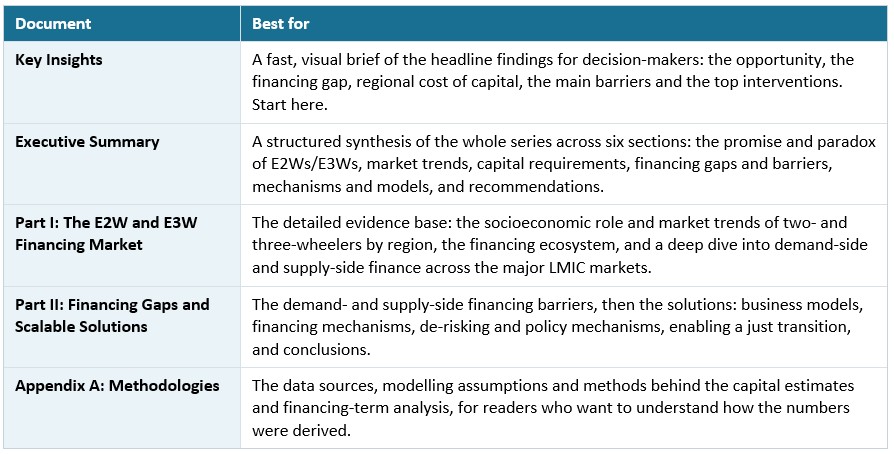
Coming later: a set of case studies (including AIZEN, iFood, M-KOPA, Revfin and Spiro) will be published as a follow-up. This launch covers the Key Insights, Executive Summary, Part I, Part II and the Methodologies appendix.
_______________________________________________________________
Launch webinar
The series is launched in a live webinar in which the lead author, together with speakers from the industry, presents the findings. The session is clustered into three parts, with an industry speaker introduced after each part to share specific market insights, followed by a moderated audience Q&A.
Event details
Date: Wednesday, 22 July 2026
Time: 16:00 – 17:30 East Africa Time / EAT (UTC+3)
Other time zones: 13:00 UTC · 15:00 CEST (Geneva) · 14:00 WAT (Lagos) · 18:30 IST (New Delhi) · 09:00 EDT (New York)
Duration: 90 minutes (≈60 min presentation + 30 min Q&A / guided discussion)
Format: Report presentation in three parts, case-study speakers, and moderated Q&A
Language: English
Platform: Teams
Host / Moderator: UNEP Global Electric Mobility Programme (Sustainable Mobility Unit) & Lead Author
_______________________________________________________________
Registration:
Register Here >> The webinar link will be shared after registration.
_______________________________________________________________
Author, funder and contact
Lead author: Dustin Kahler
Funded by: the Global Environment Facility (GEF).
Implemented by: the UNEP Global Electric Mobility Programme, Sustainable Mobility Unit, Industry and Economy Division.
Language: English
Questions: unep-emobility@un.org
_______________________________________________________________
Related links & further reading