
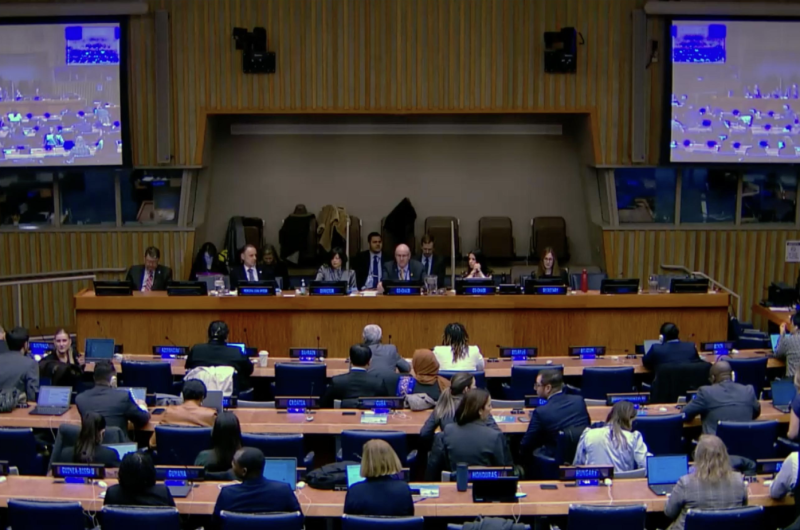
PrepCom III session: Delegates met in plenary to hear the Co-Chairs’ reports from the parallel meetings held on Tuesday, 31 March 2026.
The third and final Preparatory Commission (PrepCom III) for the Agreement under the United Nations Convention on the Law of the Sea on the Conservation and Sustainable Use of Marine Biological Diversity of Areas beyond National Jurisdiction (BBNJ Agreement) is currently underway (22 March to 2 April) at UN Headquarters in New York. As the first meeting following the BBNJ Agreement’s entry into force, PrepCom III marks the moment to shift to implementation priorities and bring the Agreement to life. In this context, negotiations will concentrate on establishing the operational foundations including governance structures, compliance procedures, and capacity-building and technology transfer frameworks. PrepCom III will adopt its recommendations and forward them to the Conference of the Parties (COP).
Adopted in June 2023 and in force since 17 January 2026, the Agreement is the first legally binding global instrument dedicated to the conservation and sustainable use of marine biodiversity in areas beyond national jurisdiction (BBNJ). Covering nearly two-thirds of the global ocean, these areas remain largely unprotected, with only about 1.45 percent under protection compared to more than 22 percent within national jurisdiction. Achieving global targets such as 30×30 (protecting at least 30 percent of the ocean by 2030,) will not be possible without scaling up protection in the high seas.
The Agreement establishes a comprehensive legal and institutional pathway to develop area-based management tools (ABMTs), including marine protected areas (MPAs) in ABNJ, while strengthening environmental impact assessment (EIA) processes and enabling more equitable access to and benefit-sharing of marine genetic resources (MGRs). Protecting ABNJ will not only safeguard biodiversity but also reinforce national MPA networks and enhance biological connectivity, supporting fisheries sustainability, climate regulation, and global ecosystem resilience.
In this regard, the Regional Seas Programme (RSP) is critical for the Agreement. The RSP, encompassing 18 Regional Seas Conventions and Action Plans (Regional Seas) and over 146 countries, draws on more than 50 years of experience in coastal and marine management and provides established legal, policy, and institutional frameworks. Several Regional Seas (Barcelona Convention, CCAMLR Convention, Lima Convention, Noumea Convention, and OSPAR Convention) already have mandates that extend into ABNJ, including the establishment of MPAs. Building on these frameworks, the Abidjan Convention, Barcelona Convention, and the Nairobi Convention have adopted decisions and Ministerial Declarations related to BBNJ, enforcing the role of the Regional Seas as a practical platform for implementing the Agreement.
Activities under the RSP supporting the early implementation of the BBNJ Agreement are ongoing. For example: the Nairobi Convention launched the Western Indian Ocean (WIO) BBNJ Legal and Technical Working Group in October 2025, advancing a regional BBNJ Vision and Implementation Framework and supporting Member States in aligning policies, identifying priority areas, and strengthening technical capacity.
The Regional Seas Programme is therefore well positioned to support implementation by bridging cooperation between areas within and beyond national jurisdiction, ensuring ecological connectivity and coherent, science-based conservation networks. Through existing Specially Protected Areas and Biodiversity Protocols, as well as strong science–policy interfaces, Regional Seas provide practical legal frameworks to translate global commitments into regional action.
The BBNJ Agreement represents a global commitment to protect and sustainably use our shared ocean. Its success will depend on effective regional delivery, strengthened capacity, and sustained financing.