
Every year, airports around the world release fluorinated firefighting foams during training exercises and emergency responses. These foams contain PFAS—per- and polyfluoroalkyl substances — a group of chemicals so resistant to environmental breakdown that scientists call them "forever chemicals." Once released, PFAS can persist in soil and water for decades, accumulating in ecosystems and human bodies, and have been linked to serious health and environmental risks.
But at Nairobi's Jomo Kenyatta International Airport (JKIA), something is different. The fire trucks are loaded with fluorine-free foam. The drills look the same. The safety outcomes are the same. But the chemical footprint is not.
A decade ago, Kenya made a decisive shift.
A Transition built on preparation, not chance
The transition at JKIA did not happen overnight. It was built on training, testing, and a deliberate commitment to maintaining the highest operational standards while eliminating harm.
"In aviation firefighting, safety is everything. We approached the transition carefully, through training, testing, and operational preparation. Our priority was simple: maintain the highest safety standards while protecting the environment, and people” says Francis Ndeleva, Airport Chief Fire Officer, Kenya Airports Authority.
That philosophy—safety and sustainability as complementary, not competing, goals—is now at the heart of a continent-wide effort. A JKIA firefighter described the outcome simply: having trained, tested, and adapted, the team responds just as effectively today, but with a solution that is safer for their communities.
Kenya's experience is proof that the aviation sector does not have to choose between keeping planes and passengers safe and protecting the communities and ecosystems around airports.
The FIRE Project: Turning Kenya's Model into a Continental Standard
Kenya's leadership is now being channeled into the Fortifying Infrastructure for Responsible Extinguishments (FIRE) project, a $82.5 million initiative implemented by the United Nations Environment Programme (UNEP) and executed by the International Civil Aviation Organization (ICAO), with a $10 million grant from the Global Environment Facility (GEF) and $72.5 million in co-financing from partners.
The project is working with major airports across five African countries—Egypt, Ethiopia, Kenya, Nigeria, and South Africa—to phase out PFAS-based firefighting foams and replace them with safer, fluorine-free alternatives. It is expected to promote the safe removal of 130 tonnes of PFAS-based foam concentrate.
"The GEF supports projects like FIRE because they turn environmental commitments into practical action, including reducing pollution, building local capacity, and creating solutions that can be replicated far beyond the first airports involved,” says Anil Sookdeo, Chemicals and Waste Coordinator, GEF.
Beyond its environmental objectives, the FIRE Project also integrates gender considerations across its activities, recognising that women and men may experience different levels of exposure to hazardous chemicals, access to training opportunities, and participation in decision-making within the aviation and firefighting sectors. Through the collection of sex-disaggregated data, inclusive capacity-building initiatives, gender-responsive occupational safety measures, and efforts to strengthen women’s participation in technical, operational and regulatory processes, the project seeks to ensure that the transition to fluorine-free firefighting is both environmentally sustainable and socially inclusive.
Watch the FIRE Project video to learn more about the initiative and its impact across Africa:
The environmental stakes are significant. PFAS chemicals are listed under the Stockholm Convention on Persistent Organic Pollutants (POPs), an international treaty that recognises these substances as among the most dangerous and persistent pollutants on the planet.
"PFAS in firefighting foams are a major environmental concern because they persist in water, soil, and ecosystems for a very long time. Supporting safer alternatives helps reduce these risks and contributes to the objectives of the Stockholm Convention,” outlines Ludovic Bernaudat, Head of GEF Chemicals and Green Chemistry Unit at UNEP’s Chemicals and Health Branch.
Aviation Safety and Environmental Responsibility, Together
One of the most important messages to emerge from Kenya's transition is that operational safety and environmental responsibility are not in tension.
"In aviation firefighting, operational safety can never be compromised. The transition away from fluorinated firefighting foams must therefore be done carefully, with proper testing, training, and alignment with international aviation standards. Through the FIRE Project, ICAO is working with partners and airports across Africa to ensure that this transition maintains the highest levels of safety while helping the aviation sector move toward more sustainable firefighting solutions,” says Guillermo Iovino, Acting Chief, Field Operations, ICAO"
From Africa to the World
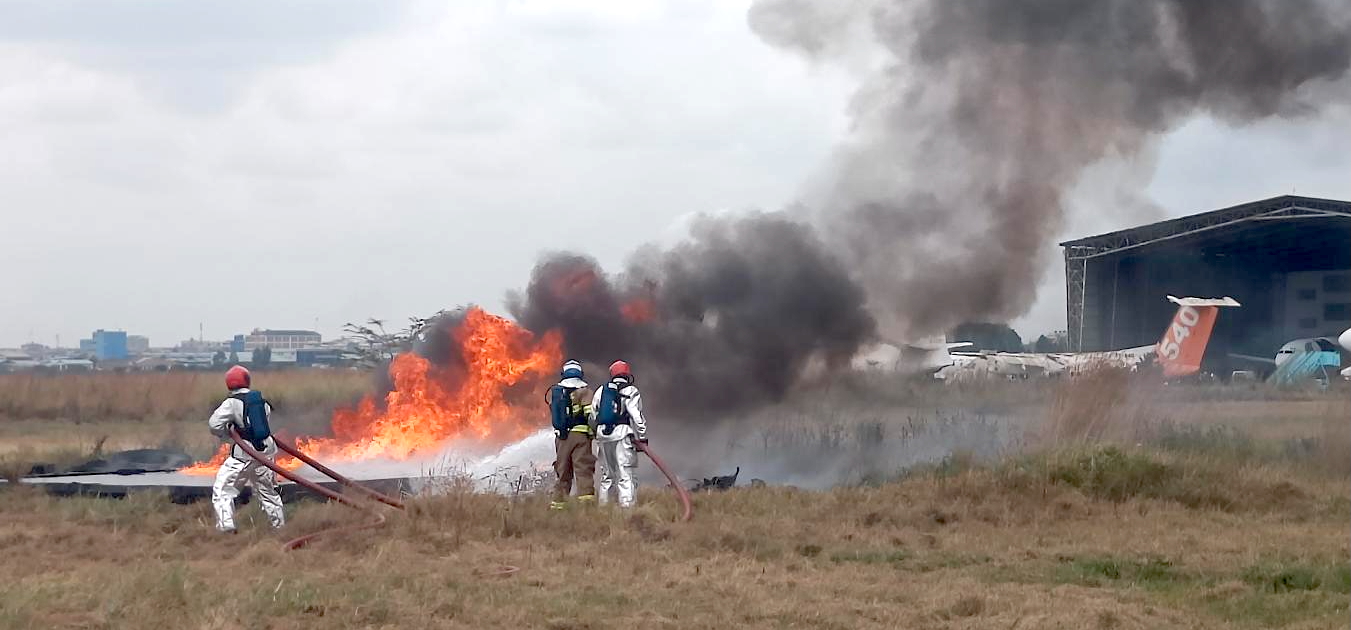
The fire drill at JKIA on 18 April 2026 was not just a test of emergency preparedness. It was a demonstration to Africa and to the world that the transition away from PFAS-based firefighting foams is achievable, safe, and replicable.
Removing PFAS from firefighting foams means cleaner soil, safer water, and healthier communities for the millions of people who live and work around airports. And it means that airports, as facilities that sit at the intersection of global mobility, local ecosystems, and community health, can take their place as leaders in the global response to chemical pollution.
"Airports play a critical role in turning global commitments into real action. At JKIA, we are proud to contribute to this transition by demonstrating how fluorine-free foams can be implemented safely in aviation firefighting. By sharing our experience through the FIRE Project, we hope to support other airports as they move toward safer and more sustainable firefighting practices. — Dr. Simon Peter, General Manager, Kenya Airports Authority"
Kenya's message, delivered on a tarmac in Nairobi, is clear: if you train for it, test for it, and commit to it, safer skies can also mean a safer planet.
"The FIRE project shows how sector-focused action can drive the elimination of hazardous chemicals across value chains. We hope this will inspire both participating countries and the wider aviation sector to transition to PFAS-free firefighting foams. — Anil Sookdeo, GEF"
The FIRE Project is implemented by UNEP, executed by ICAO, and funded by the Global Environment Facility (GEF). It is part of a broader set of UNEP-GEF activities dedicated to global monitoring and eliminating the use of Persistent Organic Pollutants and reducing their impacts on human health and the environment.