
The Global Framework on Chemicals Fund issues periodic calls for applications to support projects that strengthen the safe and sustainable management of chemicals and waste.
The first round of applications was launched on 1 October 2024 and closed on 31 January 2025. The inaugural call offered grants ranging from US$300,000 to US$800,000 for projects with implementation periods of up to three years.
The response demonstrated strong global interest in the Fund. A total of 105 applications from 77 countries were submitted, highlighting significant demand for financial and technical support to strengthen national and regional chemicals management capacities.
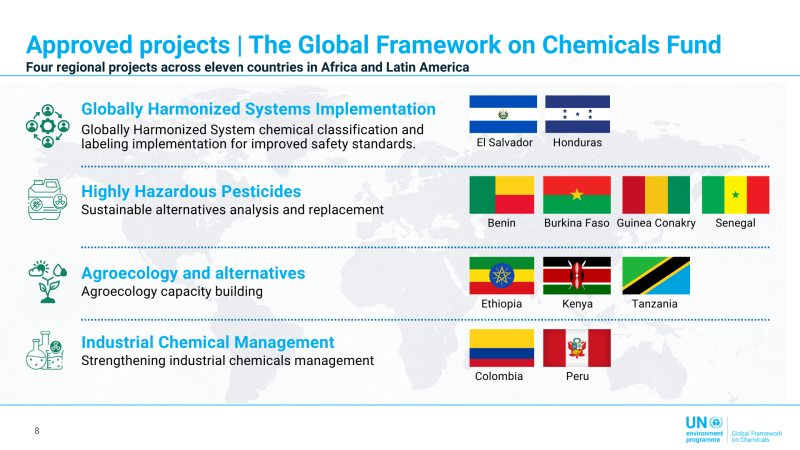
Following a rigorous evaluation process, four regional projects have been approved, benefiting 11 countries across Latin America and Africa.
-
Project in Colombia and Peru
Strengthening Industrial Chemicals Management through Regional Cooperation: Action Plans, Legislation, IT Systems and Capacity Building
Colombia and Peru are joining forces to strengthen industrial chemicals management through a 33-month initiative organized by their respective Ministries of Environment and coordinated by the Basel and Stockholm Conventions Regional Centre in Uruguay. The project will deliver tailored legislation, national action plans, and roadmaps to guide chemical safety efforts. A key output is an open-source IT system developed for Peru and informed by Colombia’s experience to support data collection, risk prioritization, and regulatory transparency. The system will be freely accessible in English and Spanish to encourage wider regional adoption. Through the project, Colombia will update its national chemical profile using recent inventory data, creating a replicable model for other countries.
To build lasting change, the project will train government officials, industry actors, academia, and civil society on chemical risk assessment, inviting participation from countries across the region and multiplying the benefits of the GFC funding. The project also emphasizes early education, introducing sustainability and chemical safety concepts to middle school students. Designed to scale and share best practices, this collaborative effort offers a replicable model for advancing chemical safety, data transparency, and sustainable development across Latin America.
Access the project factsheet here.
-
Project in Benin, Burkina Faso, Guinea and Senegal
Highly Hazardous Pesticides: Analysis, Regulation and Sustainable Alternatives
This regional initiative aims to reduce the risks posed by highly hazardous pesticides (HHPs) in Benin, Burkina Faso, Guinea Conakry, and Senegal by promoting agroecological alternatives and strengthening national regulatory systems. Led by Pesticide Action Network Africa, the three-year project will engage smallholder farmers, agricultural workers, rural communities, and farmers’ organizations in designing and adopting local, sustainable pest management practices. Through farmer field schools, demonstration plots, and training rooted in indigenous knowledge and innovation, the project will improve crop production systems, food security, and food safety while advancing the progressive elimination of toxic pesticides.
To create lasting change, the project will unite ministries of environment, agriculture, health, and labour to strengthen policies that support safer alternatives, and it will develop a shared HHP database to enhance coordination, information exchange, and harmonized regulatory action across the four countries. Awareness campaigns will build public understanding of pesticide risks and empower local actors to advocate for sustainable solutions, helping to strengthen chemicals management systems across West Africa. The project team will also collaborate closely with the East Africa team to scale up successful approaches to reducing HHPs across the African continent.
Access the project factsheet here
-
Project in Ethiopia, Kenya and Tanzania
Building Capacity for Replacing Highly Hazardous Pesticides with Agroecology
This regional project will equip smallholder farmers across Ethiopia, Kenya, and Tanzania with the tools and training to phase out highly hazardous pesticides (HHPs) and shift to agroecological practices that are safer for people and the planet. Over three years, the project will support farmers in identifying HHPs, monitoring their health and environmental impacts, and testing viable alternatives through farmer field schools that blend scientific research with indigenous knowledge. Partners including AGENDA for Environment and Responsible Development, Centre for Environment Justice and Development, and Pesticide Action Network International will lead implementation, while Rainforest Alliance will help farmers unlock new markets.
Beyond the farm, the project will activate networks across the region—including government, civil society, researchers, media, and the private sector—to raise awareness and support the transition to safer pest management alternatives. Training sessions and knowledge exchanges will spread effective practices, creating a ripple effect of impact across East Africa. Together, these efforts will protect health, preserve ecosystems, and support a more resilient and sustainable future for agriculture in the region. The East Africa project team will also work hand-in-hand with the West Africa project team to scale up winning approaches to HHP reductions across the African continent.
Access the fact sheet here
-
Project in El Salvador and Honduras
Information will be made available soon.