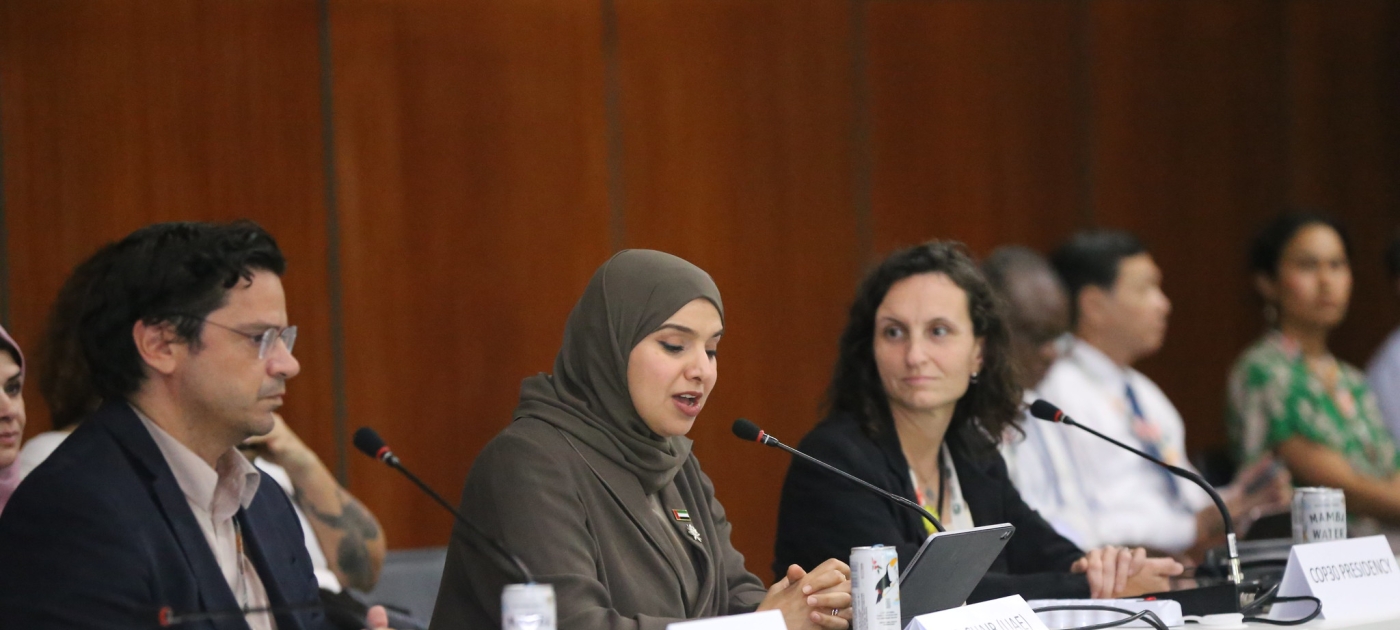
At COP30 in Belém, governments established new institutional architecture to coordinate global cooling efforts. This took place at the second Ministerial Dialogue on the Global Cooling Pledge – the world’s first collective commitment to cut cooling-related emissions by 68 per cent by 2050 – where over 50 ministers and leaders adopted new measures and reaffirmed existing ones to mitigate and adapt to extreme heat.
Extreme heat as a top-tier climate risk
Heatwaves are the deadliest climate hazard. According to the Global Cooling Watch 2025, a report recently launched by the UN Environment Programme (UNEP), cooling capacity could more than triple by 2050 as populations, cities and incomes grow alongside intensifying heat. As such, the race to deliver life-saving cooling must be won sustainably and equitably.
By formally recognizing extreme heat as a top-tier climate risk, countries signalled a shift toward treating cooling as a strategic priority rather than a technical afterthought.
“The urgency is clear. According to the Global Cooling Watch, heat stress could erase the equivalent of 80 million full-time jobs within five years,” said Martin Krause, UNEP’s Climate Change Division Director. “Yet more than 1 billion people still lack access to adequate cooling”.
Adoption of the Belém Communiqué on Extreme Heat
At the strategic level, the Belém Communiqué on Extreme Heat, adopted at the Dialogue, positions heat as a defining climate risk requiring cross-sectoral coordination and recognizes cooling as essential infrastructure alongside water, energy and sanitation. To address the intersection of these issues, it calls for integrated mitigation and adaptation strategies that bridge health, climate, energy and development agendas.
Committing to Beat the Heat
To move the Communiqué from ambition to implementation, Ministers and leaders reemphasized their commitment to Beat the Heat (Mutirão contra o Calor Extremo), a collective effort to localize the Global Cooling Pledge led by the COP30 Brazilian Presidency and UNEP’s Cool Coalition. Through heat risk assessments, passive and nature-based solutions and financial mobilization, Beat the Heat equips cities and sub-national actors with knowledge and technical resources to accelerate progress on the Global Cooling Pledge. As of today, over 200 cities – from Rio de Janeiro to Chennai and Paris – have joined Beat the Heat alongside the 72 country signatories.
Operationalizing the Enabling Pledge Implementation for Cooling (EPIC) platform
The newly operationalized Enabling Pledge Implementation for Cooling (EPIC) was set into force as a platform that provides countries with tools to meet cooling needs sustainably. One part of the platform facilitates business models and technology rollouts, including cooling for universities, schools and hospitals as well as cold-chain solutions and solar-powered cooling, while another offers technical assistance for National Cooling Action Plans, Nationally Determined Contributions, Heat Action Plans, Minimum Energy Performance Standards, integration of passive cooling into building codes, and investment roadmaps.
Establishment of the Intergovernmental Committee on Cooling
If the rapidly increasing demand for cooling is not met with sustainable infrastructure, cooling-related greenhouse gas emissions could almost double by 2050, as compared to 2022, according to the new Global Cooling Watch.
To help reduce the emissions of this projection, the ministerial also saw the formal establishment of the Intergovernmental Committee on Cooling, a governance mechanism to monitor and guide delivery of the 14 targets in the Global Cooling Pledge. These include passive and nature-based solutions for cooling, energy codes for buildings, higher efficiency standards and the phase-down of greenhouse gas refrigerants.
“If countries stay the course, Belém could be a turning point for making sustainable cooling one of this decade’s most high-impact climate solutions,” said Krause.
Additional quotes
“As a global leader in responding to the escalating challenge of extreme heat, the United Arab Emirates continues to set the benchmark for sustainable cooling. Its role as co-chair of the Global Cooling Pledge demonstrates a strong commitment to high-ambition climate action and international cooperation. Nationally, the UAE is embedding sustainable cooling across national policy frameworks, including through its latest updated NDC, and is advancing the formulation of its National Cooling Action Plan to provide a comprehensive roadmap for efficient and climate-aligned cooling.”
H.E. Dr. Amna bint Abdullah Al Dahak, the UAE Minister of Climate Change and Environment
“To contribute to the advancement of the Global Cooling Pledge and Beat the Heat, Singapore will host the Global Cooling Pledge Focal Meeting, as well as share our expertise in urban heat assessments and simulation of cooling solutions through digital model we developed jointly with ETH-Zurich known as the Digital Urban Climate Twin (DUCT).”
H.E. Grace Fu, Minister for Sustainability and the Environment of Singapore
“The Global Cooling Pledge is a battle‑cry: no more dumping obsolete coolers that cripple the poorest. Through the Cool Coalition we’re raising Minimum Energy Performance Standards, scaling the EcoFridges GO initiative, and delivering efficient cooling to every Ghanaian home.”
H.E. Seidu Issifu, Minister for Climate Change and Sustainability, Ghana
Note to Editors
About the Cool Coalition
The UNEP-led Cool Coalition is a global platform bringing together over 250 governments, businesses, cities, and financial institutions to drive comprehensive action on sustainable cooling and extreme heat. The Coalition advances implementation of the Paris Agreement, the 2030 Agenda, and the Kigali Amendment to the Montreal Protocol by working across three pillars: advocacy, science, and joint action. It champions a holistic approach to cooling and cold chains in both industrialized and developing countries, promoting passive cooling, improved energy efficiency, and the rapid phase-down of climate-warming refrigerants. The Cool Coalition also serves as the Secretariat to the Global Cooling Pledge.
About the Global Cooling Pledge
The Global Cooling Pledge represents the world’s first collective commitment to reducing cooling-related emissions by 68 per cent by 2050, while also expanding equitable access to cooling. It is anchored in the science of the Global Cooling Watch and lays out 14 national targets, including National Cooling Action Plans, passive and nature-based solutions, building energy codes, higher efficiency standards, and refrigerant phase-down.