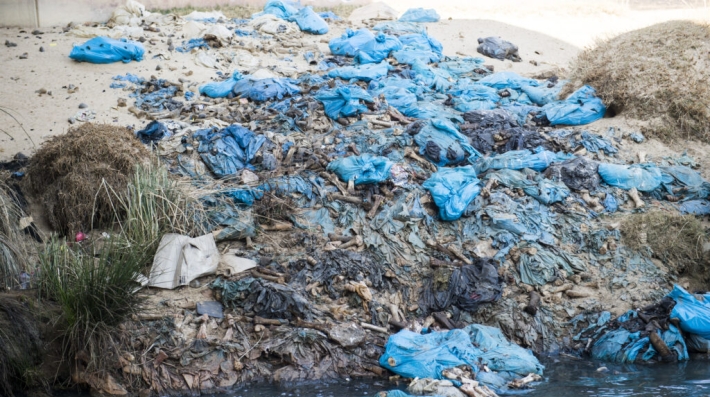

Three economic sector value chains profoundly influence the development and spread of antimicrobial resistance (AMR)
- Pharmaceuticals and Chemicals Manufacturing,
- Agriculture and Food Production - including terrestrial animal farming, aquaculture, and food crops
- Healthcare delivery in hospitals, medical facilities, community healthcare facilities and pharmacies, where a range of chemicals and disinfectants are used.
In addition, poor sanitation, untreated wastewater and effluent from human and animal waste systems, such as municipal wastewater are important sources of AMR in the environment.
Management options to address releases, effluent and waste, include
In Pharmaceutical Manufacturing
- Ensure adequate waste and wastewater containment and treatment.
- Incorporate waste management into standard operating procedures used in the production of antimicrobials with a lifecycle approach.
- Promote sustainable procurement and reimbursement systems for manufacturers.
In Food and Agriculture
- Limit antimicrobial use and prevent discharges to protect water sources from pollutants, resistant microorganisms, and antimicrobial residue contamination.
- Apply infection control and prevention measures.
In Healthcare
- Install hospital-specific wastewater treatment systems, especially in locations without modern community wastewater treatment plants.
- Leverage hospital stewardship and infection prevention control programmes to limit environmental contamination by AMR pollutants.
In Municipals Systems
- Improve waste containment, wastewater treatment and sludge management processes.
- Innovate and adapt wastewater treatment options, including technologies for different resource settings.
Safe Disposal of Unused Medicines – A One Health Approach for National Systems
Unused medicines arise from multiple factors, such as changes in treatment, over-prescription, non-adherence and supply mismanagement across both human and veterinary sectors. These challenges are increasingly recognized in countries’ National Action Plans on AMR and global policy discussions. Nevertheless, the absence of a coordinated and holistic approach continues to hinder the effective implementation of safe disposal practices, contributing to environmental pollution and public health risks.
In response, UNEP has developed the guidance Safe disposal of unused medicines - A One Health approach for national systems. The guidance provides a systematic, comprehensive and multisectoral framework to support countries in strengthening national systems for the safe disposal of unused human and veterinary medicines.
Grounded in a One Health approach, the guidance emphasizes the interconnections between human health, animal health and the environment. It focuses on key sectors—healthcare, agriculture, pharmaceutical industry and households—and is structured around four foundational pillars:
- Waste prevention
- Comprehensive take-back schemes
- Legal and policy frameworks
- Awareness-raising
The guidance also offers stepwise approaches, practical examples and enabling conditions to support implementation across diverse national contexts.