
Public finance plays a key role in accelerating actions on climate, nature and biodiversity, and pollution. Its effectiveness can be enhanced through fiscal policy, which can transform economic and financial structures to be better aligned with the commitments stipulated in the Sustainable Development Goals (SDGs), the Paris Agreement, the Kunming-Montreal Global Biodiversity Framework (GBF), as well as the Basel, Rotterdam and Stockholm conventions.
Such policies can be used to reflect the cost of externalities into market prices, promoting cost-effective, sustainable consumption and production and innovation. At the same time, they can create the fiscal space needed to further contribute to sustainability goals by facilitating positive double-dividends and supporting the most vulnerable affected by the transition.
UNEP assists countries in their transition towards a sustainable economy by incorporating sustainability into national budgets, revenue and expenditure policies, enhancing the effectiveness of its work through an integrated approach built on strategic partnerships.
Learn more about green fiscal policy.
Tracking and Assessing National Budget Impacts on Sustainability
A core aspect of UNEP's work is supporting governments in planning trade-offs when making public finance decisions, especially when progress in one sector (e.g., socioeconomic development) potentially offsets environmental ones. Through its Sustainable Budgeting Approach (SBA), UNEP supports partner countries to make evidence-based fiscal decisions that collectively contribute towards a coherent vision of sustainable development.
The SBA is a decision-support framework for Ministries of Finance to assess the alignment with and directional implications of fiscal policies with respect to national priorities in a certain country. It categorizes revenue and/or expenditure policies into a standardized policy archetype, thereby quantifying its directional impact against a range of nationally defined economic, social, and environmental criteria. Following a successful pilot in Gabon in 2021, the SBA is increasingly gaining global recognition and was officially endorsed in the communiqué of the International Cooperation Forum and the Meeting of African Ministers of Finance, Economy, and Environment during COP27.
Improving the Efficiency of Public Finance while Shifting Behaviors towards Sustainability
UNEP supports countries to identify and assess subsidies with negative environmental impacts, and enhance their sustainability . Building on the global UN report “A Multi-Billion-Dollar Opportunity”, UNEP is leading a global campaign with UNDP, BIOFIN, PAGE, and other partners to build an international consensus on redirecting agricultural subsidies toward sustainable food systems, biodiversity conservation, and climate objectives.
As the custodian for SDG Indicator 12.c.1., UNEP, in collaboration with the OECD, provides countries guidance on how to measure and report on fossil fuel subsidies under the SDG reporting process. UNEP provides technical guidance on how to improve the efficiency of public finance by redressing and repurposing harmful subsidies.
Mobilize Domestic Resources and Enabling Investment Policy Environment
UNEP supports global efforts to increase financing for sustainability by providing technical support, guidelines, and interoperable frameworks that align fiscal policy with climate, nature, and pollution action. Our workstreams facilitate expert advice and consultations on evolving approaches in sustainable public finance across revenue (e.g., environmental taxes on pollution and carbon), and debt (e.g., green, and blue bonds, and debt-for-nature swaps) instruments which can extend to institutional capabilities and enabling environments.
As a Global Lead of the GEF Net Zero and Nature Positive Accelerator Integrated Program (NZNP IP), together with the Asian Development Bank and the Development Bank of Latin America and Caribbean (CAF), UNEP supports countries to implement their NZNP strategies and plans through fiscal policy and financing options. The program recognizes the interconnected nature of climate change and biodiversity loss, aiming to integrate financing solutions that simultaneously address both challenges. To this end, the NZNPA IP provides a coordinated framework for knowledge sharing, capacity building, and financial mobilization.
UNEP also supports countries in mobilizing finance for preserving biodiversity.
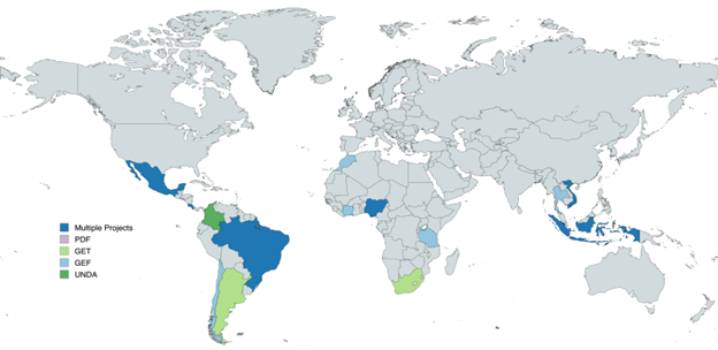
In cooperation with GIZ, UNEP is providing technical support on the Fast-tracking Transformation through Sustainable Public Finance for Biodiversity (FAST) This project aims to align public finance with biodiversity protection in Brazil, Costa Rica, Indonesia, and Nigeria. This involves restructuring fiscal policies and budgets to incentivize climate and biodiversity actions, contributing to the objectives of the Paris Agreement and the Global Biodiversity Framework. The outcomes of the program will contribute substantively to knowledge, capacity, and partnerships supported by the Green Fiscal Policy Network and foster communities of practice in finance for biodiversity.
Promoting Effectiveness through Strategic Partnerships
To further enhance the impact of its work, UNEP cultivates strategic partnerships through a platform such as:
- The Green Fiscal Policy Network (GFPN)facilitates sharing knowledge and good practices on sustainable fiscal policy among policymakers.
- the Coalition of Finance Ministers for Climate Action (CFMCA),
- the Partnership for Action on Green Economy (PAGE), and
- the Climate Nature Coordination Platform (CNCP) to mainstream its expertise on sustainable fiscal policy.
A list of partner countries supported through our work can be found below: