Trade for environment and sustainable development.
International trade plays a role in resource extraction, management, and use of natural resources as well as changes in land use, acting as an amplifier to the triple planetary crises of climate change, biodiversity loss, and pollution. However, trade is also bound by nature and can contribute to enabling a transformative shift toward inclusive, sustainable and resilient economies, supporting global environmental goals.
UNEP’s Executive Director Inger Andersen's key messages on how trade contributes to sustainability: Listen here
How does UNEP build a mutually supportive collaboration between trade and environment?
Established in 2015 and launched on the sidelines of the WTO 10th Ministerial Conference, UNEP Environment and Trade assists countries in transitioning toward inclusive, resilient, and green economies and reducing the negative impacts on climate, nature and biodiversity, pollution and waste, making trade an enabler and catalyzer of this transformative change.
To achieve this, UNEP Environment and Trade provides policy advice, institutional and technical assistance, and capacity building services to countries, policy makers, WTO, CBD, research institutions, civil society, and experts at the national, regional, and international level, to identify policies and solutions for a supportive trade and environment interface that helps deliver global environmental commitments, across high-impact sectors.
A glance at UNEP’s Value Offer on trade for the environment:
- Policy advice to assist governments to develop, revise, implement and align trade and environment policies, regulations, strategies and trade agreements that support global environment, advancing trade as enabler of the transformation toward inclusive, resilient and green economies.
- Technical Assistance and Capacity Building to seize trade-related opportunities to mainstream sustainable consumption and production systems, access global value chains and markets, and increase participation and competitiveness in high-impact sectors, supportive of environmental commitments and ambitions for sustainable socio-economic growth.
- Science-Based and Data-driven Knowledge and Tools that support and inform decision-making processes and deliver global environmental agendas.
- Strengthened partnerships between environment and trade communities, promoting proactive leadership, dialogue and cooperation between governments, WTO, CBD and relevant MEAs, Regional Economic Commissions, international organizations, finance institutions, academia and civil society, and experts, to identify and accelerate joint solutions tackling the triple planetary crises and fostering sustainable development.
A glance at UNEP’s work across high-impact sectors:
-
Textiles
 The textiles industry has grown to become one of the largest global industries, projected to reach US$3.3 trillion in 2030. Yet, the under-utilization of clothes and lack of reuse and recycling results in more than US$500 billion in value being lost every year.
Consumption patterns between the global north and global south have reflected how used textiles are discarded, donated, and exported. The trade of used textiles provides livelihoods and strengthens economies, and it can also contribute to a transformation to a circular textile sector.
In developing countries, there is a high demand for used textiles due to affordability, offering socio-economic benefits, particularly in informal sectors. Despite these, if not managed adequately, it could create pollution and environmental degradation, pose human health risks, and impact economy of those relying on the second-hand clothing sector.
Acknowledging the role that trade can have as a positive force to enhance the circularity of used textiles, UNEP is implementing the Circularity and Used Textiles Trade project in Kenya, Ghana, Tunisia and Pakistan, funded by the European Union.
The project contributes to UNEP’s focus on upstream interventions that target overconsumption and overproduction to create the circular textile sector of tomorrow, preventing waste, phasing out hazardous chemicals in the value chain, and ensuring that only used textiles of value are traded; and to support global agendas to advance the circularity of the textile sector.
More on UNEP's work on Trade and Textiles. -
Agriculture
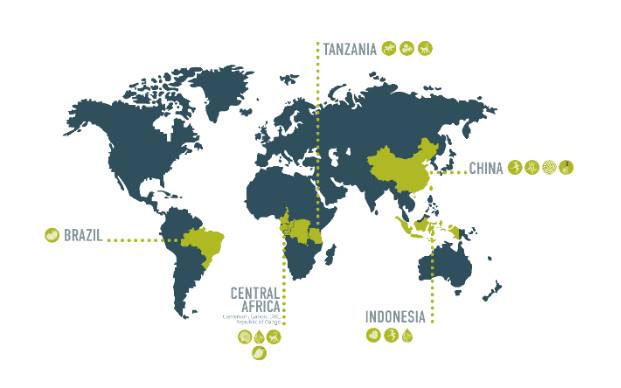 The Trade, Development and Environment Hub project (TRADE Hub),a global multidisciplinary project funded by the UK Research and Innovation Global Challenges Fund (UKRI GCRF), which convened over 50 partners spanning across international organizations, research institutions, academia, and civil society in Brazil, China, Indonesia and Central African Countries.
 The TRADE Hub aimed to identify and create opportunities for improving the environmental and social sustainability in the global-to-local trading system of six (6) major agricultural commodities, wild meat and wildlife.
As a leading partner, UNEP - through the Environment and Trade portfolio, enhanced the environment and trade policy interface identifying potential solutions and pathways to make trade an enabler of a sustainable agriculture sector, and supportive of the Kunming-Montreal Global Biodiversity targets.
To achieve this, UNEP delivered policy advice through knowledge products, tools, multistakeholder dialogues which raised the profile of nature in the international trade fora, including through nature-positive trade discussions at the World Trade Organization (WTO); and forged partnerships between key actors including the WTO and the Convention on Biological Diversity (CBD) to pave the way for improved cooperation in the context of the Kunming-Montreal Global Biodiversity Framework, which resulted in hosting the first ever ‘Trade Day’ at CBD COP16, in collaboration with UNCTAD, WTO and CBD Secretariats.
-
Mining and Metals
UNEP promotes sustainable practices across mineral supply chains, advancing circular economy approaches and supporting countries in integrating environmental priorities into trade and investment policies, UNEP helps ensure that the sector’s global reach becomes a lever for sustainability. Harnessing trade as a pathway for environmental cooperation, resource efficiency and equitable growth, the mining and metals sector can play a pivotal role in achieving the Sustainable Development Goals and accelerating a just transition to a low-carbon future.
The mining and metals sector is a cornerstone of the global economy, supplying the essential raw materials that make modern life possible. From the infrastructure that connects communities, to the technologies driving digital innovation, to the minerals powering the clean energy transition, its reach is vast. This scale of influence comes with equally significant environmental and social footprints: intensive resource use, biodiversity loss, water and soil degradation, waste and pollution, and substantial greenhouse gas emissions.
Minerals and metals are therefore among the most traded commodities in the world. Rapidly growing demand for critical minerals such as lithium, cobalt and rare earth elements, driven by the shift to renewable energy, electric mobility, and low-carbon technologies, is reshaping trade flows and investment landscapes. These dynamics create opportunities for sustainable growth, but also heighten the need for strong safeguards to ensure that the benefits of trade do not come at the expense of ecosystems or communities.
UNEP’s work on mining and metals:
-
Sustainable Trade in Resources: Global Material Flows, Circularity and Trade
-
Trade in Minerals Critical for Climate Transitions and the Green Economy: Developing Country Perspectives and Pathways for International Cooperation Trade in Minerals Critical for Climate Transitions and the Green Economy: Developing Country Perspectives and Pathways for International Cooperation
-
-
Past work