
• Overview
  • Why does it matter?
  • About the project
  • Global Inventory
  • Case Studies
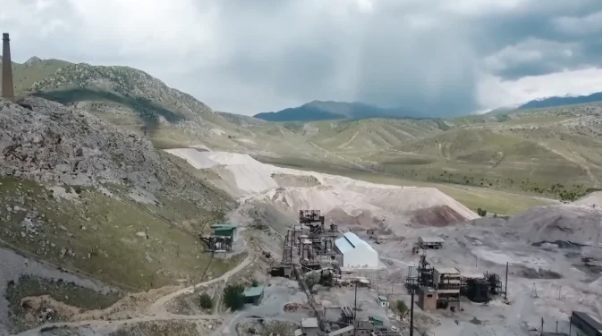
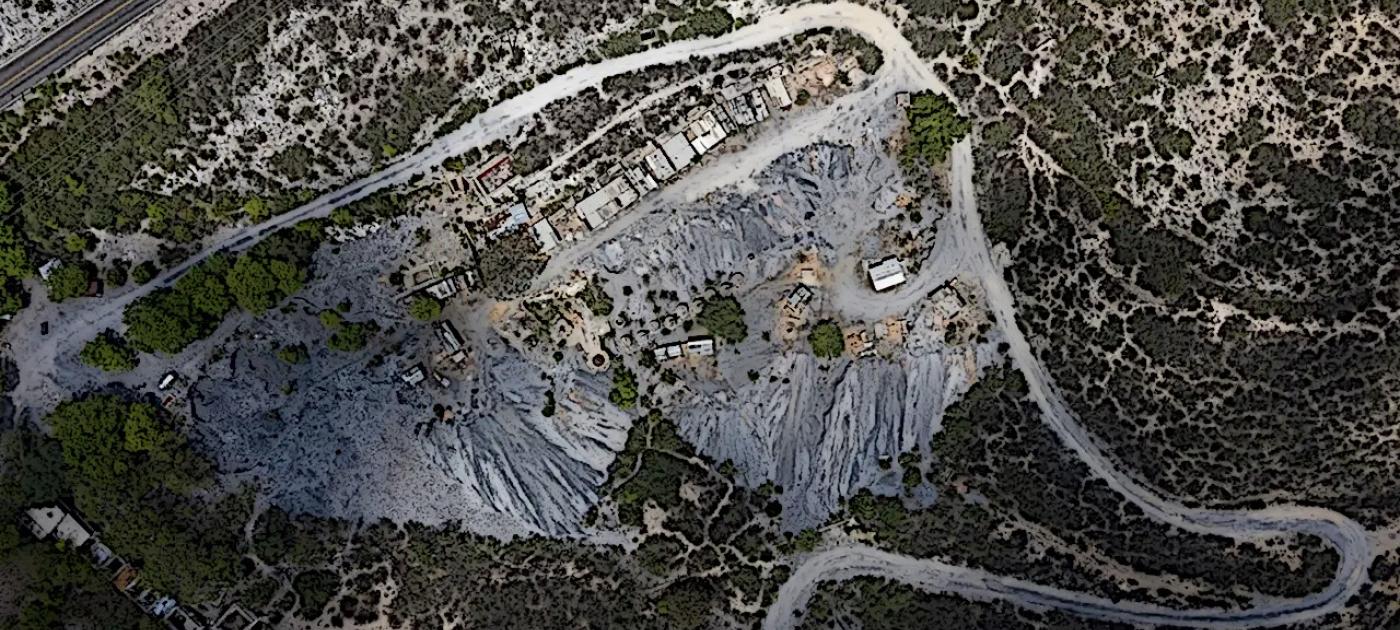
smelting furnaces at the Camargo mine
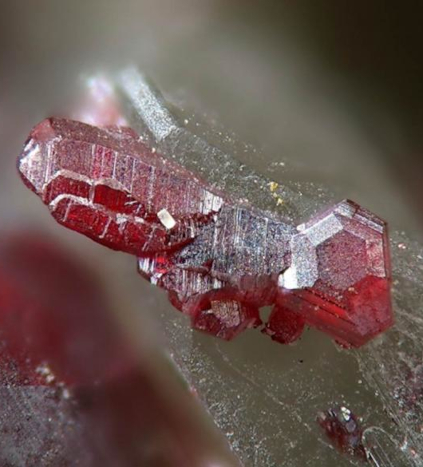
Cinnebar. Source: Christen Weizer

Mercury is a highly toxic substance posing long-term risks to human health and the environment. Its impacts are often invisible, but long-lasting, affecting human health and ecosystems.

While many mercury mines have closed or partially rehabilitated, their environmental and social legacies remain in soil, water, and community livelihoods.

Learn more why it matters, read the case studies, and explore the inventory of mercury mines around the world.

     Resources  

     News  

     Events
 

Cinnabar - a mercury sulfide ore - has been mined for thousands of years, with evidence of extraction across several ancient civilizations, including Egypt, Rome, China, and India. The purposes are multiple: for remedies, ceremonial purposes, and as a pigment. Major, large-scale industrial mining and use of mercury for gold and silver extraction gained momentum in Roman times (in Spain for example) and boomed at the global level before the year of 1900.

Mercury is not just a technical or localized challenge. It moves, spreads, and persists globally. It is a human and environmental reality that often remains unseen until the impacts are felt.

Impact on nature and ecosystems

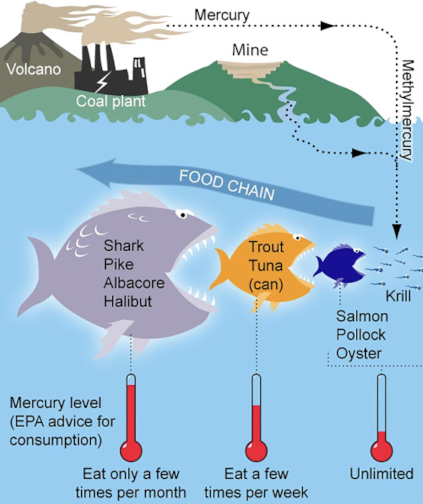
What begins at a mining site does not stay there. Mercury released into the environment travels through air and water, settling into soils, rivers, and oceans. It enters the food chain, accumulates in fish, and ultimately reaches people who are often far from the original source.

mercury poisoning circle
Mercury poisoning. Source: Bretwood Higman, Ground Truth Trekking

Mercury disrupts the entire ecosystems:

  • In water bodies, it transforms into methylmercury, a highly toxic form that builds up in fish and wildlife.
  • Predatory species accumulate higher concentrations, affecting biodiversity and ecological balance.
  • Contaminated soils reduce land productivity and affect vegetation.

These impacts are long-term. Even after mining stops, mercury can remain in the environment for decades, continuing to circulate and cause harm.

Impact on people and communities

For communities living near mercury mining areas, exposure is direct and immediate. Mercury can affect the nervous system, kidneys, and overall development. It poses particular risks to children and pregnant women. Health impacts are often invisible at first, but irreversible over time.

At the same time, for many, mercury mining is not a choice, but a necessity. It provides income where few alternatives exist. This creates a difficult balance: economic survival today versus long-term health and environmental risks. Without viable options, change is not possible.

A global problem requires a global response

Because mercury travels across borders, no country can address this issue alone. The Minamata Convention on Mercury was adopted to protect human health and the environment from mercury across the world. It provides an international framework to:

  • Control the supply and trade of mercury
  • Reduce emissions and releases into the environment
  • Phase out or restrict mercury use in products and processes
  • Support safer alternatives and sustainable practices.

Mercury and mining under the Minamata Convention

The Convention recognizes primary mercury mining as a critical source of supply. Key Convention provisions include:

  • No new primary mercury mines
  • Phase-out of existing primary mercury mining within a defined timeframe
  • Control of mercury trade to ensure it is only used for allowed purposes
  • Environmentally sound management of mercury stocks and wastes.

These measures are designed to “turn off the tap”, to stop new mercury from entering global supply chains. Reducing demand is important. But without addressing supply, mercury will remain available, affordable, and in circulation to flow into products, processes, and the environment.

Turning off the tap means:

  • Limiting new mercury entering the global market
  • Reducing long-term environmental accumulation
  • Supporting a transition toward safer alternatives.

Connecting global supply chains to local realities

Mercury is traded globally, but its impacts are often local. Communities near mining sites bear the environmental and health burden, while mercury moves through international supply chains into various uses.

To address this imbalance, we need to:

  • Improve transparency on where mercury comes from
  • Strengthen monitoring and governance
  • Support communities to transition to safer livelihoods.

GEF and UNEP logos

Ongoing project (2021, 2026)

Implemented by the United Nations Environment Programme with support from the Global Environment Facility, the project “Reducing global environmental risks through the monitoring and development of alternative livelihood for the primary mercury mining sector in Mexico” focuses on understanding, monitoring, and reducing environmental risks from primary mercury mining, while supporting pathways toward safer and more sustainable alternative livelihoods in the state of Queretaro, Mexico.

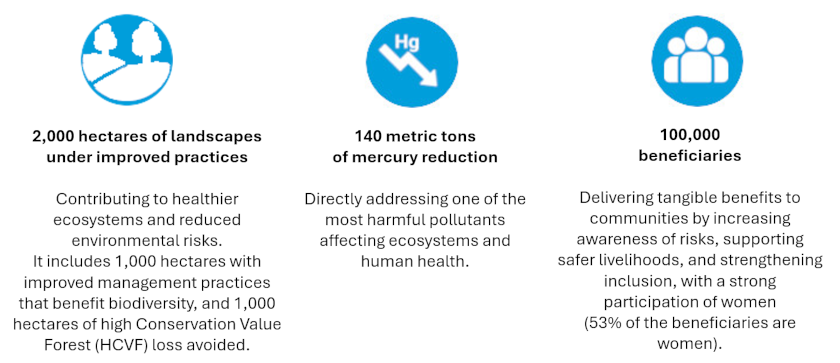
Project Targets

targets

Two core areas of action

Understanding and Controlling Mercury Mining

The project builds a clearer, evidence-based picture of mercury mining and strengthens the ability of institutions to manage and reduce its impacts. Key activities include:

mapMapping and characterizing mercury mining sites
Developing a more complete and continuous understanding of contamination, beyond isolated studies

monitoringEstablishing monitoring systems
Strengthening the ability to measure mercury emissions and releases over time

high riskIdentifying high-risk sites and planning responses
Prioritizing contaminated areas and developing site-specific remediation strategies (when possible)

regulationReviewing and strengthening regulations
Assessing legal gaps and supporting updates to align with the Minamata Convention, especially on mercury supply and trade

capacityBuilding institutional capacity
Training and equipping authorities to better identify, quantify, and manage mercury risks with a coordinated approach

Supporting Transition to Alternative Livelihoods

Recognizing that mining is often a source of income, the project supports communities in identifying and transitioning to safer economic activities. Key activities include:

economicsIdentifying viable alternative livelihoods
Assessing economic options suited to local conditions and capacities

sustainabilityAssessing feasibility and promoting uptake
Supporting the adoption of alternatives that are both environmentally sound and economically viable

megaphoneRaising awareness among communities
Improving understanding of mercury risks and obligations under the Minamata Convention

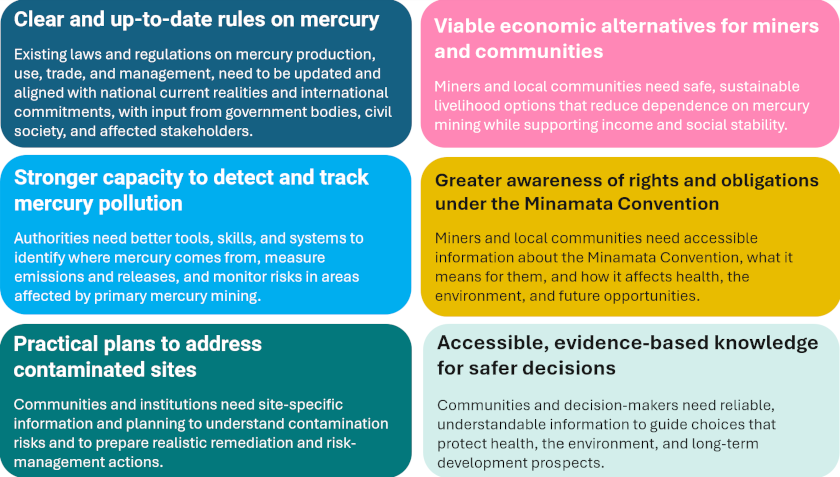
The project responds to six urgent needs

needs


Considering its legacy, it is imperative to maintain a global inventory of mercury mines and their status for monitoring purpose. The below interactive world map will help you identify where mercury mining has taken place or is ongoing and understand geographic patterns and legacy risks.  The map is continuously updated as new information becomes available.

Stories from rehabilitations efforts around the world

Aidarken/Aydarken Mercury Mining Area, Kyrgyzstan

For decades, the Khaidarkan mercury mine helped supply the world with primary mercury. But the same operation also tied one community’s future to a toxic industry under growing international pressure. In response, UNEP and partners supported Kyrgyzstan to begin a different kind of rehabilitation effort: not just cleaning up contamination, but reducing immediate risks, planning remediation, and creating conditions for alternative jobs and industries.

Aidarken

In Aidarken, rehabilitation was not a single engineering intervention. It was a broader transition strategy. Environmental experts assessed contaminated sites. Economic studies examined how other minerals and local industries could reduce dependence on mercury. Community-focused activities, including work with UNDP, sought to expand alternative employment opportunities. The goal was clear: make it possible to move away from mercury without abandoning the people whose lives had long depended on it.

The case shows that in active or recently active mercury mining areas, rehabilitation is rarely only about land. It is about risk reduction, social stability, economic replacement, and political feasibility at the same time. Khaidarkan demonstrates both the necessity of acting on mercury supply and the difficulty of doing so where a town, its jobs, and its infrastructure remain tied to the mine.

Almadén Mine, Spain

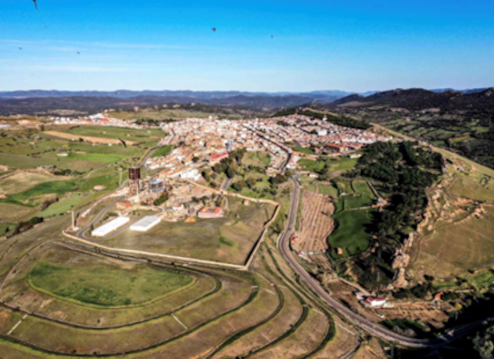
The Almadén mining district in Spain had been one of the most important sources of mercury in the world for more than two millennia. At peak, it supplied up to one third of global production, which was central to historical gold and silver extraction processes but also left behind a complex environmental legacy. When the mine closed in 2002, the challenge was not only to manage contamination, but to redefine the future of an entire community.

Almaden mine

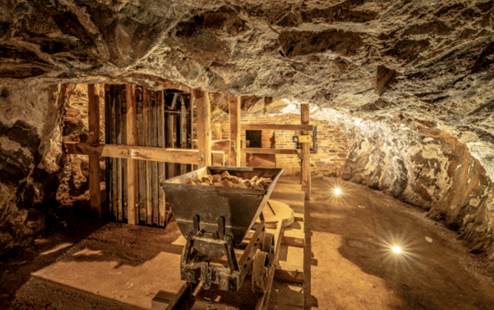
Rather than abandoning the site, Spain chose to transform it. Firstly, mining infrastructure on the ground and underground was stabilized; contaminated materials were contained and managed; long-term monitoring was carried out to prevent further dispersion of mercury into the environment. Secondly, instead of dismantling, the Government preserved and repurposed the industrial infrastructure into public space for education, memory, and public engagement. Visitors can now walk through former shafts and learn how mercury shaped global history and why its impacts matter today. At the same time, the local economy began to shift, with tourism and cultural activities gradually replacing extraction.

Almaden mine

Almadén shows that rehabilitation can go beyond environmental management. It can become a process of reframing identity, reusing infrastructure, and building new economic pathways. The site no longer produces mercury. Instead, it produces knowledge about history, risk, and transition. In 2012, Almadén was inscribed as a UNESCO World Heritage Site as a recognition of its global historical significance in mercury production.