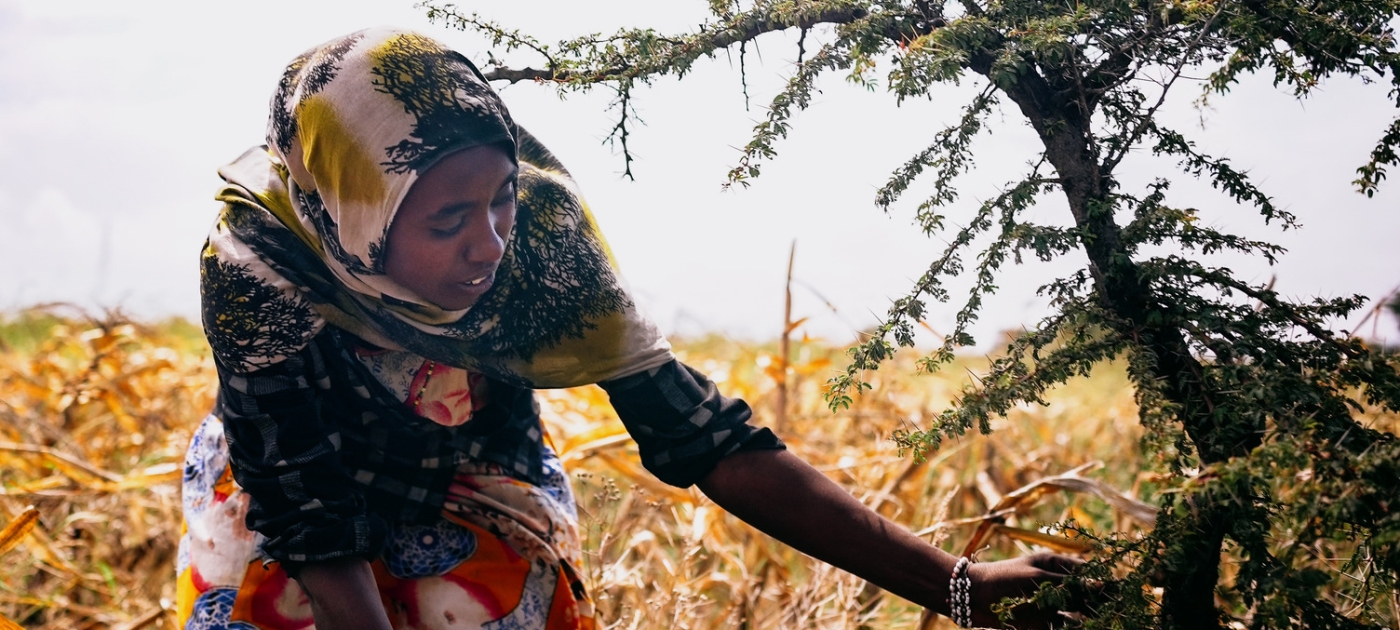
Addis Ababa, 25 May 2026 – Ethiopia is scaling up nature-based solutions to tackle the growing impacts of climate change, with the launch of a new US$ 9.8 million project supported by the Least Developed Countries Fund of the Global Environment Facility and implemented by the United Nations Environment Programme (UNEP).
Scaling up the Green Legacy Initiative best practices to enhance the climate resilience of smallholder farmers and vulnerable groups in Ethiopia will strengthen the resilience of vulnerable communities by expanding ecosystem-based adaptation approaches across the country, in a way that prepares for the future climate.
“Restoration must go beyond tree planting — it is about restoring ecosystems in ways that strengthen livelihoods, protect watersheds, improve soil and water systems, and help communities withstand future climate shocks,” said Margaret Oduk, Head of UNEP’s Addis Ababa Liaison Office.
Implemented in partnership with the Government of Ethiopia through the Ethiopian Forestry Development as lead Executing Entity, the Pastoral and Environmental Network in the Horn of Africa , the Center for International Forestry Research, national institutions, implementing regions and Woredas, this project builds on the strong foundation of the Green Legacy Initiative (GLI) while deepening its adaptation impact.
“The Green Legacy Initiative is more than a restoration effort — it is about building climate resilience, creating green jobs, improving food security, and empowering women and youth, while strengthening ecosystems across Ethiopia,” said H.E. Ato Kebede Yimam, Director General, Ethiopian Forestry Development.
Ethiopia is already experiencing the impacts of climate change, including rising temperatures, erratic rainfall, recurrent droughts and floods, and ensuing widespread land degradation. These changes are placing significant pressure on ecosystems and rural livelihoods.
For millions of smallholder farmers who depend on rain-fed agriculture, these impacts are reducing agricultural productivity, increasing food insecurity, and exacerbating water scarcity. Economic losses are also mounting, with climate impacts already estimated to reduce Ethiopia’s GDP by 1–4 per cent, projected to reach up to 10 per cent by 2045 without effective adaptation measures.
Strengthening resilience of people and ecosystems
By promoting ecosystem-based adaptation across three regions - Oromia, Amhara and Central Ethiopia - and six districts in Ethiopia’s midlands and highlands, the project will:
- Restore 18,000 hectares of degraded forest and agricultural landscapes and place 42,000 hectares of natural forest under climate-resilient sustainable management
- Place 7,200 hectares under climate-resilient plantation forestry and agroforestry
- Support 3,000 people with climate-resilient livelihoods and improved market access
- Provide climate information services to inform adaptation planning
- Strengthen institutional capacity, financing mechanisms and knowledge management to scale up climate-resilient GLI best practices
Integrated solutions for long-term resilience
By bringing together sustainable forest management, restoration of degraded forest landscapes, climate services, and livelihood support, the initiative moves beyond isolated interventions to tackle the multiple crises of climate change, biodiversity loss, and rural poverty in an integrated landscape and ecosystem-based adaptation approach.
Beyond its immediate impact, the project aims to position Ethiopia as a regional leader in ecosystem-based adaptation, generating scalable solutions that advance national climate goals, national adaptation priorities and global commitments under the Paris Agreement and the Sustainable Development Goals.
NOTES TO EDITORS
About the United Nations Environment Programme (UNEP)
UNEP is the leading global authority on the environment. It provides leadership and encourages partnership in caring for the environment by inspiring, informing and enabling nations and peoples to improve their quality of life without compromising that of future generations.
About the Global Environment Facility
The Global Environment Facility (GEF) is the world’s largest multilateral fund for the environment. Its family of funds works together to address the planet's most pressing challenges in an integrated way. Its financing helps developing countries address complex challenges and work towards meeting international environmental goals. Over the past three decades, the GEF has provided more than $27 billion in financing, primarily as grants, and mobilized another $155 billion for country-driven priority projects.
For further information, please contact:
News and Media Unit, UN Environment Programme