Good morning.
Thank you very much to my two Nairobi sisters here, Zainab Hawa Bangura and Anacláudia Rossbach, my co-conspirators and, as Zainab just said, “partners in crime”. As I was listening to Zainab deliver her opening remarks, I was thinking of John Lewis, the African American civil rights leader and US politician, who spoke about “getting in good trouble”, fighting for the things that are right. I think we are the three sisters who get up to “good trouble”. And good trouble is also something that women have to get up to. That's part of the conversations that we are having here. So, let me begin by being a bit provocative.
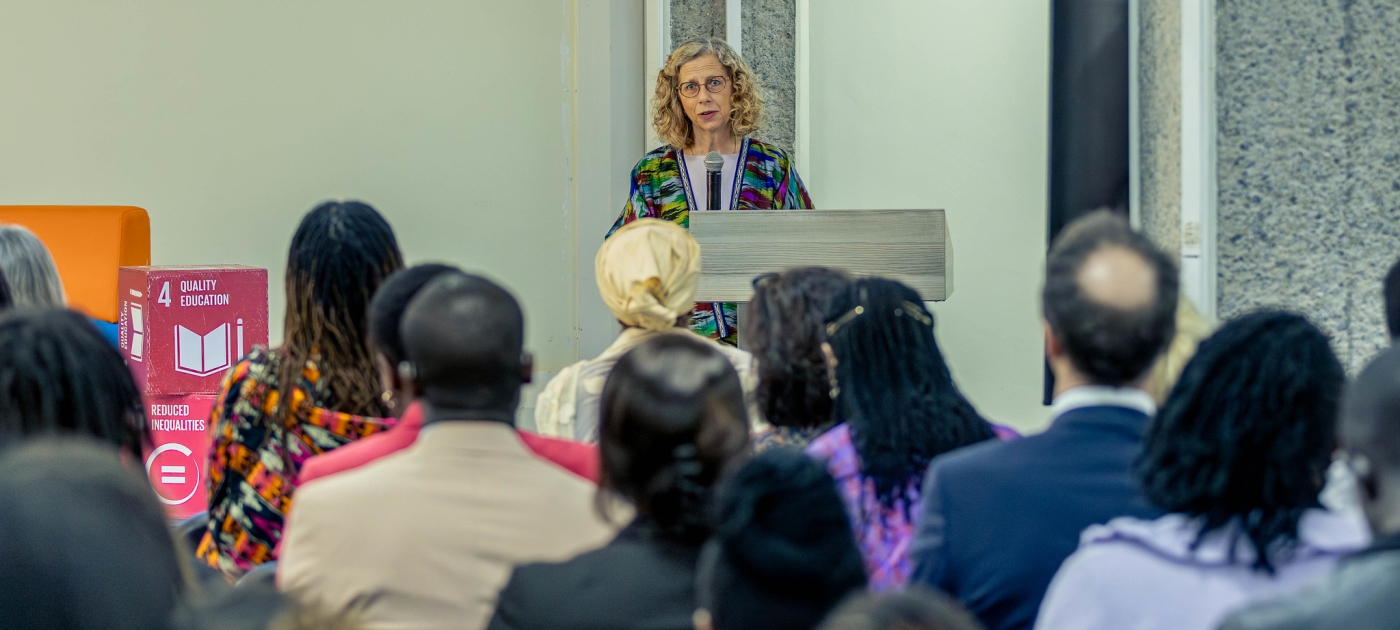
I noticed the Sustainable Development Goals (SDGs) displays that were put up here on the stage. Did you notice? We have gender equality, of course. We have equality of education, and we have incoming equalities. But where is climate? Where is biodiversity? Below water and above water. Where are cities? Someone forgot. And we must not forget. When we think of gender we must see it through every lens of the SDGs. Because gender is an element that transcends it all. After all, we are talking of half of humanity.
We cannot forget who is managing and safeguarding the resources we rely on – energy, biodiversity, water and much more. It is women. That’s why we must think in this integrated way. And that is what both UNEP and UN Habitat bring to the table. Because gender matters across the board.
And we see that, yes, we have travelled a long way, but we still have a long way to go. Globally, women hold just 64 per cent of the rights that men hold. There are issues over land ownership, inheritance rights, issues of freedom of movement, issues of agency over our bodies body and women’s rights to make decisions and life choices. This is not just an isolated issue. We see this in a significant number of countries. And this simply cannot be so in the year 2026.
And when women are exposed to violence or denial of their equal rights, we, not infrequently, see discriminatory laws, harmful social norms, inadequate protection and skewed enforcement systems that do not believe the woman, but tend to believe the man. Justice therefore must be the foundation to the equality that we seek.
And justice is something we must talk about. Justice that comes from equal access to education, that comes from having a voice, that comes from equality under the law, that comes from agency over our bodies and our life decisions.
And, of course, we cannot build a sustainable future with just half the population – I think we all understand that. When women are part of the science and STEM sectors and when we have a seat at the table, we see how women contribute --not only in the social sectors where women have always been engaged – be it health, education and caring,-- but also in the fields such as science, engineering, technology and mathematics – all essential to building a sustainable tomorrow.
In this regard, I want to say that, from UNEP's side, we are really happy that we were named a “best performer” on gender markers in SWAP – the UN system-wide Action Plan – and that we also received “the most improved performance award”. We will continue to strive to do even better because the work is never done. In UNEP, however, we have now reached gender equity in all professional grades, but we have gender inequity in our general staff still. We are working hard on this.
In our programmatic work, we are aiming to support more women-led research with women scientists. At UNEP, one of our key areas of work is biodiversity. And from the science, we know that a biodiverse ecosystem is stronger, more resilient to any fungi, any pathogen, any disease that might hit it. The diversity of the ecosystem makes it stronger. That's biodiversity for you. The same principle applies to our societies: when diversity is fully reflected, society as a whole becomes stronger, better ideas and sharper innovation.
Yes, progress is real across the board. For example, almost half of the women working on Intergovernmental Panel on Climate Change (IPCC) seventh assessment cycle reports are involved thanks to the work of the former Gender Action Team. This is good. But we are still catching up.
The reality is it remains at times a challenge for us at UNEP to find women scientists who have the seniority and the publication record behind them to speak with authority on issues. And this is why we need to bring in young women scientists, to support them and allow them to gain the experience they need, whether in UNEP and in our scientific settings – like the IPCC, or the Intergovernmental Science-Policy Platform on Biodiversity and Ecosystem Services (IPBES), as well as the newly created Intergovernmental Science-Policy Panel on Chemicals, Waste and Pollution (ISR-CWP).
One area that I also want to highlight is the environmental defenders. We know that nearly 200 environmental activists are murdered every year. And many of these are women. They are standing up for the environment. They are standing up against polluting industries. They are standing up against land crime. They are standing up for their rights, the rights of their families, and their future. It is critical that we hear these voices and that we at UNEP do all we can to work to protect environmental defenders and their families.
My first role model in the UN was Ellen Johnson Sirleaf. At that time, she was Head of UNDP’s African Bureau, so her big career lay before her – although to those of us working with her it was clear that her path would be one of trailblazing. But she was magnificent for us younger women. And I will always remember that she used to say, “if your dreams do not scare you, your dreams are not big enough.” I think that it is such a glorious saying, because we must look at what we can be. How far we can reach, what might be possible.
And one person who reached far and made her dream come true is the Nobel Prize winner, Wangari Maathai - another much admired woman. An environmentalist who fought with her body as well as with her brain.
She fought for land rights, for the right of people and families to have access to green and clean settings. She ignited a movement – the Greenbelt Movement – arguing that green spaces is critical. And here, right next door to the UNEP compound, she fought for Karura forest, an urban forest which must be protected under any circumstances. It is a breathing lung for Nairobi. She showed that women’s empowerment and ecosystems work hand in hand. A PhD in biological sciences, a brilliant woman, who was in the STEM sciences and who showed true, true leadership.
The power is in small acts she said. She often spoke of the story of the forest fire. When there is a forest fire, what can you do? The fire is ablaze. Everyone gives up. But then there is a little hummingbird that flies to the river. It picks a single drop of water from the river in its tiny beak. And it flies back to the forest and drops that single drop of water on the flames. All the other animals ask why do you bother? What will that change? And Wangari said, that the hummingbird said: “I am just doing what I can to help.” And that is indeed what we all must do.
We have to be inspired by those leaders. We have to step into this space. We have to show true leadership because we know that the spotlight on women is not one day or one month. It has to be every day, because women do hold up half the sky. That is why I am happy with my Nairobi sisters here, and the good trouble that we make. Thank you to SIDA for their support. And thank you, everyone here today at this event, for championing this important work every step of the way.