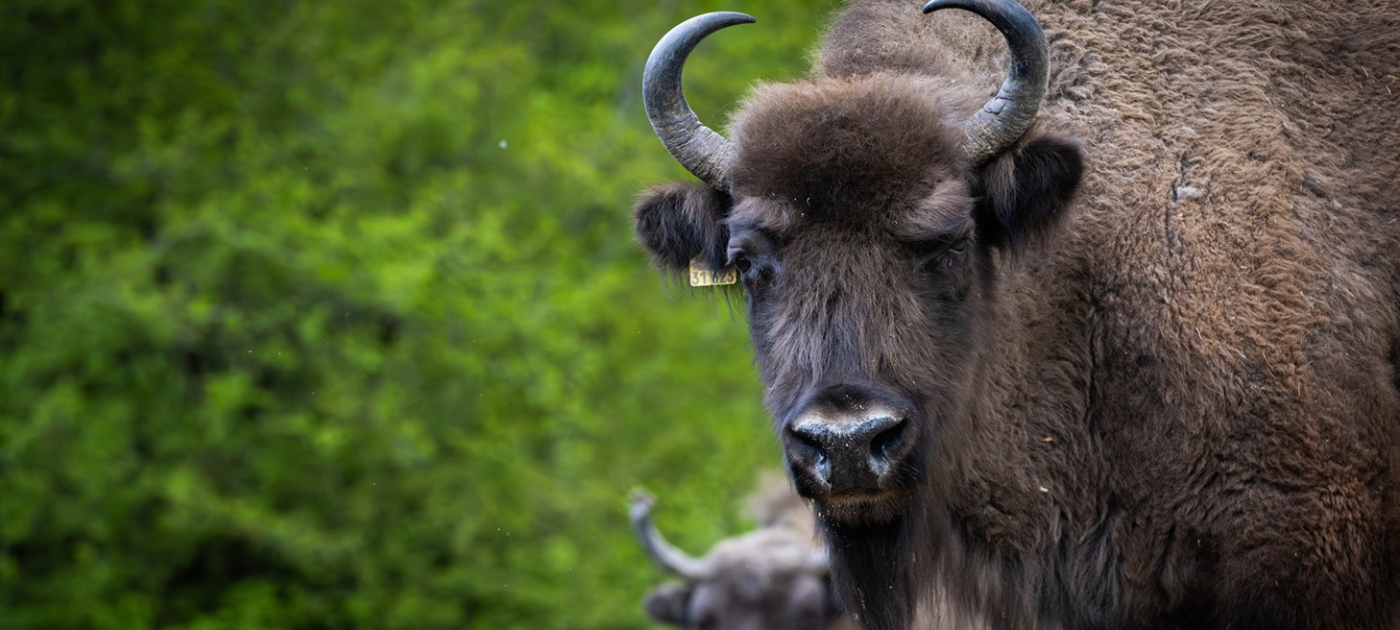
In the dappled shade of Azerbaijan’s Shahdagh National Park, beneath the snowy peaks of the Caucasus Mountains, lumber shaggy beasts not seen in these forests for over a century.
Many of these bison, a hybrid of the lowland and Caucasian varieties, were plucked from European zoos and transplanted to the park over the last seven years. There are now around 90 of the animals living in Shahdagh, including several pregnant females.
These bison are helping to revive the plains on which they roam, stabilizing the mountain grasslands on which local communities rely for food, fresh water and tourism income.

They are part of a broader national effort to restore Azerbaijan’s ecosystems by reintroducing species, including those that have gone extinct in the wild. That push is designed in part to help blunt the effects of climate change, which has been raising temperatures, disrupting precipitation patterns, and increasing the risk of wildfires and landslides across the country.
“Whenever we help nature to be healthy, nature delivers on more than one front,” says Mirey Atallah, the head of the Adaptation and Resilience branch of the United Nations Environment Programme (UNEP). “In the long term, we're delivering benefits for people in terms of climate mitigation and adaptation and societal resilience.”

Restoring ecosystems helps temper the effects of climate change in many different ways. For example, replanting mangroves can buffer coastal communities against increasingly severe storm surges and sea-level rise. Reviving wetlands can recharge groundwater supplies, crucial during times of drought. And seeding vegetation along hillsides can prevent landslides triggered by heavier-than-normal rains.
“Ecosystem restoration helps human social and economic systems to cope with multiple climate shocks,” explains Atallah.
Reintroducing native species, known as rewilding, is one of many restoration techniques – and among the most effective, she adds.
Ecosystem engineers
Victims of overhunting and habitat loss, the last wild Caucasian bison was killed in 1927. Elshad Askerov, head of World Wildlife Fund Azerbaijan, explains that during the Soviet period, many other species were pushed to the brink of extinction. “Soils and forests were severely overused, and many animals lost their habitats,” he says.
“We now have a historic opportunity to restore our species.”

The bison rewilding project is the result of an ambitious cooperative effort involving partners across Europe; along with WWF, these include the Azerbaijan Ministry of Ecology and Natural Resources, Azerbaijani non-profit International Dialogue for Environmental Action, Tierpark Berlin, and the international breeding program for the European Association of Zoos and Aquaria. It was co-financed by Rewilding Europe.
Large animals like bison, Askerov explains, act as “ecosystem engineers,” distributing seeds through their waste and changing the composition of the soil. Their movement and grazing habits can clear dense undergrowth, creating mosaic patterns of vegetation that allow grasslands to recover and attract smaller herbivores. “Grasslands like these also attract different insects, and insects attract different bird species,” adds Askerov. “This is how an ecosystem can recover, and a richer ecosystem is more resilient against climate change.”
Shahdagh’s bison were brought to Azerbaijan from European zoos, where a breeding program crossed European lowland bison with the last remaining Caucasian male. Since the bison’s release into the wild, more than 25 calves have been born in the national park. Over the next 25 years the programme aims to grow this herd to 500 individuals – the minimum number required for a sustainable population.
Restoring the food chain
Azerbaijan’s rewilding programme extends to other threatened species as well, including the goitered gazelle that once grazed the lowlands and foothills of the Caucasus in the tens of thousands.

In 1960 zoologists counted less then 200 gazelles in the entire country, their numbers decimated by poaching and habitat loss. But thanks to the establishment of wildlife reserves and the reintroduction of over 1,000 animals, there are now around 7,000 wild gazelles living in Azerbaijan’s semi-arid Shirvan National Park.
Like bison, gazelles impact the land through their grazing patterns. But they also play another important role in the ecosystem – as prey for endangered carnivores, such as European lynx, striped hyenas and gray wolves. “Because this prey species is now numerous, the population of endangered carnivore species has started to recover,” says Askerov. “In a food chain, every link is important.”

The bison reintroduction project, meanwhile, is being carefully watched by other environmental groups in the region, and one of Azerbaijan’s neighbors has already shown interest in replicating it.
“The rewilding projects are very successful in Azerbaijan – they are a model for other Caucasian countries,” says Askerov. “We hope that eventually, these different herds will meet each other and become one big Caucasian population.”
---
About World Environment Day
World Environment Day, celebrated annually on 5 June, is one of the planet's largest platforms for environmental outreach and is led by the United Nations Environment Programme (UNEP). This year's iteration, hosted by Azerbaijan, will focus on the mushrooming climate crisis. See how you can get involved.
Written by: Hilary Heuler
Reviewed by: Mahir Aliyev, Arnold Kreilhuber, Mirey Atallah