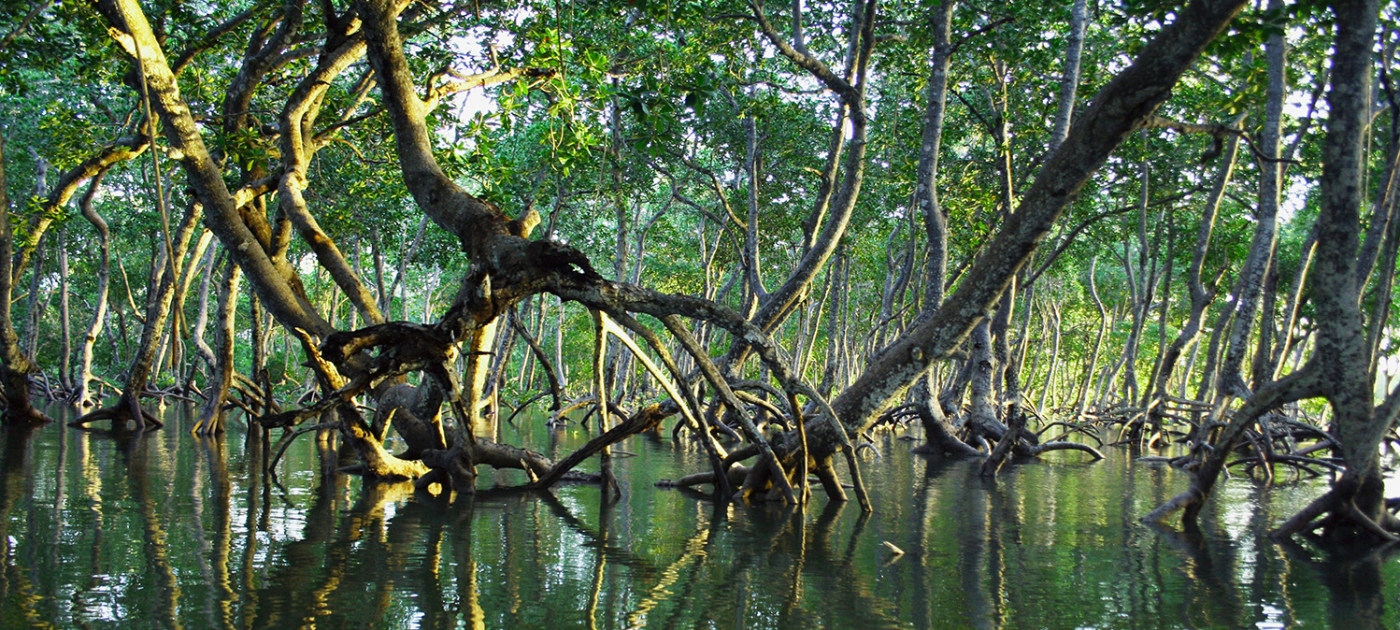
For decades, mangrove forests were considered one of the world’s fastest disappearing ecosystems, due to pressures from coastal development, overharvesting, aquaculture, agriculture, pollution and climate change.
However, a global study that recently appeared in the journal Science offers one of the most encouraging conservation stories in recent years. Using satellite imagery from the 1980s to 2023, researchers tracked annual changes in mangrove extent and canopy condition, finding that global losses have slowed dramatically while gains have increased. It appears that natural regeneration and expansion are now offsetting much of the historical decline, suggesting that mangroves are far more resilient than previously believed. These findings reinforce conclusions from UNEP’s 2023 report, The Decade of Mangrove Forest Change, which found that global mangrove losses had largely stabilized and gains were occurring in and around many of the world’s major rivers, estuaries and deltas.
“This is encouraging news for global restoration and conservation efforts at a time when we all need that glimmer of hope,” says Sinikinesh Beyene Jimma, Chief of Marine and Coastal Ecosystems Unit at the United Nations Environment Programme (UNEP). “But it is important to remember that there are threats, like pollution and biodiversity loss, that satellite imagery does not reveal.”
Mangrove forests represent unique ecosystems along tropical and subtropical coastlines and estuaries. Although comprising less than 1 per cent of the world’s tropical forests, they provide a vital lifeline for the estimated 2.4 billion people living within 100 kilometres of the coast, shielding shorelines from storms, erosion and flooding, filtering water, storing large amounts of carbon and supporting fisheries. More than 1,500 species depend on mangroves as their habitat.
“It is hard to overstate the role these forests play in the life of coastal communities,” Beyene Jimma says. “This is why we put so much emphasis on science-based conservation.” In line with the Kunming-Montreal Global Biodiversity Framework, UNEP advocates the restoration of 30 per cent of degraded marine and coastal ecosystems and the protection and better management of at least 30 per cent of the ocean.
Around the world, UNEP and its partners are supporting projects that draw on the latest science and local knowledge to support local communities in their mangrove restoration and conservation efforts.
Building the foundation for long-term restoration
In Kenya’s Lamu seascape, the Kenya Marine and Fisheries Research Institute (KMFRI), supported by UNEP and the International Coral Reef Initiative (ICRI), laid the scientific foundations for large-scale restoration by mapping mangrove and seagrass ecosystems and producing baseline ecological data to guide future conservation efforts.
The project also trained 50 community members in blue carbon assessment and restoration, developed technical guidance for mangrove restoration and species identification, and supported the development of national restoration guidelines. Building on this work, a larger blue carbon initiative run by the EU-funded Go Blue project now manages nearly 5,000 hectares of mangroves through restoration, avoided deforestation and improved forest management. The project has also advanced efforts to develop sustainable blue carbon financing mechanisms.
Empowering communities to restore degraded forests
In Costa Rica’s Golfo Dulce Hammerhead Shark Sanctuary, Misión Tiburón restored 68 hectares of degraded mangrove habitat with support from UNEP and the International Coral Reef Initiative (ICRI). Community members established mangrove nurseries, collected and planted more than 12,000 native seedlings, and created permanent monitoring plots to track recovery.
The project also trained park rangers and residents, generated temporary employment for fishing communities and reached more than 1,500 students through environmental education programs. Early monitoring showed an average seedling survival rate of over 80 per cent, demonstrating the effectiveness of community-led restoration.
Making conservation work for people as well as nature
In Benin’s Mono Delta Biosphere Reserve, UNEP’s Small Grants Programme, implemented through International Union for Conservation of Nature - the Netherlands (IUCN NL) and Eco-Benin, combines ecological restoration with community stewardship, traditional governance and sustainable livelihoods.
Rather than relying only on tree planting, the project restored natural water flows by constructing more than 3.6 kilometres of restoration canals, allowing mangroves to regenerate naturally. Communities also designated new sacred mangrove areas, protected under traditional governance systems, while women received training in solar salt production to reduce their dependence on mangrove wood.
Building on customary knowledge, the initiative helped protect more than 530 hectares of mangroves. Alongside restoration, the project is developing blue carbon financing mechanisms that could generate long-term income for conservation while supporting local communities.
Scaling up restoration through regional cooperation
The Implementing the Strategic Action Programme for the South China Sea and Gulf of Thailand (SCS SAP) project, led by UNEP and funded by the Global Environment Facility, brings together Cambodia, China, Indonesia, the Philippines, Thailand and Viet Nam to restore and sustainably manage critical coastal ecosystems.
The programme supports the declaration of 57,400 hectares of mangroves as protected areas, management planning for an additional 166,600 hectares, sustainable-use reforms covering 602,800 hectares, and large-scale restoration and enrichment planting. It also works alongside efforts to restore coral reefs, seagrass meadows and wetlands, recognizing that healthy coastal ecosystems are interconnected.
A recovery worth protecting
The global recovery of mangroves shows that science-based conservation efforts led by local communities deliver results. However, future progress will depend on sustained investment, sustainable management and long-term protection.
The examples from Kenya, Costa Rica, Benin and Viet Nam demonstrate how science, local stewardship, innovative financing and international cooperation are helping one of the world’s most valuable coastal ecosystems make a remarkable comeback.
The International Day for the Conservation of the Mangrove Ecosystem is celebrated every year on 26 July and aims to raise awareness of the importance of mangrove ecosystems as “a unique, special and vulnerable ecosystem” and to promote solutions for their sustainable management, conservation and uses.