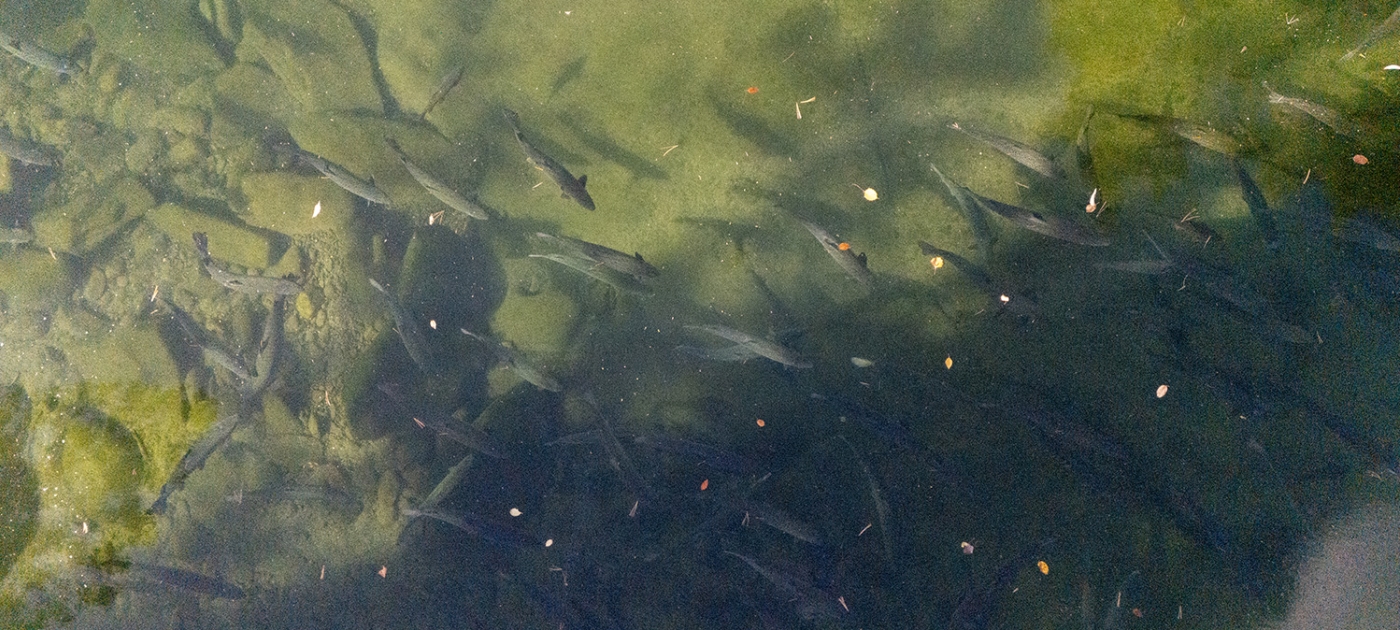
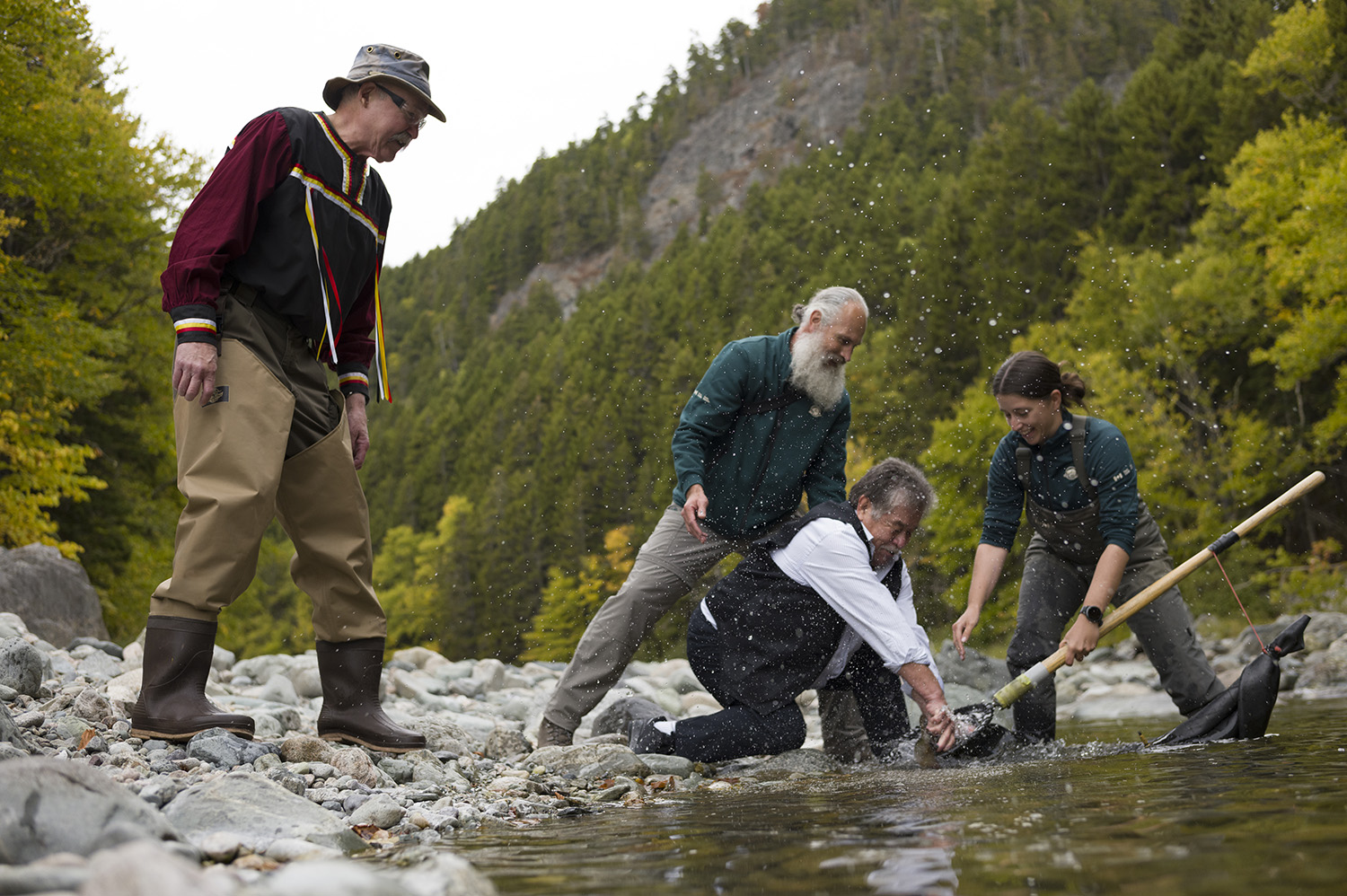
Preparing to release several hulking fish into the shallows of a Canadian river, a group of Indigenous leaders and scientists hold a traditional ceremony for an event that some thought they would never see – the return of the Atlantic salmon.
“Don’t be afraid of people telling you, ‘Oh, that species will never come back’,” said Rebecca Knockwood, Chief of Fort Folly First Nation, a Mi’gmaw community in New Brunswick. “Don’t be afraid to prove them wrong.”
Indigenous and local communities are at the heart of an initiative called “Respectful Returns” that was developed in 2010 by Parks Canada, collaborating with these communities and other partners to restore wild salmon populations in rivers and streams in seven national parks along the Pacific and Atlantic coasts of Canada. By addressing the habitat degradation and over-exploitation that have pushed various species toward extinction, Respectful Returns has seen wild populations of the fish increase in six of the seven areas – giving hope that both the ecosystems, and the cultural heritage that they represent, can be secured for future generations.
In recognition, the United Nations has named Respectful Returns a World Restoration Flagship, an award extended to outstanding examples of landscape and seascape restoration that can inspire similar efforts across the globe.
“Empowering communities to preserve and restore their culture is key to sustaining the thriving, resilient ecosystems that underpin the wellbeing of us all,” said Natalia Alekseeva of the UN Environment Programme. “Canada has combined that commitment with cutting-edge science to give salmon a chance that seemed out of reach.”
Salmon decline
Atlantic salmon – often described as “the king of fish” for their size and strength – along with Pacific salmon species such as chinook, chum and coho, have been prized food fish for millennia across Asia, Europe and North America.
Today, most of the salmon we eat are farmed in large numbers in commercial aquaculture. Meanwhile, many wild populations have declined dramatically or vanished in recent decades in the face of pressures including habitat loss, climate change, overfishing and disease.
Aside from a few landlocked species, wild salmon on both coasts of Canada are migratory and share similar movement patterns – hatching in freshwater, migrating to the ocean, and then returning to freshwater to spawn. Key to helping reverse the species’ decline has been understanding these patterns and intervening at key points.
Working with communities, anglers, local authorities and researchers across the seven national parks, Respectful Returns has removed obstacles in rivers and streams so the fish can reach their spawning grounds, improved the riverbeds for spawning and reduced illegal fishing. At two sites, the initiative has also raised and released Atlantic salmon back into local rivers.
So far, the initiative has helped restore more than 65,000 hectares of land in the rivers’ watersheds and 228 kilometres of waterways, created more than 100 jobs, and sparked dozens of research projects.
Innovative partnerships
At Fundy National Park in New Brunswick, the restoration effort has pioneered a new approach.
Since the 2000s, park staff and members of the Fort Folly First Nation have been fending off the extinction of local salmon populations by breeding them in captivity and releasing them as juveniles. But while the fish thrived in the rivers, the number returning from the ocean to spawn have remained perilously low.
To improve survival rates, the initiative in 2016 partnered with an aquaculture company to capture a portion of the juvenile fish migrating downstream and raise them to maturity in ocean pens in the Bay of Fundy – a world first – before releasing them back into the river to spawn.
According to the project’s first project manager and champion Corey Clarke the number of juvenile salmon in the river is rising, indicating that the released adults are spawning successfully. Moreover, some of the released adults – identified using electronic tags – have returned from the ocean to breed again.
“This is a particularly welcome thing to happen in a river where we haven't seen adult returns for a decade, so this has caused a lot of excitement,” Clarke said.
Cultural restoration
As well as restoring freshwater ecosystems along Canada’s eastern and western seaboards, the initiative is helping to revive traditions bound up with salmon.
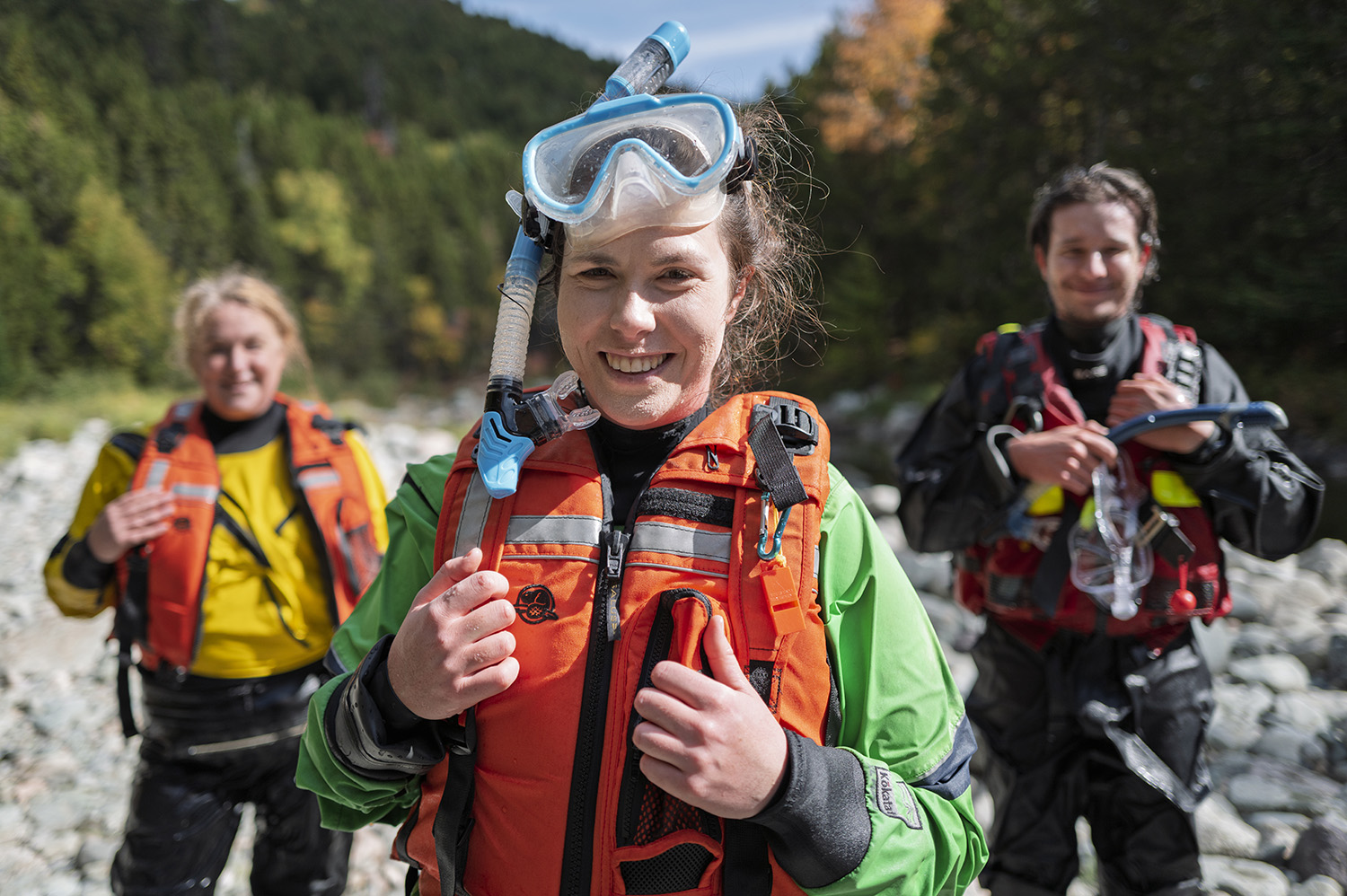
Indigenous communities have been closely involved in planning restoration activities, including the monitoring of salmon and other species, where their intimate knowledge of their traditional lands has complemented the input of experts and government authorities. Outreach and education programmes involving local communities are designed to further strengthen a sense of pride and ownership.
Betty Ward, a Metepenagiag First Nation salmon knowledge holder working as a conservation advisor to the Fundy National Park project, said the initiative was a chance for her community to revive and honour the connection that their ancestors had with the river.
To that end, community members, college classes, project partners and park visitors are regularly invited to take a hands-on role in releasing fish and to attend traditional blessing ceremonies on the riverbank.
“Salmon sustained us, kept our people alive for thousands of years,” said Ward. “I'm hoping that, as Aboriginal people in our communities, we see and realize how important it is to take care of the salmon … and make them ‘the king of fish’ again.”
About the UN World Restoration Flagships
Countries have already promised to restore 1 billion hectares – an area larger than China – as part of their commitments to the Paris climate agreement, the targets of the Kunming-Montreal Global Biodiversity Framework, the Land Degradation Neutrality targets and the Bonn Challenge. However, little is known about the progress or quality of this restoration. With the World Restoration Flagships, the UN Decade on Ecosystem Restoration is honouring the best examples of large-scale and long-term ecosystem restoration in any country or region, embodying the 10 Restoration Principles of the UN Decade. Progress of all World Restoration Flagships will be transparently monitored through the Framework for Ecosystem Restoration Monitoring, the UN Decade’s platform for keeping track of global restoration efforts.