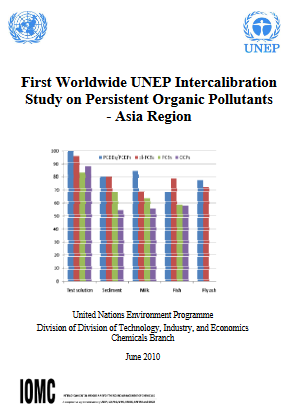
The first worldwide interlaboratory study on persistent organic pollutants (POPs) under the Stockholm Convention was organised in the Asian/Pacific region. In addition to Asian laboratories, several laboratories from OECD countries participated. The participating laboratories had a choice to analyse different matrices: two test solutions, a fish sample, a sediment, a fly ash and a human milk sample. In total, 38 laboratories from Asia, Europe and North America participated in the present study. Of these, 35 laboratories submitted data on the test solutions (either for basic POPs or for dioxin-like POPs), 30 on the sedi- ment, 20 on the human milk, 24 on the fish and 24 on fly ash. All results were statistically evaluated according to the procedures used in the QUASIMEME proficiency testing scheme.
United Nations Environment Programme
- Who we are
- Where we work
-
What we do
- Air quality
- Biosafety
- Cities
- Digital Transformations
- Disasters and conflicts
- Energy
- Environment under review
- Environmental law and governance
- Extractives
- Finance and Economic Transformations
- Food Systems
- Forests
- Fresh Water
- Gender
- Ocean, seas and coasts
- Peatlands
- Sustainable Development Goals
- Transport
- Youth, education and environment
- Publications & Knowledge