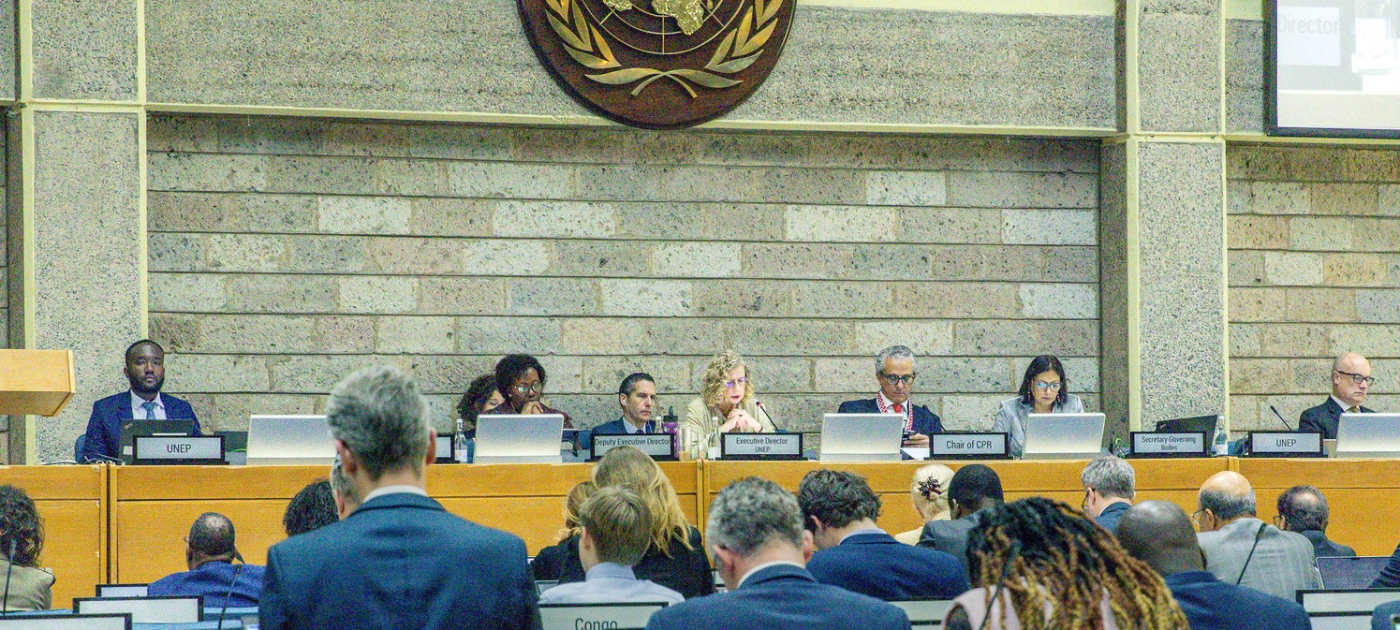
Your Excellency, Firas Khouri, Chair of the Committee of Permanent Representatives,
Ambassadors and colleagues.
Welcome to the 170th meeting of the Committee of Permanent Representatives (CPR).
Let me begin by congratulating the newly elected Bureau of the CPR and wish them a successful tenure, including with the important task of leading the preparations for UNEA-7. The CPR-Bureau-elect can count on my full support and the full support of UNEP.
I would also like to thank the current Bureau, in particular the Chair, H.E. Firas Khouri, for guiding the work of the CPR with consummate diplomatic skill, leadership and dedication over the past two years.
Excellencies,
Amid growing conflict, geopolitical tensions and fears of backsliding on global commitments, we are of course all deeply concerned. I echo the Secretary-General’s call for peace, for reflection on the immediate and long-term needs of people and planet, and for nations to resolve their differences at the negotiating table.
Despite the challenges we see playing out in the world right now, environmental multilateralism continues to show that nations can come to the table and find common ground under the big multilateral tent. Since the last meeting of this Committee, environmental multilateralism has delivered some important wins.
Let me start with how, just days ago in Punta del Este, Uruguay, we made history. In a major step forward to protect people and planet, and proving yet again that environmental multilateralism delivers, Member States established the Intergovernmental Science-Policy Panel on Chemicals, Waste and Pollution. This new entrant to the family of panels – including the Intergovernmental Panel on Climate Change (IPCC) established in 1988 and the Intergovernmental Platform on Biodiversity and Ecosystem Services (IPBES) established in 2012 – will now provide nations with the best peer-reviewed science across the three environmental planetary crises.
This process was, of course, kick-started by you – Member States – at the UN Environment Assembly (UNEA) in March 2022, so this is your success. I cannot stress enough how important this panel will be – a panel that will conduct global assessments. Identify knowledge gaps. Communicate complex science in policy-friendly formats. And integrate capacity for national decision-making in relation to the panel’s function. This is a major win for us all. Now our focus turns to operationalizing the panel so that it can quickly support countries, safeguard our environment and protect generations to come.
There were also big steps forward on chemicals, pollution and waste at the meetings of the Conferences of the Parties of the Basel, Rotterdam and Stockholm Conventions in May. A total of 56 decisions were adopted across these conventions, strengthening the sound management of chemicals and wastes for the protection of human health and the environment.
Earlier this month, the UN Ocean Conference delivered the Nice Ocean Action Plan, which included a political declaration and over 800 voluntary commitments. In Nice, UNEP and the UN Global Compact launched the Ocean Investment Protocol to unlock private capital for a sustainable and regenerative blue economy. UNEP and six UN entities launched a co-design phase for the One Ocean Finance Facility. And UNEP, with WEF and Friends of Ocean Actions, launched the 30x30 Ocean Action Plan to accelerate the achievement of 30 per cent ocean protection by 2030.
The conference also saw an additional 19 countries ratify the Agreement, bringing the number of ratifications up to 51. The agreement now stands just nine short of the 60 ratifications required to bring it into force. There is now real hope that this crucial agreement could gather enough ratifications in the next months to come into effect by January next year. This would be a huge boost as the world seeks to increase the 1.7 per cent of the ocean beyond national jurisdiction that is currently covered by protected and conserved areas.
This agreement, of course, is about protection of biodiversity beyond national jurisdiction. In this respect, let me recall that UNEP has been active in the protection of biodiversity within national jurisdictions for 50 years. Through the Regional Seas conventions and action plans. Through our hosting of the Biodiversity Convention, the Convention on Migratory Species and the Convention on International Trade in Endangered Species of Wild Flora and Fauna. Through UNEP’s marine programme. Through pollution prevention – including through the Basel, Rotterdam and Stockholm Conventions. And – hopefully soon – through the plastic pollution treaty.
In this respect, let me mention that at the last Biodiversity Beyond National Jurisdiction PrepCom in April 2025, it was agreed that the PrepCom Secretariat would prepare a document on the arrangements for the secretariat of selected instruments representative of the various models available. Let me stress that this concerns administrative and institutional arrangements, not physical location of the Secretariat. Accordingly, UNEP has submitted documentation, which we understand will be reflected in a matrix form by the PrepCom Secretariat presenting the various options that Member States can review. Essentially, the question is whether the Secretariat will be a stand-alone Secretariat like the International Seabed Authority or the UNFCCC, or whether it will be hosted by a UN entity.
At a time when everyone is calling for cost efficiency, synergies, simplification and avoidance of duplication, I believe that UNEP presents a very effective and efficient administrative and institutional host. We stood up the interim Intergovernmental Negotiating Committee (INC) Secretariat from one day to the next. We host 15 conventions and now 3 multilaterally negotiated science-policy panels. We generally support some 7–8 COPs every year. We can bring a “plug and play” system to the administrative back-office of the BBNJ when it comes to HR, administration, budget management, travel services, legal services, COP management, document flow and overall secretariat services and more.
We would obviously wish to work in collaboration the BBNJ Secretariat with our friends at the UN Convention on the Law of the Sea in New York, as we are not experts in that field. But let me stress that administratively as well as substantively UNEP is the only entity that can present such a strong, cost effective and substantive offer. This treaty is about biodiversity, and this is an area where we are unsurpassed in terms of knowledge and expertise. The full articulation of the UNEP offer and the details that UNEP presents will be shared with Member States in the coming weeks.
Just as important to ocean health is tackling plastic pollution. And nations are deploying serious diplomacy to create the best chance of a successful outcome at the resumed fifth session of talks on an international legally binding instrument on plastic pollution, including in the marine environment.
On the sidelines of the Ocean Conference, we held a closed High Level Ministerial – or Heads of Delegation meeting – with strong commitment to finding a pathway to success at the resumed fifth session of the Intergovernmental Negotiating Committee on Plastic Pollution (INC-5.2) in Geneva this August. Regional consultations have already been held in Panama and Bangkok. Nairobi will follow in July. In addition, the informal in-person Heads of Delegation meeting is scheduled to be held here in Nairobi in a few days.
Allow me also to brief you on the massive response to World Environment Day this year, which was themed around beating plastic pollution. The Republic of Korea hosted World Environment Day on Jeju Island. My deep thanks. And the celebrations reached across the globe. Over 3,000 events were held in almost every corner of the world. Millions of people engaged with the World Environment Day digital content and hashtag, which trended globally. We saw awareness campaigns in the airports from Baghdad to Beijing, Brussels and Kansai. In train stations in Beijing and Mexico City. In New York’s Times Square and at Geneva’s iconic Jet d’Eau. The message from World Environment Day is clear: people want this challenge solved.
And another big multilateral success – albeit outside the environment sphere – came in May. Our friends at the World Health Organization spearheaded a massive result when Member States adopted the Pandemic Agreement, which sets out the principles, approaches and tools for better international coordination on pandemic prevention, preparedness and response.
Excellencies,
As geopolitical tensions grow, UNEP continues to respond to Member States’ requests for support to understand and address the environmental impacts of conflict. To this end, UNEP has received a further formal request from the State of Palestine to update the environmental damage assessment for the Gaza Strip, pursuant to UNEA Resolution 6/12. This follows the preliminary assessment that UNEP produced in June of last year.
UNEP is working to update data and analysis to the extent possible, in close partnership with UN entities and other relevant institutions. UNEP is currently unable to access the Gaza Strip for field-based assessments, due to the security situation. Furthermore, UNEP staff have not yet been able to engage in person with officials of the Palestinian environmental institutions in Ramallah. Our staff have applied for visas so that they can carry out their work, but these have not yet been issued by the Israeli authorities. UNEP hopes for peace in the region, and that all current impediments to the technical work can soon be lifted. This will allow us to support all relevant interlocutors to promote environmental recovery from conflicts.
In the context of UN80, the review is currently underway. As you know, UN80 is not a reactive cost cutting exercise. Instead UN80 aims to eliminate inefficiency and duplication that creates waste of effort and money, all to ensure delivery of the 2030 Agenda and beyond. Let me mention that the SG today has arranged for full briefing of the General Assembly on the overarching thrust of UN80.
I have mentioned previously that we at UNEP have always sought to be cost-efficient and demand responsive. However, given the funding reductions which we could anticipate, UNEP initiated a Functional Review ahead of the announcement of the UN80 initiative. The Functional Review seeks to find cost reductions while also seeking to create a more agile, responsive and forward-looking UNEP as the global authoritative voice on the environment. The environment is indeed unique in the UN writ large. Amid budget redirections, I ask Member States to remember that the environment is crucial to every person on this planet.
At the same time, UNEP is responding to the current budget realities. Earlier this month, we responded to the UN Controller’s instruction to revise the 2026 Regular Budget by cutting 20 per cent, or 23 posts out of 116 posts, as well as cutting non-post costs. This resulted in the reduction of the 2026 Regular Budget proposal from USD 23.7 million to USD 20.6 million. While UNEP has prioritised cutting vacant positions, some of the 23 posts are encumbered, for which we are committed to duty of care. The final decision from the General Assembly is expected at the end of the year.
The outlook for the Environment Fund is also changing. We achieved the highest contributions ever in both 2023 and 2024, reaching over USD 90 million for 2024, by the highest number of contributors. While many of our key funding partners have signalled their intent to maintain their contributions, we have been informed by a few of reductions from their previous levels. The full picture will only be known by November 2025. These anticipated reductions, unfortunately, will have an impact on jobs, while we continue making every effort to exercise duty of care.
But even in financially constrained times, Member States have shown that they trust UNEP. The Environment Fund had 102 contributors in 2024. I ask you all to keep trusting us and help to maintain Environment Fund levels with new or increased funding. On our part, UNEP will continue to work hard to ensure sustainable financial management, efficiencies, transparency and accountability.
Funding issues also extend to UNEA-7, I am afraid, with a shortfall of almost USD 1.4 million. The UNEA and CPR Bureau have agreed that if full funding has not been secured or pledged by Member States by early September, the Bureau will revise the structure of UNEA-7 with a view to scaling back the meetings. I call on everyone who can to come forward with funding to avoid this situation. UNEA-7, which is your event, is a crucial way to advance the environmental agenda at a critical time.
You have had the opportunity to see my report highlighting new, urgent or underexplored issues that Member States may wish to focus on through resolutions submitted for adoption by UNEA-7.
I identified five priority areas: water resource management, nutrient pollution, mineral governance, stratospheric protection and the environmental footprint of AI. Action in these areas is an essential part of addressing the three planetary environmental crises – the crisis of climate change; the crisis of biodiversity loss, desertification, land degradation and drought; and the crisis of pollution and waste.
By targeting these priority areas and backing UNEP to act on them with appropriate resources, Member States can strengthen UNEA’s mission of protecting the planet, strengthening the well-being of humanity and increasing national prosperity.
Excellencies,
The Functional Review underway at UNEP aims at ensuring that we can deliver on the new Medium-Term Strategy 2026-2029 and any new resolutions that you may wish to adopt at UNEA-7. I will be presenting the first draft of the Strategy, Programme of Work and associated budget at this gathering. These documents have benefitted tremendously from your counsel, advice and wisdom, with over 500 comments received. The team was able to incorporate most advice. I thank you for your committed engagement.
This Strategy is our collective vision of a UNEP that delivers on the needs of Member States and the people we all serve by building on the three strategic objectives of the last Strategy: Climate Stability; Living in Harmony with Nature and Achieving Land Degradation Neutrality; and a Pollution-Free Planet.
This Strategy foresees a UNEP that doubles down on science and data to support Member States to enhance sustainable consumption and production and circularity. To strengthen environmental governance and meet international commitments. To advance the implementation of environmental rule of law and rights-based approaches. To generate finance for sustainable development. To promote digital solutions and sustainable AI. To create and implement solutions that listen to and cater to the views and needs of Indigenous Peoples, women, youth, communities and other groups.
I look forward to hearing and incorporating your views on the Strategy so that it can become our joint vision for a stronger UNEP that helps steer the world through the current storms into calmer seas and a brighter future for all.