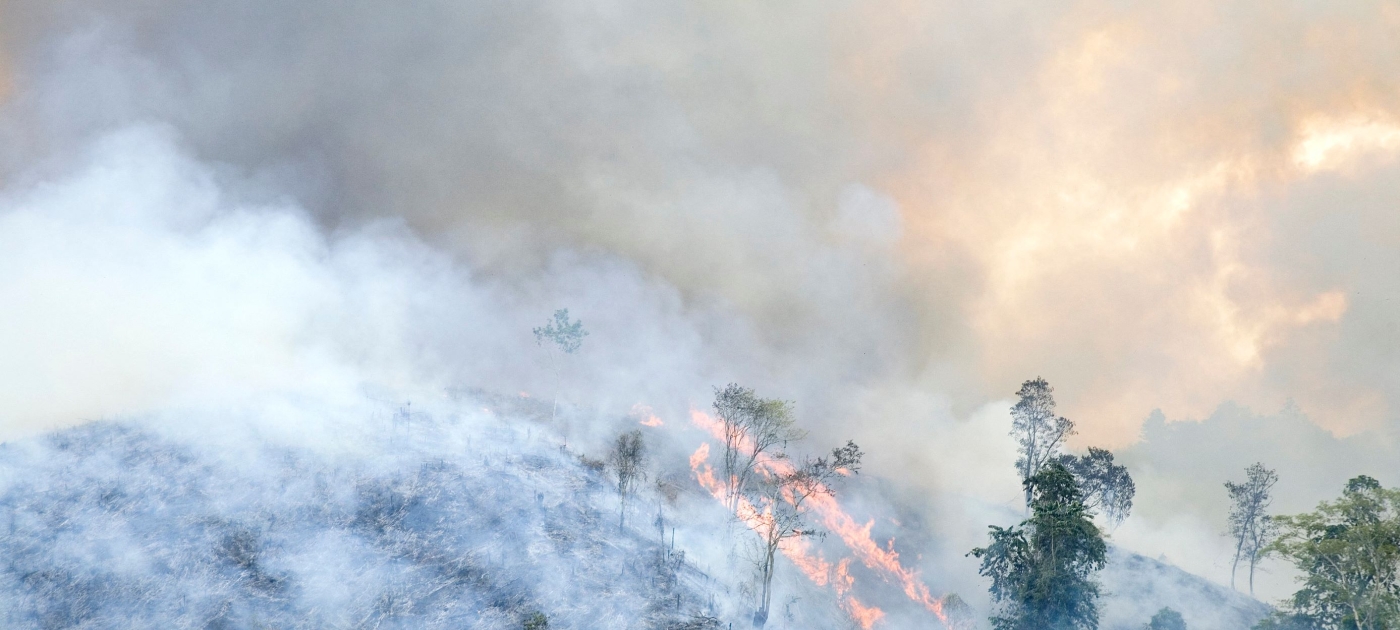
From March to May each year, dark smoke laden with harmful particulate matter and carbon dioxide drifts across the mountain forests of the Lao People's Democratic Republic (Lao PDR) as frantic villagers try to beat back the flames tearing through the trees.
Such fires start when farmers try to burn away small areas to prepare for planting crops. They have long been a significant problem in the Lao PDR, with slash-and-burn agriculture starting around 90 per cent of the country’s forest fires, found one national study. The situation worsens as temperatures rise, and controlled blazes more quickly become uncontrollable. The Global Forest Watch portal tracked 7,671 fire alerts between 17 June 2024 and 16 June 2025.
For a long time, the country couldn’t track greenhouse gas emissions from these fires, or other sources.
This hampered Lao PDR’s effort to develop a complete plan to reduce emissions, which drives climate change. It also meant the government couldn’t accurately report on Lao PDR’s commitments under the Paris Agreement on climate change, which targets a reduction in emissions of about 60 per cent by 2030. This kind of transparency, experts say, is crucial for building trust among countries and potential international donors and unlocking financing.
But the situation is changing thanks to six years of institutional reform and the creation of a national greenhouse gas inventory management system, backed by the United Nations Environment Programme (UNEP) and funded by the Global Environment Facility (GEF).
The system uses satellite imagery and is increasingly using AI-based software and historical data to monitor fires and estimate the greenhouse gases they emit. It uses emission factors, such as the amount of CO₂ equivalent released per hectare of land burned, from different fire-related activities. These factors are based on past data and scientific studies and are refined with real-time or near-real-time observations from satellites wherever possible. Together, this approach enables a more accurate mapping of fire events and calculation of their climate impact.
“[The system] helps our country identify key areas for climate action and supports evidence-based policymaking for Nationally Determined Contributions under the Paris Agreement,” says Malabou Baylatry, Deputy Director of the Greenhouse Gas Mitigation Division in the Lao PDR’s Ministry of Natural Resources and Environment. “The system has laid the foundation of the country's transparency system.”
Why transparency matters
Nationally Determined Contributions (NDCs) outline how countries plan to reduce greenhouse gas emissions and adapt to an already-changing climate. They are at the heart of the Paris Agreement. The latest round is due to be submitted before the next round of climate talks in November. Experts say these NDCs must collectively increase pledges to cut greenhouse gas emissions and stop climate change from spiraling out of control. According to UNEP’s 2024 Emissions Gap Report, cuts of 42 per cent off annual greenhouse gas emissions are needed by 2030 to keep alive the Paris Agreement’s goal of limiting global temperature rise to 1.5°C.
Thanks to transparency, climate plans and words on paper are backed with clear and robust data and facts, says Gulnara Roll, Acting Chief of the Mitigation Branch in UNEP’s Climate Division.
“It’s vital that countries know where they stand in their efforts to rein in greenhouse gas emissions,” Gulnara says. “This isn’t something the world can guess. The whole architecture of the Paris Agreement relies on sound data and transparency.”
UNEP currently supports 35 transparency projects implementing US$157 million of GEF funds, helping to improve data collection and reporting on greenhouse gas emissions. While just a few of these countries are major emitters, action on climate, and therefore action on transparency, is still crucial to their futures, says Roll.
In the Caribbean, Panama is now working to collect timely emissions data from sectors like industry, waste and forestry, even from areas of difficult access. In Africa, Burkina Faso, after submitting its first Biennial Transparency Report, which updated its progress on climate-change-related issues, is formulating emissions reductions goals through a platform set up through UNEP-GEF support.
“Transparency isn’t just about reporting; it’s about taking smart, inclusive, future-proof climate action that builds trust,” says Roll. “These three countries show what’s possible when transparency is embedded into climate planning, turning data into decisions that cut emissions, empower stakeholders and drive lasting change.”
Working towards real cuts in Laos
Work has been going on in the Lao PDR since 2019, with the Greenhouse Gas Inventory Database Management System piloted in 2022. Before this initiative, there was no systematic tracking of emissions in the country. Now, that data is charted and aggregated into national reporting systems: emissions data is compiled through ground-based reporting and satellite imagery, with line ministries inputting sector data into a central system coordinated by the Department of Climate Change. For example, from 2001 to 2024, Lao lost 9,000 hectares of tree cover from fires – around the equivalent of 24,000 football fields – contributing to over 36,000 Gg CO₂e in emissions from forest and grassland conversion, and accounting for 71 per cent of the country’s total greenhouse gas emissions in 2008.
Gathering that data is becoming increasingly important. Forest fires in the Lao PDR are worsening as temperatures rise, and controlled blazes more quickly become uncontrollable.
The UNEP-GEF project put almost US$1.5 million into building the greenhouse gas monitoring platform and training national staff. The greenhouse gas data can now be used to prepare biennial transparency reports and future NDCs. A climate finance tracking system has also been put in place to enhance the Lao PDR’s capacity to systematically track and report its budget spending on climate, as well as financial support it receives to implement its NDC. The result is that the country will be in a stronger position to plan for decarbonization and deploy strategies to deal with issues such as forest fires.
“The Lao PDR has set the target to become net-zero by 2050, and to be able to be resilient to the impacts of climate change,” says Baylatry. “The data in our national system is invaluable to these goals, and will guide the implementation, monitoring, evaluation and reporting of our NDC targets.”
UNEP's work is made possible by flexible contributions from Member States and other partners to the Environment Fund and UNEP Climate, Nature and Pollution funds. These funds enable agile, innovative solutions to climate change, nature and biodiversity loss, and pollution and waste. Learn how to support UNEP to invest in people and planet.
The Sectoral Solution to the climate crisis
UNEP is at the forefront of supporting the Paris Agreement goal of keeping global temperature rise well below 2°C, and aiming for 1.5°C, compared to pre-industrial levels. To do this, UNEP has developed the Sectoral Solutions, a roadmap to reducing emissions across sectors in line with the Paris Agreement commitments and in pursuit of climate stability. Key sectors identified are: energy; industry; agriculture and food; forests and land use; transport; and buildings and cities.
About the Global Environment Facility (GEF)
The Global Environment Facility (GEF) includes several multilateral funds working together to address the planet's most pressing challenges in an integrated way. Its financing helps developing countries address complex challenges and work towards meeting international environmental goals. Over the past three decades, the GEF has provided more than US$26 billion in financing, primarily as grants, and mobilized another US$148 billion for country-driven priority projects.