
Partner with UNEP to drive action for a sustainable future.
As environmental challenges reach unprecedented levels, UNEP works tirelessly across the globe to tackle the triple planetary crisis of climate change, nature and biodiversity loss, and pollution and waste. As the world’s leading environmental authority for more than 50 years, UNEP addresses some of the most urgent challenges facing the planet and humankind through its powerful advocacy, setting the global environmental agenda, providing leadership and delivering scientific solutions.
UNEP cannot do this without its wide range of partners. This includes the 193 Member States that guide and govern its work, civil society organizations and NGOs that extend its reach into communities worldwide, the UN agencies, funds and programmes that it collaborates with, and the private sector, whose capital, innovation and technology are increasingly vital to environmental action. Both on the ground and through the multilateral environmental agreements and research bodies it hosts, UNEP brings nations and the environmental community together to build a resilient future
UNEP works with partners in four main ways.
Implementation partnerships are the principal partnership modality. Here, a partner takes on responsibility for delivering agreed activities and outputs, using funding disbursed by UNEP or by one of the MEA secretariats it hosts. Non-governmental, not-for-profit implementing partners are selected through a transparent, fair and competitive process. Given their status as strategic partners, governmental, inter-governmental entities and UN System Organisations can be engaged directly based on programme needs. Implementing partners are subject to the most rigorous oversight of any partnership modality, which is scaled to risk rating of each partner.
Cooperation partnerships, by contrast, do not involve financial commitment. They establish a framework for collaboration between UNEP or an MEA secretariat and a partner around specific, pre-agreed areas of work, usually in the fields of research, advocacy and/or technical exchange.
Donor Partnerships bring funding or in-kind contributions into UNEP or an MEA secretariat for agreed purposes, ranging from single project grants to broader programmatic support.
Multi-stakeholder partnerships connect a broad range of organisations, including governments, businesses, civil society and UN entities, though coalitions, networks and platforms working together on knowledge-sharing, capacity-building and collective action
How UNEP is funded
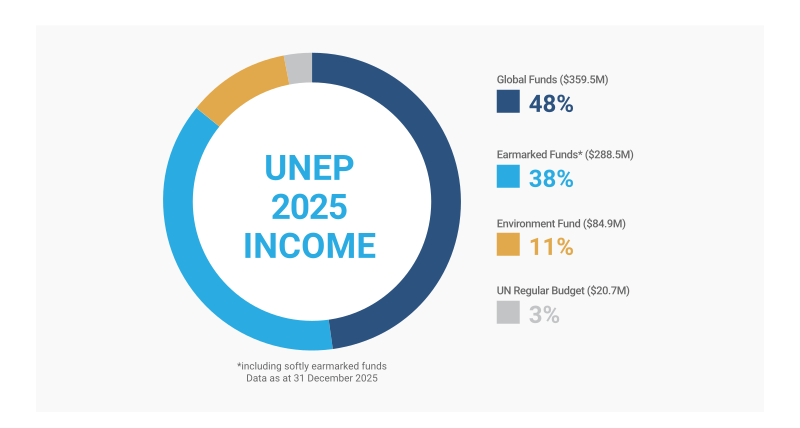
Fully reliant on voluntary contributions for more than 95 per cent of its funding, UNEP's commitment to effectiveness and value for money ensures that supporting UNEP means investing in people and planet.
At the heart of UNEP is its core fund, the Environment Fund, financed solely by Member States. The Environment Fund supports the essential capacity needed for the balanced and efficient delivery of UNEP's programme of work.
The three UNEP Planetary Funds – the UNEP Climate Fund, UNEP Nature Fund and UNEP Pollution Fund – are open to contributions from all manner of funding partners. These flexible funds allow UNEP to accelerate its work on holistically addressing the triple planetary crisis through targeted interventions.
Earmarked Contributions for specific projects, themes or countries enable the expansion and replication of UNEP's programme of work in more countries and with more partners. These include funds from Member States, European Commission, the UN family and global funds such as the Global Environment Facility and the Green Climate Fund.
Contributions from the UN Regular Budget are the only regular source of funding, supporting the functions of the UNEP Secretariat, including the Governing Bodies, coordination in the UN system, and cooperation with global scientific communities.
Explore the results of UNEP's funding and partnerships in the 2025 Annual Report.