- Ms Marina Silva, Minister of the Environment and Climate
- Change of Brazil
- Mr João Paulo Capobianco, President-designate of COP-15
- Mr Mauricio Lyrio, Secretary for Energy, Climate and Environment (Brazil)
- Mr Eduardo Riedel, Governor of Mato Grosso do Sul
- Ms Adriane Lopes, Mayor of Campo Grande
- Mr. Herman Benjamin, President of the Superior Court of Justice of Brazil
- Ms Amy Fraenkel and your team, thank you for the substantive preparation for this COP.
Distinguished delegates, Ladies and Gentlemen, all Protocols observed.
At a time of geopolitical tensions and uncertainty, one important truth stands out: environmental multilateralism works. Cooperation to protect biodiversity — especially migratory species that cross borders and oceans — is both effective and essential.
Yet the urgency is clear. Nearly half — 49 percent — of all migratory species listed under the Convention on the Conservation of Migratory Species of Wild Animals declining.
Protecting these species cannot be achieved by any country acting alone. Their survival depends on coordinated international action.
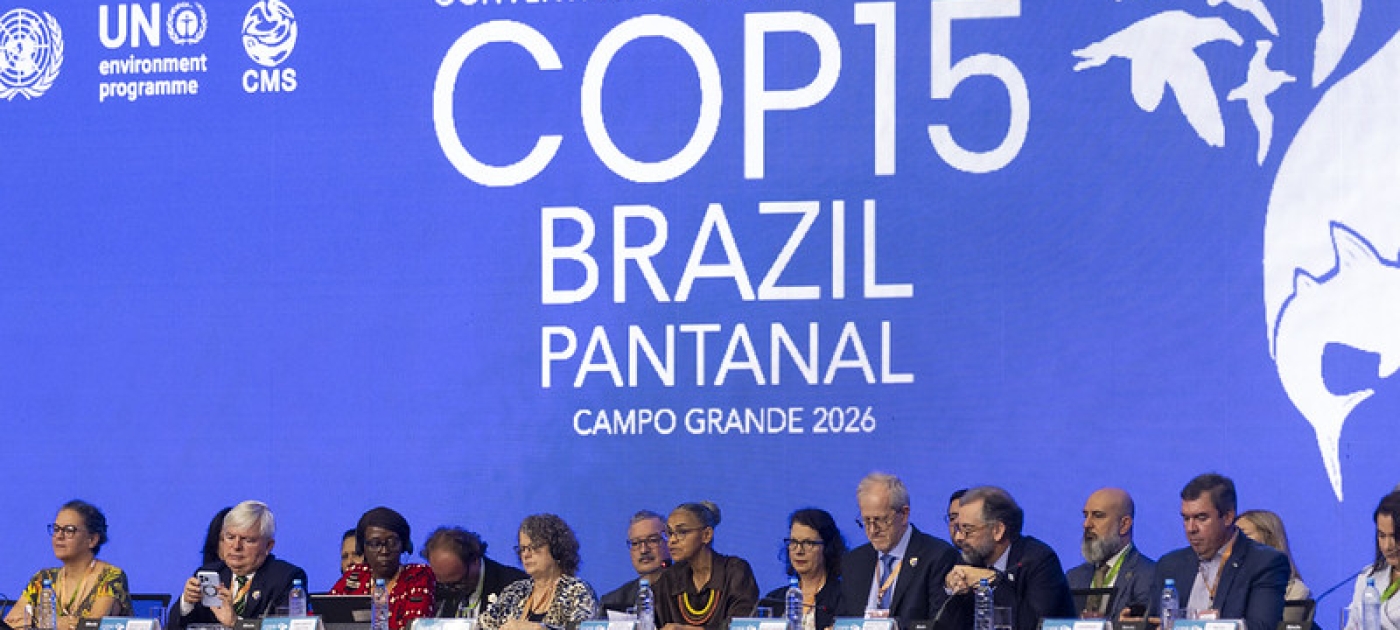
It is therefore especially fitting that we gather here in Campo Grande, at the gateway to the Pantanal — the world’s largest tropical wetland ecosystem. This extraordinary transboundary biome is a living example of ecological connectivity in action.
Allow me to express our deep appreciation to Brazil for hosting CMS COP15. Brazil’s leadership is both timely and significant.
As the most biodiverse country on Earth, Brazil plays a critical role for migratory species across forests, wetlands, rivers, and oceans. Its ecosystems support global flyways, vast freshwater migrations, and marine routes that connect continents. In many ways, Brazil embodies the very principles of CMS — connectivity, cooperation, and shared responsibility — making it a natural and compelling host for this Conference.
As the writer Haruki Murakami one said: “Migratory birds have no concept of borders between countries.”
Nor do ecosystems. And nor do the challenges they face.
Over the years, CMS has built a strong track record in strengthening cooperation and synergies across environmental agreements, contributing to global priorities such as the Kunming–Montreal Global Biodiversity Framework and the Sustainable Development Goals.
CMS works closely with other key conventions, including the Convention on Biological Diversity, CITES, and Ramsar, to mention but few.
The Samarkand Strategic Plan for Migratory Species 2024–2032 plays a significant role in supporting countries to integrate migratory species into national biodiversity strategies.
UNEP is proud to administer the CMS Secretariat — which is hosted by Government of Germany — and provide scientific, technical, and policy support to Parties.
Our scientific work underpins CMS action, including the landmark report on the State of the World’s Migratory Species report issued in 2024. This COP will receive updated status in the past two years. At national and regional levels, UNEP supports countries in implementing CMS obligations, strengthening environmental law, and enhancing access to knowledge through platforms such as InforMEA.
We also deliver concrete impact on the ground — from administering the African Elephant Fund to supporting regional initiatives such as transboundary ecosystem programmes.
Before I finish, I would like to take this opportunity to express my sincere fond appreciation to Amy Fraenkel for her dedicated leadership and service as CMS Executive Secretary since 2019. Her commitment has greatly strengthened the work of the Convention and its community. For me personally, the fond memory Amy leaves me behind with is her perseverance in highlighting the importance and understanding of the ecological connectivity, a principle which is finding its inspiration in several key documents including the Global Biodiversity Framework.
As she prepares to retire at the end of May this year, we thank her warmly for her contributions not only to the work of CMS but beyond to the work of the United Nations as a whole especially UNEP in the past years as a regional director of North America and later as a Director in the CBD Secretariat. I wish her a very fulfilling and well-deserved retirement.
At this point, as notified through a formal CMS Notification, I am pleased to introduce Mr. Andrew Raine as the appointed new Executive Secretary of CMS Secretariat as from 1 June 2026. Andrew, could you please stand, so that we can see and greet you. I certain that the valuable work at the CMS Secretariat as will be left by Amy will be in safe hands and further grow.
Distinguished delegates,
UNEP remains committed to working with CMS, parties, and partners to turn the decisions taken here in Campo Grande into concrete actions — actions that protects migratory species and delivers lasting benefits for ecosystems and communities alike.
Thank you.