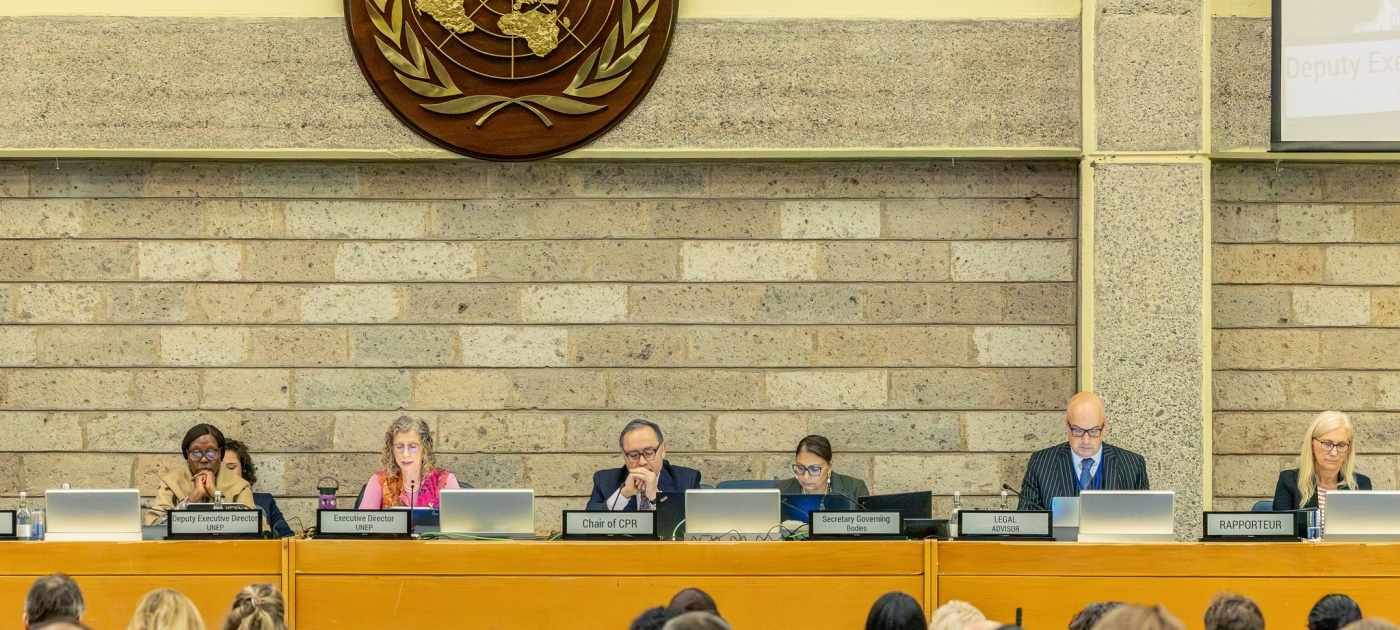
Your Excellency, Sultan Hajiyev, Chair of the Committee of Permanent Representatives,
Ambassadors and colleagues. Welcome to the 174th meeting of the Committee of Permanent Representatives (CPR).
Let me also echo the Chair in sharing our deep condolences to the government of the Philippines following deadly earthquakes earlier this week, and to the government and people of Venezuela following yesterday’s devastating earthquakes. The UN is on the ground in Venezuela supporting recovery efforts, and our thoughts are with all those impacted by these tragedies.
It is with the heaviest of hearts that I also share the news that our dear colleague, Tessa Goverse, has passed away in Geneva whilst on mission. Many of you know Tessa, a much-loved member of the Industry and Economy Division, a brilliant manager and a caring colleague.
Tessa was deeply committed to UNEP for over 20 years and served as Head of the Interim Secretariat of the Intergovernmental Science-Policy Panel on Chemicals, Waste and Pollution (ISP-CWP) – a Panel she played a critical role in delivering and on which I know many of you worked with her.
UNEP is better off for having Tessa’s leadership and expertise – and so is the world. Her legacy will continue and help ensure a safer, more sustainable future for everyone. We are thinking of her husband, family and loved ones during this heartbreaking time.
Excellencies,
We are gathering at a time when many nations of the world have suffered, are suffering or are about to suffer extreme temperatures. The World Meteorological Organization has warned that a particularly strong El Niño could, in the coming months, supercharge these climate change-driven extremes – threatening lives, harvests, property and more.
As the UN Secretary-General said in his speech at London Climate Action Week, the world is facing not just a climate crisis, but an energy crisis that exposes the risks of global reliance on fossil fuels and the vulnerable global supply chains that deliver them.
The solution to both crises is to accelerate the transition to net zero. This includes taking strong and rapid action to reduce methane emissions in the fossil fuel, agriculture and waste sectors, as outlined in the Secretary-General’s just-released Call to Action on Methane, to which UNEP contributed.
This is why UNEP focused minds on climate action during World Environment Day (WED). This year’s event impactful celebration, hosted by Azerbaijan in Baku, delivered the message that urgent climate action can prevent millions of deaths and trillions in economic losses, and drive growth, jobs, resilience and investment. My deep thanks to Azerbaijan for the wonderful celebrations they organized in beautiful Baku.
On June 5, many political leaders stepped up with messages of strong support. The campaign trended globally on social media, reaching over 90 million people. More than 55,000 news articles mentioning WED were published across 176 countries. And 58 cities made concrete pledges to deal with extreme heat. Through the 50@50 activation, these cities turned the Beat the Heat Implementation Drive into action: engaging communities from Barranquilla to Lagos and Tokyo with campaigns on extreme heat and sustainable cooling. Sixteen cities will conduct heat stress tests over the next 12 months.
UNEP also took the opportunity to launch the policy brief ‘Cheaper. Cleaner. Unstoppable’, which shows that clean solutions across energy, transport, buildings and cooling are cost‑competitive, scaling rapidly and offering policymakers options for a resilient, equitable and climate‑safe future.
So, momentum for climate action is growing. Not just because of what happened on WED. We saw a significant step in the UN General Assembly resolution backing the International Court of Justice’s ruling that nations have a legal obligation to protect people and planet from greenhouse gas emissions. It is now up to all of us to turn this momentum into accelerated action.
Excellencies,
In the last few months, we also saw Central Asian nations increasingly emerging as leaders in the fight against climate change, nature and biodiversity loss, land degradation and desertification, and pollution and waste.
Uzbekistan hosted the Global Environment Facility (GEF) Assembly in Samarkand, in early June. Under the theme “last sprint toward 2030”, the Assembly brought together over 2,000 participants from governments, civil society, Indigenous Peoples, youth and the private sector to reflect on the achievements of the GEF partnership and celebrate the US$ 3.9 billion – a number that will likely grow – GEF-9 Replenishment.
The GEF-9 replenishment package also included structural reforms. Integrated programmes, blended finance, whole-of-government and whole-of-society engagement and strengthened support for vulnerable countries are all designed to make GEF faster, simpler and more accountable. UNEP – with its unique role in converging science, policy and partnerships to support countries – welcomes these reforms and looks forward to a stronger partnership. Thirty-five years after its creation, the need for a strong GEF has never been more important.
In April, on Earth Day, Kazakhstan hosted the Regional Ecological Summit in Astana. At the Summit, where UNEP was a proud UN partner, three messages stood out: shared challenges present shared opportunities; circularity must shape future pathways; and stronger regional collaboration is essential to protect biodiversity. I was also pleased to sign a Memorandum of Understanding with Kazakhstan, which expands Kazakhstan’s support to UNEP and expands UNEP’s regional presence through our sub-regional office in Almaty.
I am deeply grateful to all Central Asian nations for the leadership and look forward to deeper engagement.
Excellencies,
In the last few months, we have also seen strong leadership from African nations, particularly Kenya. The Africa Forward Summit, co-hosted by Kenya and France in Nairobi this May, showed how African nations are building partnerships that strengthen economies, value natural resources and drive innovation. A sustainable blue economy was a key item on the agenda, and I was pleased to join Ministers and Heads of State for a valuable discussion on the opportunities ahead as we strive to protect our oceans.
And just last week, both the eleventh Our Oceans Conference and the observance of World Desertification and Drought Day took place, in Mombasa and Kilifi – one looking out to the sea and the other looking inland at land degradation.
At the Our Oceans conference, it was my pleasure to engage with African ministers on ocean governance for a blue economy – discussing how integrated governance, stronger finance and fast implementation of the BBNJ Agreement can boost Africa’s Blue Economy, delivering increased food security, livelihoods, biodiversity and resilience to climate change.
At World Desertification and Drought Day, the focus was on rangelands and the need to recognize, respect and restore these vast landscapes, which cover more than half of the Earth’s land surface. They sustain millions of pastoralist livelihoods, biodiversity, water security, cultural identity and resilience. But they are fragile. We must ensure their survival so they can sustain and support communities for generations to come.
At UNEP we are working to ensure that our data systems are methodically tagging our investments in Desertification, Land Degradation and Drought (DLDD) across the world. The purpose is to provide a consistent portfolio view for DLDD reporting while avoiding a complex or burdensome data collection process. We also plan to use this to engage further with countries and agencies to inform our investments pipelines in DLDD with additional data on investments related to sand and dust storms.
Excellencies,
UNEP is continuing to reshape under our new Medium-Term Strategy and Programme of Work to support nations as they face up to the many challenges confronting the world.
On the admin and operational front, we are working towards faster implementation and greater efficiency with standardized templates, faster concept approvals, decision-ready datasets and dashboards for our programmes, and stronger partnerships.
We are working towards being smarter with an updated resource mobilization strategy. We are a normative entity but we are also in the finance space, and we will seek to locate ourselves in the value chain for blended finance, where UNEP can underscore our years of experience in ensuring enabling fiscal policy, bankable pipelines and advising countries on credible measurement and integrated policies that consider people and planet. We greatly appreciate the helpful comments received in the consultation on June 11, 2026, and look forward to presenting the strategy to the Annual Subcommittee.
And we are constantly striving, responding to country needs while ensuring agile support to regional offices. Our project due diligence system is strong, transforming the way we design, learn and incorporate science into our programmes, and use measurement to inform it. Our data systems and dashboards are showing us decision-grade data, while ensuring that we are gathering data on leverage, value for money and impact. These represent important operational strengths for UNEP.
We at UNEP are also working hard on increasing regional diversity. Our staff representation is now as follows: 19 per cent African group, 22 per cent Asia Pacific, 7 per cent Eastern Europe, 11 per cent Latin American and Caribbean, 4 per cent US and 37 per cent Western European and Other States.
UNEP is also playing a key role in the UN80 Initiative, leading on Work Package 27 on the environment together with the UNFCC. It was my pleasure to brief you on this last Friday. As we move into the next stage of the UN80 Initiative, your feedback was extremely timely.
I am mindful that the Work Package 27 draft recommendations still require further details. We will work on this as we advance towards August, when the Secretary-General will be expected to present an Information Brief on this work package.
Ultimately, some decisions will lie within the UN entities’ own authority – and where they do, the Secretary-General is mobilizing the UN system to act, keeping Member States fully informed. There will be areas where Member States’ decisions will be needed if Members States choose to pursue a specific recommendation – either through the UN Environment Assembly (UNEA), the General Assembly or the Conferences of the Parties as it relates to Multilateral Environmental Agreements.
In the meantime, I look forward to briefing your counterparts in New York on Monday. I also very much look forward to a deeper conversation with you at the Annual Subcommittee in September on this Work Package and the broader array of innovations coming out of UN80.
As the Secretary-General has said, you, Member States, “have recognized that the case for reform is robust. And as the ones driving the UN80 Process, [Member States] will craft its key outcomes.” We at the Secretariat will be there to support you as we navigate to the ultimate destination.
As part of the efforts to strengthen UNEP, we have also been looking at the Joint Inspection Unit (JIU) recommendation that UNEA should, at its eighth session in 2027 at the latest, clarify the mandate and role of the CPR as its intersessional body and examine the frequency of its formal meetings, as appropriate.
The CPR Bureau has agreed to discuss the scope of the exercise with regional groups and come back to the CPR for further discussion. This is an important issue, but I ask that you think about the previous CPR-based review – which was started by Member States in March 2019 with the adoption of UNEA decision 4/2 and ended in March 2022 with the adoption of decision 5/2 – and think carefully about resource constraints as you consider starting new processes.
On the issue of resources, I would like to thank the 45 Member States who have contributed to the Environment Fund this year to date, in particular the 33 Member States, or 73 per cent of all contributors, who did so at full share level. I call on all remaining Member States to provide their support as soon as possible.
As I have said many times, the Environment Fund is UNEP’s financial backbone. It enables us to navigate the ship in the direction you have set and make good on your expectations. We will dig deeper into what motivates and challenges Member States to contribute to UNEP, and the Environment Fund in particular, at the Annual Subcommittee meeting. I hope that by then, most of you can engage in this discussion knowing that your contribution has already been provided.
Finally, Excellencies, the UN Secretary-General has welcomed the peace deal between the United States and Iran, which constitutes a critical step towards a peaceful settlement of the Middle East conflict. UNEP continues to work with the UN system to keep the environmental situation in the region under review.
In addition to contamination from oil spills, fires and damaged infrastructure, the conflict has exacerbated longstanding environmental challenges, including water scarcity and marine pollution. Serious risks remain, with widespread damage and numerous ships still waiting to transit the Strait of Hormuz. Multilateral organizations continue to play critical, coordinated roles towards the management of risks to people and the environment.
My thanks again for your commitment and engagement with UNEP in this period, when the environmental agenda has never been more prominent or more important.