Oaxaca’s dry forests represent a living system shaped by extremes. Without rain for more than half the year, these forests endure drought through methods like shedding leaves to conserve moisture and storing water in deep, efficient root systems. Dry but thriving, this resilience demonstrates how Oaxaca’s landscapes are places where life is uniquely adapted.
This contributes to Oaxaca’s ranking as one of Mexico’s most biodiverse states. Its dry forests alone host the largest variety of reptiles and amphibians in the country, and of its more than 9,000 plant species, 722 are found nowhere else on Earth.

However, tropical dry forests around the world, including Oaxaca’s, are facing increasing pressures from unsustainable use, making them one of the world’s most degraded and threatened types of ecosystems. In Mexico, more than 70 per cent of these biomes have already been lost or transformed for agriculture.
Land degradation is more than a biodiversity problem. It threatens the livelihoods of billions of people around the world. In Mexico, over 71 per cent of the total land area is degraded, affecting nearly 11 million people.
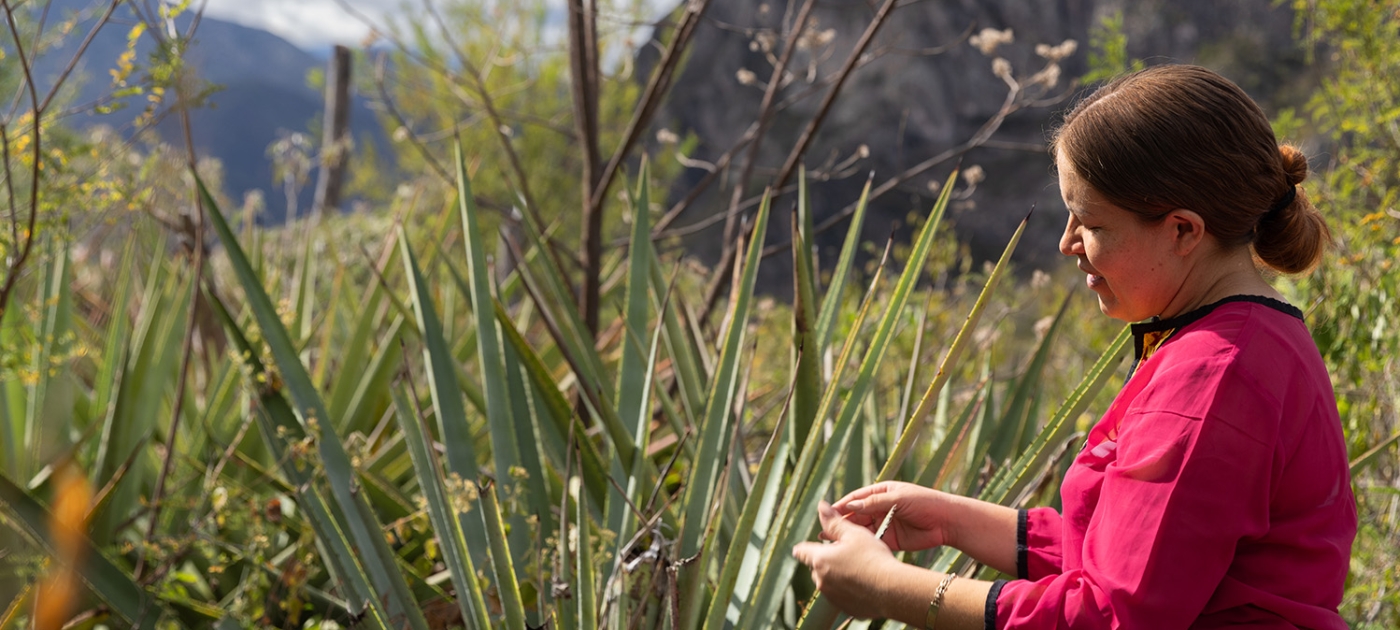
In Oaxaca’s Central Valleys, agave defines both the landscape of tropical dry forests and local livelihoods. For generations, cultivation of the native succulent has underpinned the production of mezcal, a spirit that is far more than a commodity. Rooted in family-run palenque settlements and longstanding traditions, mezcal is embedded in community life across the region.

During the last decade, global demand for mezcal quickly grew. This meant that agave production expanded rapidly, and in some areas, this growth was accompanied by unsustainable land-use and agave monocultures, accelerating soil degradation and biodiversity loss. Between 1995 and 2022, agave plantations accounted for 62 per cent of forest loss in certain parts of Oaxaca.
However, livelihoods in the state remain deeply dependent on agave. In 2023 Oaxaca was responsible for over 90 per cent of Mexico’s mezcal production. As pressure on the land here intensifies, the future of the agave-mezcal value chain increasingly depends on the health of the ecosystems that support it.
Gladys Sanchez, an agave farmer and mezcal producer in the Oaxacan town of Santa Maria Zoquitlán, has observed changes to the region firsthand.

“One of the worst impacts of the mezcal boom, [was that] in a lot of places, financing was provided to take down natural vegetation and establish agave plots,” Sanchez said. “It had a lot of impact on the ecosystems.”
Sanchez is a member of Las Guardianas des Mezcal, a women’s collective of agave farmers and mezcal producers that advocates for sustainable land-use practices and supports local producers.

Through a project funded by the Global Environment Facility (GEF), led by the United Nations Environment Programme (UNEP) and implemented by conservation organization Pronatura Sur, Las Guardianas and two other similar producer collectives are supported to help restore degraded landscapes through agroforestry and promote a more sustainable agave-mezcal value chain.
The project supports these collectives by promoting environmentally sound production practices, protecting agave ecosystems and advancing gender equity through training, legal support, business planning and marketing assistance. Through hands-on agroforestry training, soil and water conservation practices and the use of bio-inputs and native species, the project has now strengthened sustainable land management and agave restoration for 157 producers.

“At our distillery, we only use dead wood, we re-use water, and we leave some agaves to flower, collecting the seeds,” Sanchez said, noting changes she’s made to her production thanks to the project. Wood is necessary to fuel distillation processes, while allowing some agave plants to reach maturity and produce seed supports native populations of agave to regenerate naturally.

In nearby San Luis Amatlán, the community has established a protected area for restoration, one of many sites contributing to the project’s aim of bringing 76,000 hectares of land under improved management in Oaxaca.
Here, community members tend the land – planting native tree and plant species, building stone barriers along slopes to capture rainwater and reduce soil erosion, and installing wooden perches to encourage birds to return and disperse seeds across areas where vegetation has been lost.

Across Oaxaca, the project has supported on-the-ground restoration and improved land management across multiple sites, while also strengthening habitat for other species. Community-led biodiversity monitoring has since documented rich wildlife in the area including felines, more than 90 bird species, and key pollinators like long-nosed bats and stingless bees.
These efforts are contributing to Mexico’s progress toward improving the condition of 30 per cent of degraded land by 2030, rising to 50 per cent by 2050, aligning with the global goal of land degradation neutrality under the United Nations Convention to Combat Desertification (UNCCD).
For farmers and mezcal producers in Oaxaca, restored land means healthier dry forests and ecosystems that can sustain the region’s rich biodiversity and local livelihoods.

“Agave grows slowly, and so does recovery,” said Robert Erath, UNEP task manager for the Oaxaca project. “That long-term thinking is essential because restoring landscapes means building resilience over time that is shared by ecosystems and the communities that depend on them.”