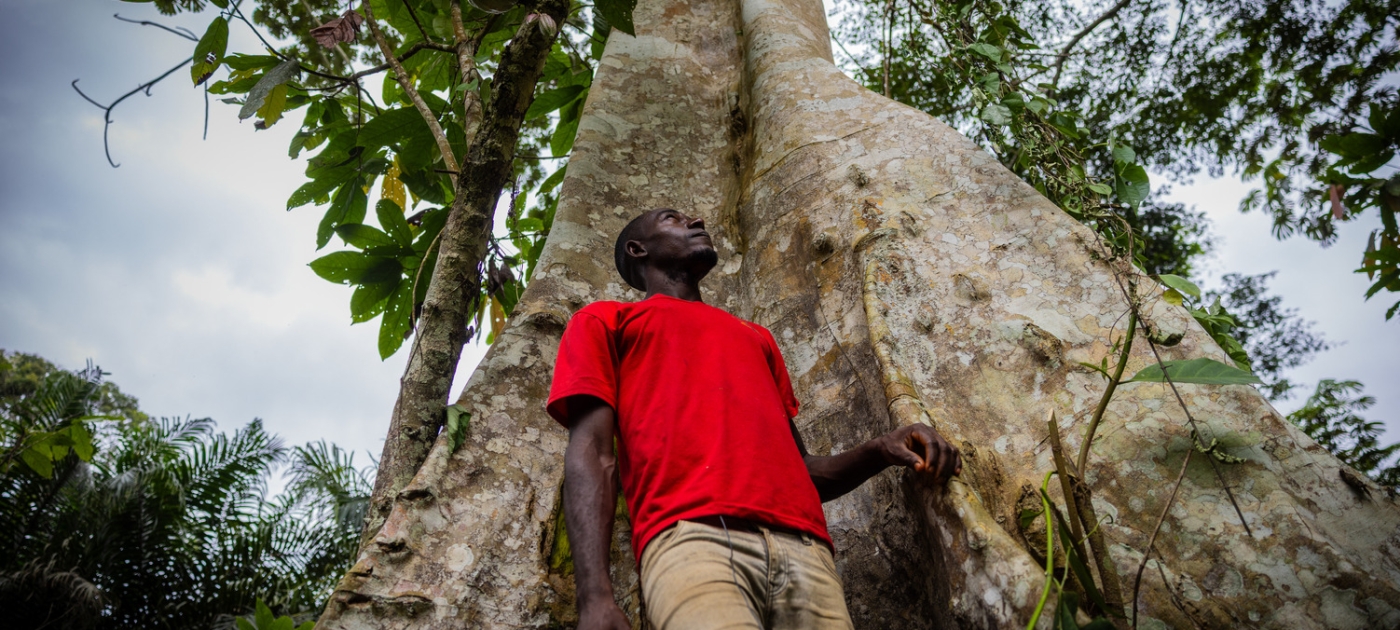
René Etoua Meto'o runs a small cacao plantation just outside of Cameroon’s Dja Faunal Reserve, one of the world’s largest intact stretches of rainforest.
Here, elephants, chimpanzees and dozens of other animals share space with the cacao trees of the Baka Indigenous People, who have lived in the dense forests of the Congo Basin for generations.
But many in this area have long been forced to scrape together a living on the margins of the reserve. That began to change in 2021, though, under a project led by the United Nations Environment Programme (UNEP). Agricultural extension workers showed Meto'o and his neighbours how to boost their yields without clearing land, critical to preserving the rainforest – and wildlife – that surrounds their farms.
“My family is now getting a premium price for our cocoa, which allows us to survive and invest,” says Meto'o, a 26-year-old father of three.
The training was part of a larger conservation effort led by UNEP. Its goal: to protect the fast-disappearing rainforests and peatlands of eight Congo Basin countries by improving the lives of people who call the region home. Financed by the Global Environment Facility, the push is designed to preserve one of the world’s most biodiverse places, a thicket of trees and peatlands home to more than 11,000 species of animals and plants, according to the World Wildlife Fund.
The work also has implications far beyond Central Africa. The Congo basin is a vast warehouse of carbon; its swamps alone store around 29 billion tonnes of the planet-warming element – about three years’ worth of global greenhouse gas emissions.
“The Congo Basin is an ecosystem with planetary importance,” says George Akwah, a programme management officer with UNEP. “Protecting it is vital for safeguarding biodiversity, countering climate change and improving the lives of millions.”

The Congo Basin houses the Earth's second-largest contiguous block of tropical rainforest after the Amazon. This ecosystem sustains tens of millions of people and, according to a study in the journal Proceedings of the National Academy of Sciences, is a haven for one in five living species. But it’s facing increasing threats. The expansion of farming and mining has led to widespread deforestation. Nearly 19,000 square kilometres of forests were “disturbed” annually between 2015 and 2020, according to a study by the Central Africa Forest Commission, a research organization. Indigenous communities, who have been safeguarding rainforests for generations, have often suffered the most from this deforestation, says Akwah.
There are fears that if the loss continues, it could impoverish millions, threaten some of Africa’s most iconic animals and hamper the basin’s ability to both store and absorb carbon.

That’s why UNEP launched the effort to support sustainable development across the countries of the Congo Basin. Launched four years ago, it’s formally known as the Congo Basin Landscapes Initiative. The work is designed in part to support the implementation of the Kunming-Montreal Global Biodiversity Framework, a landmark 2022 agreement to protect and restore the natural world. A key goal of that agreement is making farming more sustainable and re-enforcing the land rights of Indigenous Peoples.

In Cameroon, the focus is on making the production of cocoa – the powder from the cacao bean and the key ingredient in chocolate – more sustainable. Cocoa accounts for 12 per cent of the country’s exports, and in many marginalised Indigenous communities, it is a key cash crop. But cocoa production has also been linked to deforestation. A 2013 World Bank report found that in the preceding decade, cacao farms had swallowed up 1,400 square kilometres of Cameroonian forest.
“While we need to develop, we also need to protect the environment,” says Haman Yanousa, a technical advisor in Cameroon's Ministry of Environment. “We need a balance."

That is happening in the town of Mintom, which skirts the 5,000-square-kilometre Dja Faunal Reserve. The community is a hotbed of cacao production. Cacao trees, with their red and yellow pods, surround a colourful collection of houses and shops. Millions of cacao seeds – which will be processed into cocoa – dry on tarps laid out in backyards.
Here, experts from the Rainforest Alliance, a non-governmental organization, showed residents how to prune cacao trees, clear undergrowth, manage pests and better dry beans. Farmers say their yields are rising and deforestation around the town has stopped.

Since 2021, the UNEP-led project has trained more than 120 community representatives, certified over 50,000 hectares of cacao farms and established three provincial technical monitoring committees that ensure local voices are integrated into governance structures.
René Etoua Meto'o is among those who have benefitted from those efforts. He says the training helped him “master” all stages of the cocoa production process. “I feed my family from the sales of the cocoa I produce,” he says.
Stories like that are a testament to the potential of sustainable development in the Congo Basin, says UNEP’s Akwah.
“This really is an area brimming with promise, but for too long, economic growth has come at the expense of nature,” he says. “Projects like this are showing that it is possible to protect the rainforest and jumpstart the kind of sustainable development that will make life better for both Indigenous and non-Indigenous communities.”
On 9 August, the world will mark the International Day of the World’s Indigenous Peoples. This year’s commemoration will focus on how Indigenous Peoples can secure their rights in the age of artificial intelligence, and in the face of other social and environmental challenges.